Overview
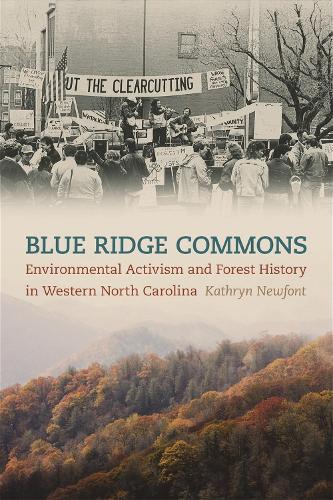
In the late twentieth century, residents of the Blue Ridge mountains in western North Carolina fiercely resisted certain environmental efforts, even while launching aggressive initiatives of their own. Kathryn Newfont examines the environmental history of this region over the course of three hundred years, identifying what she calls commons environmentalism—a cultural strain of conservation in American history that has gone largely unexplored. Efforts in the 1970s to expand federal wilderness areas in the Pisgah and Nantahala national forests generated strong opposition. For many mountain residents the idea of unspoiled wilderness seemed economically unsound, historically dishonest, and elitist. Newfont shows that local people’s sense of commons environmentalism required access to the forests that they viewed as semipublic places for hunting, fishing, and working. Policies that removed large tracts from use were perceived as “enclosure” and resisted. These battles often pitted industrialists against environmentalists. Newfont argues that the side that most effectively hitched its cause to local residents’ commons culture usually won. A few perceptive activists realized that the same cultural ground that yielded wilderness opposition could also produce ambitious protection efforts, such as Blue Ridge residents’ opposition to petroleum exploration and clearcut timber harvesting. Incorporating deep archival work and years of interviews and conversations with Appalachian residents, Blue Ridge Commons reveals a tradition of people building robust forest protection movements on their own terms.
Full Product Details
Author: Kathryn Newfont
Publisher: University of Georgia Press
Imprint: University of Georgia Press
Dimensions:
Width: 15.20cm
, Height: 2.80cm
, Length: 22.90cm
Weight: 0.612kg
ISBN: 9780820341255
ISBN 10: 0820341258
Pages: 400
Publication Date: 01 February 2012
Audience:
Professional and scholarly
,
Professional and scholarly
,
Professional & Vocational
,
Professional & Vocational
Format: Paperback
Publisher's Status: Active
Availability: Awaiting stock

The supplier is currently out of stock of this item. It will be ordered for you and placed on backorder. Once it does come back in stock, we will ship it out for you.
Language: English
Reviews
As Newfont convincingly argues, wilderness advocates and activists opposed to unbridled resource extraction recorded their greatest victories when they convinced local residents that their actions constituted a defense of the 'forest commons.' When they failed to do so, their environmental campaigns faltered. Ironically, opponents of wilderness designation enjoyed similar success when they employed the same strategy. In this meticulously research and superbly written book, Newfont cast light on this heretofore neglected chapter of environmental history. Along the way, she makes sense of this seeming paradox and shatters the stereotype of the anti-environment mountain resident. --Geoffrey L. Buckley, The South Carolina Historical Magazine
<p> Very well written and carefully researched, Blue Ridge Commons breaks new ground in Appalachian history and in our broader understanding of the politics of environmental movements. Newfont's central premise, the idea of commons environmentalism, is timely both for historians and for environmental activists, and her book will be recognized down the road, I believe, as a seminal publication that helped to change the way we understand Appalachian culture and its complex relationship to the land. --Ronald Eller, author of Uneven Ground: Appalachia since 1945
Blue Ridge Commons makes a valuable contribution to the growing field of southern environmental history. . . . Anyone ever left deeply unsatisfied by the rhetorical dichotomy of 'jobs-versus-the-environment' will find great satisfaction in the framework of commons environmentalism and the new ways Newfont helps us understand. . . --Sarah Mittlefehldt, Journal of Southern History
Very well written and carefully researched, Blue Ridge Commons breaks new ground in Appalachian history and in our broader understanding of the politics of environmental movements. Newfont's central premise, the idea of commons environmentalism, is timely both for historians and for environmental activists, and her book will be recognized down the road, I believe, as a seminal publication that helped to change the way we understand Appalachian culture and its complex relationship to the land. --Ronald Eller author of Uneven Ground: Appalachia since 1945 Blue Ridge Commons makes a valuable contribution to the growing field of southern environmental history. . . . Anyone ever left deeply unsatisfied by the rhetorical dichotomy of 'jobs-versus-the-environment' will find great satisfaction in the framework of commons environmentalism and the new ways Newfont helps us understand. . . --Sarah Mittlefehldt Journal of Southern History Newfont's book is not just eye opening but very well written. --North Carolina Historical Review The Blue Ridge forests, and the human communities they have sustained, have found in Kathryn Newfont an historian who deftly captures their cultural significance and environmental import. Blue Ridge Commons provides a close reading of local aspirations and needs, and suggests how what has happened in these particular mountains also has been manifest across the nation and globe. It is an inspired contribution to the writing of American environmental history. --Char Miller author of Ground Work: Conservation in American Environmental Culture
[A] rich empirical analysis of rural western North Carolina . . . Although the book is focused on western North Carolina, it has far-reaching relevance and importance to similar types of commons in the United States and worldwide. . . . Undoubtedly, the environmental history and politics of mountain commons have useful parallels and resonant insights for other places. --Poshendra Satyal, Mountain Research and Development
Author Information
KATHRYN NEWFONT is an associate professor of history and faculty chair for the Ramsey Center for Regional Studies at Mars Hill College.