Overview
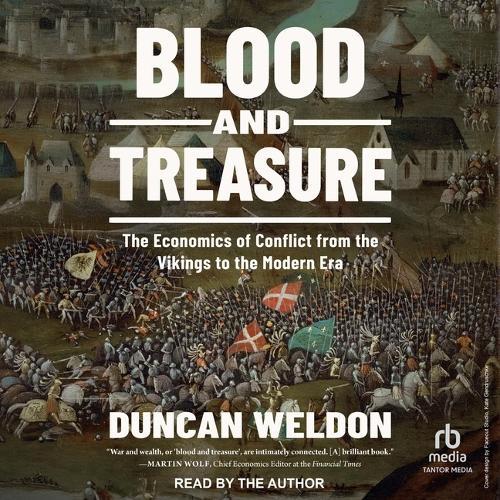
A history of the economics of warfare from the Viking Age to our current era, revealing how armed conflict has influenced world power Wars are expensive, both in human terms and monetary ones. But while warfare might be costly, it has also, at times, been an important driver of economic change and progress. Over the long span of history, nothing has shaped human institutions--and thus the process of economic development--as much as war and violence. Wars made states and states made wars. As the costs of warfighting grew, so did state structures, taxation systems, and national markets for debt. And as warfare became ever more destructive, the incentive for governments to resort to it changed too. Blood and Treasure looks at the history and economics of warfare from the Viking Age to the war in Ukraine, examining how incentives and institutions have changed over the centuries. It surveys how warfare helped drive Europe's rise to global prominence, and it explains how the total wars of the twentieth century required a new type of strategy, one that took economics seriously. Underpinning this riveting narrative is a focus on how and why the economics of conflict have changed over time. This is a story of how economics can help to explain the motivations of war, and how understanding the history of warfare can help explain modern economics.
Full Product Details
Author: Duncan Weldon ,
Duncan Weldon
Publisher: Tantor
Imprint: Tantor
Edition: Unabridged edition
ISBN: 9798228796058
Publication Date: 06 January 2026
Audience:
General/trade
,
General
Format: Audio
Publisher's Status: Active
Availability: In Print

This item will be ordered in for you from one of our suppliers. Upon receipt, we will promptly dispatch it out to you. For in store availability, please contact us.
Reviews
""A delightfully quirky approach to military history. Thanks to an obvious deep love of the subject, a deft choice of examples, and some thoroughly satisfying human stories. Weldon has made warfare a good thing to read about."" -- ""The Spectator (London)"" ""Time and again Weldon spots the invisible hand behind hostilities."" -- ""The Economist (London)"" ""Weldon emphasizes that economics explains human behavior well beyond simple money and trade. An ingenious juxtaposition. Entertaining and delightful."" -- ""Kirkus Reviews"" ""Weldon is an engaging writer who links the storytelling power of history with the analytical rigor of modern economics. He offers a novel way to think about the role of warfare in human economics."" -- ""Booklist""
Author Information
Duncan Weldon is a writer and broadcaster. As a journalist he has previously covered global economies at the Economist and the BBC, as well as presented radio documentaries. As an economist, he began his career at the Bank of England, before working in asset management and public policy. He is a member of the advisory board of the Centre for the Analysis of Comparative Advantage in the Global Economy at Warwick University. He is also a regular commentator on television and radio and writes for a variety of publications. Duncan's first book, Two Hundred Years of Muddling Through, was published in Britain and he lives in London. Duncan Weldon is a writer and broadcaster. As a journalist he has previously covered global economies at the Economist and the BBC, as well as presented radio documentaries. As an economist, he began his career at the Bank of England, before working in asset management and public policy. He is a member of the advisory board of the Centre for the Analysis of Comparative Advantage in the Global Economy at Warwick University. He is also a regular commentator on television and radio and writes for a variety of publications. Duncan's first book, Two Hundred Years of Muddling Through, was published in Britain and he lives in London.