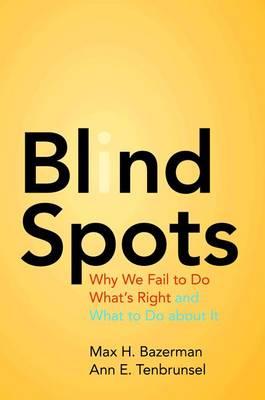
Full Product Details
Author: Max H. Bazerman ,
Ann E. Tenbrunsel
Publisher: Princeton University Press
Imprint: Princeton University Press
Dimensions:
Width: 15.20cm
, Height: 2.10cm
, Length: 23.50cm
Weight: 0.454kg
ISBN: 9780691147505
ISBN 10: 0691147507
Pages: 200
Publication Date: 20 March 2011
Audience:
General/trade
,
Professional and scholarly
,
General/trade
,
General
,
Professional & Vocational
Format: Hardback
Publisher's Status: Out of Print
Availability: In Print

Limited stock is available. It will be ordered for you and shipped pending supplier's limited stock.
Language: English
Reviews
Blind Spots is a bold argument against the decency of human beings, showing how we subvert our ethical principles time and time again. Noting a human tendency to justify our own actions to ourselves with little thought for their consequences, business professors Max Bazerman and Ann Tenbrunsel explain how employees can give rise to dysfunctional organizations for fear of rocking the boat... The authors adopt a lively tone throughout and harness a broad mix of examples, from lab experiments to the Challenger Space Shuttle disaster and the collapse of Enron. -- Gregor Hunter, The National In an era where we've watched political leaders tell blatant lies and seen the corporate world nearly sunk by an onslaught of questionable ethics, it's time to take a sober look at why people who think of themselves as moral can commit unethical and even unlawful acts--or approve the dishonest acts of others... [T]his is examined in the recent book Blind Spots, by Harvard Business School professor Max Bazerman and Ann Tenbrunsel, professor of business ethics at the University of Notre Dame. -- Toronto Star
Blind Spots is a bold argument against the decency of human beings, showing how we subvert our ethical principles time and time again. Noting a human tendency to justify our own actions to ourselves with little thought for their consequences, business professors Max Bazerman and Ann Tenbrunsel explain how employees can give rise to dysfunctional organizations for fear of rocking the boat. . . . The authors adopt a lively tone throughout and harness a broad mix of examples, from lab experiments to the Challenger Space Shuttle disaster and the collapse of Enron. -- Gregor Hunter, The National
Blind Spots is a bold argument against the decency of human beings, showing how we subvert our ethical principles time and time again. Noting a human tendency to justify our own actions to ourselves with little thought for their consequences, business professors Max Bazerman and Ann Tenbrunsel explain how employees can give rise to dysfunctional organizations for fear of rocking the boat... The authors adopt a lively tone throughout and harness a broad mix of examples, from lab experiments to the Challenger Space Shuttle disaster and the collapse of Enron. -- Gregor Hunter, The National
Author Information
Max H. Bazerman is the Jesse Isidor Straus Professor of Business Administration at Harvard Business School. He is the author and coauthor of many books, including"" Negotiation Genius"". Ann E. Tenbrunsel is the Rex and Alice A. Martin Professor of Business Ethics at the Mendoza College of Business, University of Notre Dame. She is the coeditor of several books, including ""Codes of Conduct"".