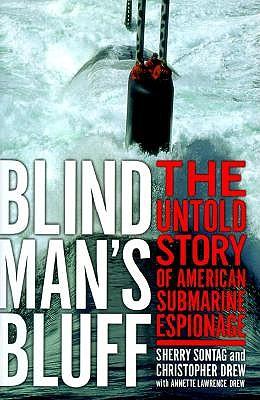
Full Product Details
Author: Sherry Sontag ,
Christopher Drew ,
Annette Lawrence Drew ,
Annette Drew
Publisher: PublicAffairs,U.S.
Imprint: PublicAffairs,U.S.
Dimensions:
Width: 15.60cm
, Height: 3.30cm
, Length: 23.50cm
Weight: 0.742kg
ISBN: 9781891620089
ISBN 10: 1891620088
Pages: 384
Publication Date: 19 October 1998
Audience:
General/trade
,
General
Format: Hardback
Publisher's Status: Out of Stock Indefinitely
Availability: Awaiting stock

Reviews
ENTHRALLING REAL-LIFE STORIES OF AMERICAN SUBMARINE SPYING THAT READ AS IF TORN FROM THE PAGES OF THE HUNT FOR RED OCTOBER . -- KIRKUS REVIEWS
""ENTHRALLING REAL-LIFE STORIES OF AMERICAN SUBMARINE SPYING THAT READ AS IF TORN FROM THE PAGES OF THE HUNT FOR RED OCTOBER"". -- KIRKUS REVIEWS
Enthralling real-life stories of American submarine spying that read as if tom from the pages of The Hunt for Red October, full of high-tech high-jinks and human drama. With materials combed from newspaper reports, American and Soviet archives, and the testimonies of officers and servicemen that could come forward only with the end of the Cold War, Blind Man's Bluff looks at one of the hottest theaters of that era - the ocean depths, and how submarines have been used by both the navy and the CIA to gather intelligence and launch covert operations. Many of the actions described will be familiar to fans of military thrillers, but few readers will have heard these exploits, described in such detail before. Included in the book are the stories of American tapping of Soviet communications cables in the Barents Sea, how the navy used a mathematical formula to find a lost warhead, and the tale of the legendary Glomar Explorer, a CIA-built excavation vessel. The authors, veteran investigative journalists (Drew is a reporter for the New York Times), have concentrated equally on the interdepartmental rivalry between the CIA and the navy. They paint an intriguing portrait of the internal straggles - for funding, materials, manpower, and the presidsent's attention - that dictated how the Ccold War was waged. The work does lack a degree of unity. At times, it seems the writers threw in every submarine secret they could possibly scrounge up. But whenever they falter, rest assured that in just a few pages, the next incredible operation stands reliably revealed. (Kirkus Reviews)
'Iceberg damage' is now revealed to be a euphemism for the consequences of collisions that occurred while Soviet and NATO submarines played an extremely hazardous game of tag in the Arctic. Britain and the USA participated in a highly classified programme of collecting the debris from Soviet missile tests, laying eavesdropping devices on Russian underwater communications cables and monitoring busy naval bases. Few outside the navies' clandestine services really know how successful these operations were. Review by NIGEL WEST Editor's note: Nigel West's books include Venona: The Greatest Secret of the Cold War. (Kirkus UK)
Author Information
Sherry Sontag is a former staff writer for the National Law Journal and has written for The New York Times. Christopher Drew is a special projects editor at the New York Times and has won numerous awards for his investigative reporting. Annette Lawrence Drew, the book's researcher, has a Ph.D. from Princeton.