Overview
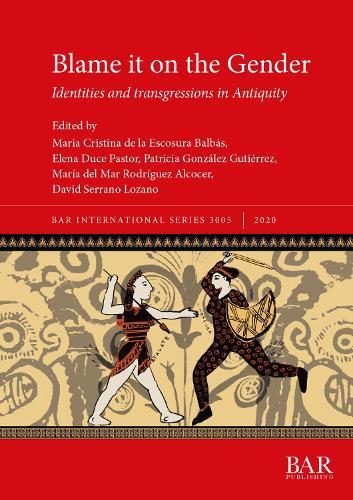
Blame it on the Gender offers a multidisciplinary approach to gender studies in Antiquity, containing contributions by international scholars on different ancient geographical contexts where gender and gender relations can be studied. From the Iron Age in northern Spain to Roman Late Antiquity, this volume revises our understanding of people's life in the past. It offers a critical analysis of previous methodological approaches and suggests new techniques. The various contributors discuss gender misconceptions repeated in scholarship over the last few decades and emphasise the need for researchers to consider gender in their own studies. Each contribution offers a recent bibliography for further reading and the chapters cover different masculinities, gender stereotypes, women, and new approaches in archaeology as well as in history, literature, and epigraphy.
Full Product Details
Author: Cristina de la Escosura Balbás ,
Elena Duce Pastor ,
María del Mar Rodríguez Alcocer ,
Patricia González Gutiérrez
Publisher: BAR Publishing
Imprint: BAR Publishing
Weight: 0.510kg
ISBN: 9781407357348
ISBN 10: 1407357344
Pages: 128
Publication Date: 29 September 2020
Audience:
Professional and scholarly
,
Professional & Vocational
Format: Paperback
Publisher's Status: Active
Availability: Available To Order

We have confirmation that this item is in stock with the supplier. It will be ordered in for you and dispatched immediately.
Language: French
Reviews
{\rtf1\ansi\ansicpg1252\deff0\deflang2057{\fonttbl{\f0\fswiss\fprq2\fcharset0 Calibri;}{\f1\fnil\fcharset0 Verdana;}} \viewkind4\uc1\pard\sa160\sl240\slmult0\f0\fs24\lquote T\fs22 he authors revisit well-known elements of material culture and texts and they make new readings on them.\rquote Professor Margarita S\'e1nchez Romero, Universidad de Granada\par \pard\sa160\sl252\slmult1\par \lquote The research findings in this book would be of considerable interest to international scholars of gender, sexuality and body history in the ancient world.\rquote Dr Peter Keegan, Macquarie University\par \par \fs20\lquote\fs22 It offers a very stimulating and rich exchange between different perspectives, from philology to epigraphy, from history of medicine to theology and film studies.\rquote Dr Irene Salvo, University of Exeter\par \pard\f1\fs17\par }
{\rtf1\ansi\ansicpg1252\deff0\deflang2057{\fonttbl{\f0\fswiss\fprq2\fcharset0 Calibri;}{\f1\fnil\fcharset0 Verdana;}} \viewkind4\uc1\pard\sa160\sl240\slmult0\f0\fs24\lquote T\fs22 he authors revisit well-known elements of material culture and texts and they make new readings on them.\rquote Professor Margarita S\'e1nchez Romero, Universidad de Granada\par \pard\sa160\sl252\slmult1\par \lquote The research findings in this book would be of considerable interest to international scholars of gender, sexuality and body history in the ancient world.\rquote Dr Peter Keegan, Macquarie University\par \par \fs20\lquote\fs22 It offers a very stimulating and rich exchange between different perspectives, from philology to epigraphy, from history of medicine to theology and film studies.\rquote Dr Irene Salvo, University of Exeter\par \pard\f1\fs17\par }
Author Information
Maria Cristina de la Escosura Balbas works at the University of Zaragoza as a Juan de la Cierva postdoctoral researcher. She is interested in Latin Epigraphy and Onomastic, especially in the context of the Western Roman Empire during the Republic and the Principate. She also participates in several projects on Digital Humanities. Elena Duce Pastor has a PhD in Ancient Greece History with a thesis entitled 'Marriage in Ancient Greece, Archaic and Classic periods' from Universidad Autónoma de Madrid. She is also interested in innovation in education. Patricia González Gutiérrez has a PhD in Gender History (Universidad Complutense), as well as a Masters in Ancient History and another Masters in Gender Studies. Her research interests focus on birth control in the Ancient World and history of corporality and medicine. She has participated in academic conferences, as well as outreach activities. María del Mar Rodríguez Alcocer has a PhD in Ancient Greek History specialised in Spartan History with a thesis entitled 'The education of Spartan women'. Her research interests are Gender Studies, education, Cultural History, Sparta and religion in Greek culture. She has taken part in many conferences and seminars and had publications related to these topics. David Serrano Lozano is a PhD candidate at the University of Santiago de Compostela. His research includes Latin Epigraphy and Classical Reception in popular culture. His publications include analysis on Latin epigraphy in north-western Spain and classical reception in cinema and videogames. He also belongs to the Fasti Congressuum project. List of contributors: Chiara Cappanera, M. Cristina de la Escosura Balbás, Elena Duce Pastor, M. Carmen Delia Gregorio Navarro, Patricia González Gutiérrez, Elena Monzón Pertejo, Gema Negrillo Pérez, María del Mar Rodríguez Alcocer, Yukiko Saito, Alberto Santos Cancelas, Camilla Tosi, Marc Vandersmissen.