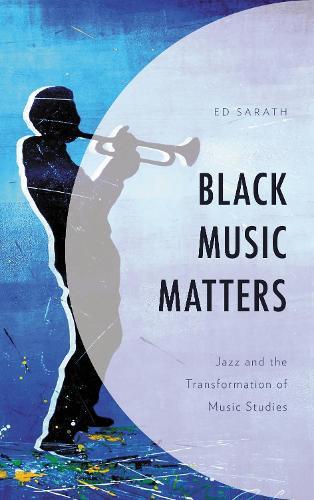
Full Product Details
Author: Ed Sarath
Publisher: Bloomsbury Publishing Plc
Imprint: Rowman & Littlefield
Dimensions:
Width: 15.30cm
, Height: 1.90cm
, Length: 23.00cm
Weight: 0.390kg
ISBN: 9781538158258
ISBN 10: 1538158256
Pages: 256
Publication Date: 03 May 2021
Audience:
Professional and scholarly
,
Professional & Vocational
Format: Paperback
Publisher's Status: Active
Availability: Manufactured on demand

We will order this item for you from a manufactured on demand supplier.
Reviews
Jazz musician, scholar, and educator Ed Sarath (Univ. of Michigan) offers an engaging study of jazz music as inextricably linked to black heritage and race relations in the US; improvisation and creativity within the arts, primarily music; and, most significantly, the need to restructure music curricula in public schools. Sarath situates this restructuring with regard not only to jazz but also to other improvised, non-Western musics. The book has two main sections- Jazz and the Creativity Turn and Jazz and the Consciousness Turn -but, as Sarath points out, the closely intertwined nature of creativity and consciousness is evident throughout the book. In the introduction, he submits that lower order change in music education has, to date, amounted to adding improvisation, composition, and engagement with diverse musical traditions to the existing pedagogical framework. He asserts that a higher order vision should stem from rebuilding the entire learning enterprise -a restructuring that would examine issues including diversity, integrative learning, embodied musicianship, and entrepreneurship. Sarath also argues that learning models should focus more on creativity and less on students as interpreters who occasionally improvise and compose. The endnotes and bibliography are extensive. Summing Up: Recommended. Upper-division undergraduates through faculty and professionals. * CHOICE * A compelling and timely solution to paradigms of dominance and control that deny music students the value of African American-based jazz improvisation. Sarath challenges the fragmentation of people and practices that persists despite our best efforts at diversity in U.S. music degree programs. He offers a blueprint for the what, how, and how not to teach an integrative studies of music from performance and education to history and ethnomusicology. One that does not leave a core national practice of music to an elective. As we progress towards curricula that promote co-constitutive competence in performance, composition, and improvisation across diverse cultures and classical traditions, this book is a must-read. -- Kyra Gaunt, University at Albany, State University of New York This is one amazing book bringing together Sarath's expertise of improvisation and consciousness/spirituality studies through the lens of jazz/black music and raising the importance of black music to a much-needed socio-political conversation. It is a must read for academics in university music studies and performance programs. -- Maud Hickey, Associate Professor, Music Education, Bienen School of Music, Northwestern University Sarath engages the reader in the critical questions facing us today, how we understand, maintain, uphold, and use American heritages of Black music culture and appreciate its importance globally. His thesis and arguments are sound, soulful, and hugely sensible. -- William Banfield, author, composer, professor, and director of Africana Studies, Berklee College of Music
A compelling and timely solution to paradigms of dominance and control that deny music students the value of African American-based jazz improvisation. Sarath challenges the fragmentation of people and practices that persists despite our best efforts at diversity in U.S. music degree programs. He offers a blueprint for the what, how, and how not to teach an integrative studies of music from performance and education to history and ethnomusicology. One that does not leave a core national practice of music to an elective. As we progress towards curricula that promote co-constitutive competence in performance, composition, and improvisation across diverse cultures and classical traditions, this book is a must-read.--Kyra Gaunt, University at Albany, State University of New York Jazz musician, scholar, and educator Ed Sarath (Univ. of Michigan) offers an engaging study of jazz music as inextricably linked to black heritage and race relations in the US; improvisation and creativity within the arts, primarily music; and, most significantly, the need to restructure music curricula in public schools. Sarath situates this restructuring with regard not only to jazz but also to other improvised, non-Western musics. The book has two main sections-- Jazz and the Creativity Turn and Jazz and the Consciousness Turn --but, as Sarath points out, the closely intertwined nature of creativity and consciousness is evident throughout the book. In the introduction, he submits that lower order change in music education has, to date, amounted to adding improvisation, composition, and engagement with diverse musical traditions to the existing pedagogical framework. He asserts that a higher order vision should stem from rebuilding the entire learning enterprise --a restructuring that would examine issues including diversity, integrative learning, embodied musicianship, and entrepreneurship. Sarath also argues that learning models should focus more on creativity and less on students as interpreters who occasionally improvise and compose. The endnotes and bibliography are extensive. Summing Up: Recommended. Upper-division undergraduates through faculty and professionals.--CHOICE Sarath engages the reader in the critical questions facing us today, how we understand, maintain, uphold, and use American heritages of Black music culture and appreciate its importance globally. His thesis and arguments are sound, soulful, and hugely sensible.--William Banfield, author, composer, professor, and director of Africana Studies, Berklee College of Music This is one amazing book bringing together Sarath's expertise of improvisation and consciousness/spirituality studies through the lens of jazz/black music and raising the importance of black music to a much-needed socio-political conversation. It is a must read for academics in university music studies and performance programs.--Maud Hickey, Associate Professor, Music Education, Bienen School of Music, Northwestern University
Author Information
Ed Sarath is professor of music at the University of Michigan, director of the U-M Program in Creativity and Consciousness Studies, and is active worldwide as a performer, composer, recording artist, and scholar. He is founder and president of the International Society for Improvised Music and is lead author of the widely read CMS Manifesto, which appears in the coauthored book Redesigning Music Studies in an Age of Change.