Overview
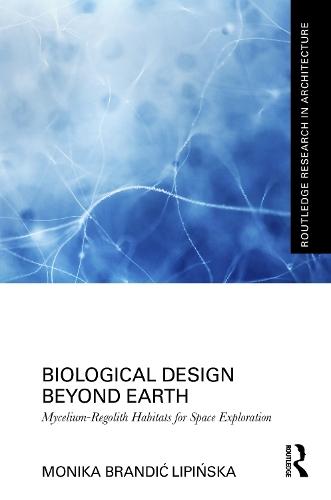
This book explores how fungal mycelium can support the construction of habitats for future human missions to Mars. Addressing the challenge of transporting building materials from Earth, presented research proposes a bio-fabrication strategy based on two principles: combining mycelium with Martian regolith to maximise local resources and employing self-assembly to reduce energy and operational demands. Through biological experiments and architectural prototyping, the research develops low-biomass mycelium-regolith composites and investigates how these materials can be organised through architecture (jamming) and biological (bio-welding) processes to form structural habitation systems. An iterative design framework integrates parametric modelling with hands-on fabrication, showing how materials can shift from passive components to active agents capable of shaping form, structure, and adaptation in extreme environments. The book is aimed at researchers, practitioners, and students in space architecture, biodesign, and emerging construction technologies, as well as readers interested in living materials and space exploration.
Full Product Details
Author: Monika Brandić Lipińska
Publisher: Taylor & Francis Ltd
Imprint: Routledge
ISBN: 9781041147916
ISBN 10: 1041147910
Pages: 262
Publication Date: 12 May 2026
Audience:
College/higher education
,
Professional and scholarly
,
Tertiary & Higher Education
,
Professional & Vocational
Format: Hardback
Publisher's Status: Forthcoming
Availability: Not yet available

This item is yet to be released. You can pre-order this item and we will dispatch it to you upon its release.
Author Information
Monika Brandić Lipińska is a space architect and researcher. Her work explores how architectural design, in-situ resource utilisation, and living materials can shape resilient habitats that support human well-being in extreme environments and how insights from space can inform more sustainable approaches to building on Earth, emphasising resourcefulness, respect for ecological limits, and connection to place and people. She completed her PhD at the Hub for Biotechnology in the Built Environment at Newcastle University, in collaboration with NASA Ames Research Center, and holds a MSc in Architecture from Lund University, an MSc in Space Studies from the International Space University and a BSc in Architecture from Wrocław University of Science and Technology. With experience across Poland, Italy, Denmark, Sweden, Austria, France, the United States, the United Kingdom, and Japan, she brings an international perspective to research, design, and teaching. She is the co-founder of the Bio-Futures for Transplanetary Habitats platform, which explores biosocial and biotechnological relations in extreme and space environments.