|
|
|||
|
||||
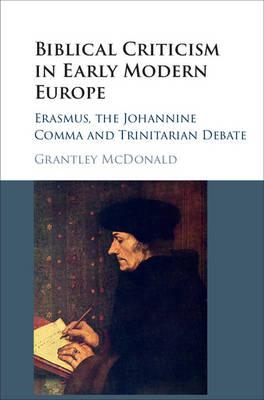
OverviewMedieval western theologians considered the Johannine comma (1 John 5:7-8) the clearest biblical evidence for the Trinity. When Erasmus failed to find the comma in the Greek manuscripts he used for his New Testament edition, he omitted it. Accused of promoting Antitrinitarian heresy, Erasmus included the comma in his third edition (1522) after seeing it in a Greek codex from England, even though he suspected the manuscript's authenticity. The resulting disputes, involving leading theologians, philologists and controversialists such as Luther, Calvin, Sozzini, Milton, Newton, Bentley, Gibbon and Porson, touched not simply on philological questions, but also on matters of doctrine, morality, social order, and toleration. While the spuriousness of the Johannine comma was established by 1900, it has again assumed iconic status in recent attempts to defend biblical inerrancy amongst the Christian Right. A social history of the Johannine comma thus provides significant insights into the recent culture wars. Full Product DetailsAuthor: Grantley McDonald (Universität Wien, Austria)Publisher: Cambridge University Press Imprint: Cambridge University Press Dimensions: Width: 15.80cm , Height: 2.50cm , Length: 23.50cm Weight: 0.690kg ISBN: 9781107125360ISBN 10: 1107125367 Pages: 400 Publication Date: 27 July 2016 Audience: Professional and scholarly , Professional & Vocational Format: Hardback Publisher's Status: Active Availability: Available To Order We have confirmation that this item is in stock with the supplier. It will be ordered in for you and dispatched immediately. Table of ContentsReviews'What this book superbly demonstrates is that the relation between philology and theology is by no means straightforward, and that there was by no means a clash between philology and theology.' Dirk van Mierr, Renaissance Quarterly Author InformationGrantley McDonald is a postdoctoral fellow at the Universität Wien, and leader of the research project 'The Court Chapel of Maximilian I: Between Art and Politics'. His research has been distinguished with prizes from the Australian Academy of the Humanities (Canberra) and the Praemium Erasmianum Foundation (Amsterdam). His recent work has focussed on print, religious radicalism and censorship. Tab Content 6Author Website:Countries AvailableAll regions |
||||