Overview
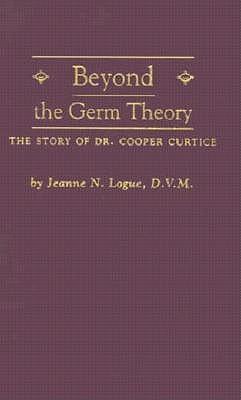
The work of Dr. Cooper Curtice (1856–1939) played a major role in saving America's livestock industry in the years around the turn of the century. But as the new biography Beyond the Germ Theory shows, Curtice's career exemplifies not only the development of veterinary medicine in the U.S. but also how government agencies and professional jealousies affect the advancement of science.""""Curtis did not receive the timely credit and recognition that was due him,"""" author Jeanne N. Logue observes. His greatest achievement was helping to eradicate ticks and the Texas fever they caused in cattle. But as he conducted his research, proposed the vector theory of disease transmission, and fought for a tick eradication program, his scientific peers often scorned his new ideas, only to appropriate them later. Curtice graduated from Cornell in 1881, and after a short stint in medical school at the University of Michigan he transferred to the Columbia Veterinary College in New York City. In 1886 he was invited to join the new Bureau of Animal Industry in Washington, D.C. While there, bureaucratic squabbling, questionable ethics in the organization, and professional backbiting buffeted his research. After a few years he left, vowing to continue his mission to eradicate ticks and stop the spread of tuberculosis by milk from diseased cattle. In his home state of New York, Curtice was the first to start testing cattle for tuberculosis, and his research contributed to the control of parasites in sheep. For his efforts, though, he sometimes received less than thanks. One cattleman wrote him a letter saying, """"You are a big ass and don't know nothing about cattle . . . feed the cattle sulpher [sic] and you will have them well in a week."""" Other times, Curtice faced armed men or other threats to his safety. On the professional side of the insults, when his former supervisor Theobald Smith published an acclaimed paper on Texas fever, he did so without even mentioning Curtice's name. Eventually, Curtice returned to government service and continued his work in Central America. Not until 1933 did he receive national recognition for his work, in the form of a medallion from the American Veterinary Medical Association. Five years after his death in 1939, the cattle fever tick that had occupied much of Curtice's attention was declared eradicated in the U.S. except for a narrow quarantine zone along the Texas-Mexico border.
Full Product Details
Author: Jeanne N. Logue
Publisher: Texas A & M University Press
Imprint: Texas A & M University Press
Dimensions:
Width: 14.50cm
, Height: 1.60cm
, Length: 22.20cm
Weight: 0.383kg
ISBN: 9780890966730
ISBN 10: 0890966737
Pages: 168
Publication Date: 30 June 2006
Audience:
Professional and scholarly
,
Professional & Vocational
Format: Hardback
Publisher's Status: Active
Availability: Temporarily unavailable

The supplier advises that this item is temporarily unavailable. It will be ordered for you and placed on backorder. Once it does come back in stock, we will ship it out to you.
Author Information
Jeanne N. Logue, D.V.M., was born in Brooklyn, New York. She earned her doctorate from Cornell University in 1944 and for a time served on the staff at the ASPCA Hospital in New York City. She was in private practice for twenty-five years before her retirement, during which she has written an autobiography The Wonder of It All (Harper, 1979) and an article """"From Brooklyn to Barnyards,"""" for the Journal of the American Veterinary Association. She currently resides in Poughkeepsie, New York.