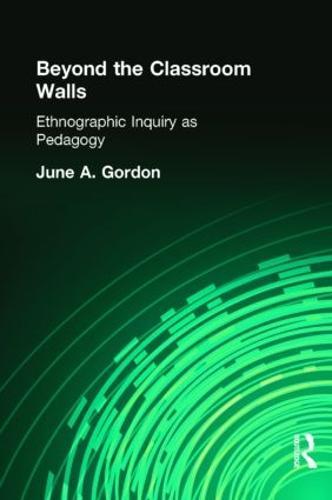
Full Product Details
Author: June A. Gordon
Publisher: Taylor & Francis Ltd
Imprint: Routledge
Dimensions:
Width: 15.20cm
, Height: 1.70cm
, Length: 22.90cm
Weight: 0.460kg
ISBN: 9780415934930
ISBN 10: 0415934931
Pages: 164
Publication Date: 20 September 2002
Audience:
College/higher education
,
General/trade
,
Tertiary & Higher Education
,
General
Format: Hardback
Publisher's Status: Active
Availability: In Print

This item will be ordered in for you from one of our suppliers. Upon receipt, we will promptly dispatch it out to you. For in store availability, please contact us.
Reviews
""The theoretical underpinnings of June Gordon's contribution to pedagogy have been around for a long time but have penetrated practice very little. Her unique contribution is in fusing theory and practice and illustrating that fusion in a range of contexts. It is a pleasure to have a silent conversation with an author who has command of both her material and the language of communicating it."" -- John I. Goodlad, president of the Institute for Educational Inquiry in Seattle and professor emeritus at the University of Washington. ""Working again off the beaten track, June Gordon shows how ethnographic methods are effective not only for research but also for pedagogy on class and race issues. Reviewing insightful examples of ethnography for educational purposes, Gordon offers keen guidelines on doing transformative research, generating dialogues between researcher and researched, reconnecting students with communities, and informing students early about the hard realities of the teaching worlds. Researching, learning, and teaching are closely linked in Gordon's innovative approach."" -- Joe R. Feagin, University of Florida (Author of Racist America, Routledge, 2000) ""The theoretical underpinnings of June Gordon's contribution to pedagogy have been around for a long time but have penetrated practice very little. Her unique contribution is in fusing theory and practice and illustrating that fusion in a range of contexts. It is a pleasure to have a silent conversation with an author who has command of both her material and the language of communicating it."" -- John I. Goodlad, president of the Institute for Educational Inquiry ""Gordon's approach to teacher education is illuminating and rich...She includes her own transformation as a participant in the communities in which she teaches and lives as part of the larger story. We in teacher education would do well to model our work on hers."" -- Anthropology & Education Quarterly
'[the author's] unique contribution is in fusing theory and practice and illustrating that fusion in a range of contexts. It is a pleasure to have a silent conversation with an author who has command of both her material and the language of communicating it.' John I. Goodlad, president of the Institute for Educational Inquiry
The theoretical underpinnings of June Gordon's contribution to pedagogy have been around for a long time but have penetrated practice very little. Her unique contribution is in fusing theory and practice and illustrating that fusion in a range of contexts. It is a pleasure to have a silent conversation with an author who has command of both her material and the language of communicating it. -- John I. Goodlad, president of the Institute for Educational Inquiry in Seattle and professor emeritus at the University of Washington. Working again off the beaten track, June Gordon shows how ethnographic methods are effective not only for research but also for pedagogy on class and race issues. Reviewing insightful examples of ethnography for educational purposes, Gordon offers keen guidelines on doing transformative research, generating dialogues between researcher and researched, reconnecting students with communities, and informing students early about the hard realities of the teaching worlds. Researching, learning, and teaching are closely linked in Gordon's innovative approach. -- Joe R. Feagin, University of Florida (Author of Racist America, Routledge, 2000) The theoretical underpinnings of June Gordon's contribution to pedagogy have been around for a long time but have penetrated practice very little. Her unique contribution is in fusing theory and practice and illustrating that fusion in a range of contexts. It is a pleasure to have a silent conversation with an author who has command of both her material and the language of communicating it. -- John I. Goodlad, president of the Institute for Educational Inquiry Gordon's approach to teacher education is illuminating and rich...She includes her own transformation as a participant in the communities in which she teaches and lives as part of the larger story. We in teacher education would do well to model our work on hers. -- Anthropology & Education Quarterly
Author Information
June A. Gordon is Assistant Professor of Education at the University of California, Santa Cruz. She is the author of The Color of Teaching (RoutledgeFalmer, 2000)