|
|
|||
|
||||
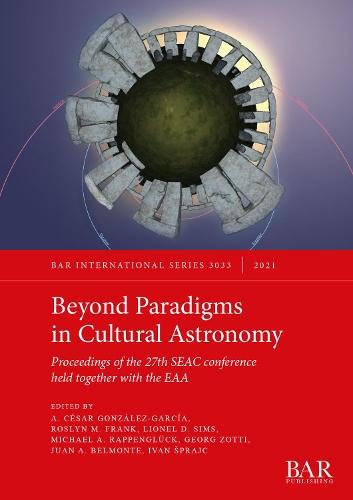
OverviewCultural Astronomy is the endeavour to understand the role of the sky in past and present societies, and how these societies incorporated the sky into their culture. This broad ranging discipline is closely related to archaeology when investigating material remains of the past. Cultural Astronomy also explores the role of the heavens from the perspectives of the anthropological sciences. In recent decades the discipline has been concerned with methodological and theoretical issues. This volume offers chapters based on presentations at the 27th SEAC meeting held in Bern (2019). These chapters provide a vivid image of front-line research in diverse areas, from Roman light and shadow effects to highlight power, to Maya city organization, Etruscan temple orientation or the ontology of the sky. Full Product DetailsAuthor: Roslyn M. Frank , Lionel D. Sims , Juan A. Belmonte , A. César González-GarcíaPublisher: BAR Publishing Imprint: BAR Publishing Weight: 0.726kg ISBN: 9781407358222ISBN 10: 1407358227 Pages: 182 Publication Date: 30 July 2021 Audience: Professional and scholarly , Professional & Vocational Format: Paperback Publisher's Status: Active Availability: Available To Order We have confirmation that this item is in stock with the supplier. It will be ordered in for you and dispatched immediately. Table of Contents"Foreword Part 1. Cultural Astronomy, Skyscape and Ontology: How Celestial Objects and Events have Featured in the Belief Systems, Cosmologies and Woldviews of Different Societies Roslyn M. Frank and Lionel D. Sims 1.Do Ancient Egyptian Almanacs Show Evidence of Celestial Recurrence? Rolf Krauss and Victor Reijs 1.1 Introduction 1.2 Pharaonic menologies and hemerologies 1.3 Schematic distribution of one third of all prognoses 1.4 Transformation of the almanac's intervals into time points 1.5 Explanation of the period ~2.85 1.6 Explanation of the split differences 1.7 Arithmetic conclusion 1.8 Different statistical techniques for periodicity analysis 1.9 Can Rayleigh test be used to determine periodicity in the data series? 1.10 Dependence on the placement of the time points over the day 1.11 Comparing different sources 1.12 Comparing different statistical techniques for periodicities 1.13 Fixed almanac prognoses relating to recurrent celestial events 1.14 Statistical conclusions 1.15 Overall conclusions 2.""Cosmic"" Containers - Elements and Representatives of Ancient Cosmovisions Barbara Rappenglück 2.1 Introduction 2.2 Notional ""cosmic containers"" in mythical cosmovisions 2.3 Containers with cosmic symbolism 2.3.1 Shape 2.3.2 Material 2.3.3 Manufacturing 2.3.4 Décor 2.3.5 Context of use 2.4 Conclusion 3.Solstice Azimuths as Design Elements at Angkor Wat and Nearby Temples William F. Romain 3.1 Introduction 3.2 Methods 3.3 Results 3.3.1 Angkor Wat 3.3.2 Other Nearby Sites 3.4 Discussion 3.5 Concluding remarks 4.Returning from the Underworld: The West Kennet Palisades in the Avebury Monument Complex Lionel D. Sims 4.1 Introduction 4.2 Framing the West Kennet Palisades 4.3 The archaeology of the West Kennet Palisades 4.4 The skyscape archaeology of Enclosure 2 of the West Kennet Palisades 4.5 Conclusion Part 2. Frontiers in Theory, Methodology and Education within Cultural Astronomy Michael A. Rappenglück and Georg Zotti 5.Beyond Paradigms: Archaeoastronomy as a New Interpretation Key to Understand the Function and Meaning of Ancient Roman Buildings Marina De Franceschini 5.1 Foreword 5.2 Hadrian's Villa in Tivoli (Rome) 5.3 The Pantheon 5.3.1 Previous studies 5.3.2 The hierophanies of the Pantheon 5.3.3 Our discovery: the hierophanies of the Arc of Light and the Square of Light 5.3.4 The symbolic meaning of the Arc of Light 5.4 Conclusions on the Pantheon 6.Astronomical Data and Their Usefulness for Dating Ancient Societies Rita Gautschy 6.1 Introduction 6.2 Ancient Egyptian Calendars 6.3 Ancient Mesopotamian Calendars 6.4 General problems 6.5 Egypt in the first half of the second millennium BCE 6.6 Mesopotamia in the first half of the second millennium BCE 6.7 Conclusions 7.Teaching Cultural Astronomy to Undergraduates with an Interdisciplinary Frame Jarita C. Holbrook 7.1 Introduction 7.2 What to teach? 7.3 Astronomy, Maps, and Mapping 7.4 Data Collection Methods and Case Studies 7.5 Student Responses 7.6 Conclusions 8.The Chiemgau Impact: Evidence of a Latest Bronze Age/Early Iron Age Meteorite Impact in the Archaeological Record, and Resulting Critical Considerations of Catastrophism Barbara Rappenglück, Michael Hiltl and Kord Ernstson 8.1 Introduction: Did meteorite impacts shape human cultures? 8.2 Holocene meteorite impacts and presumed cultural implications: some caveats 8.3 New aspects from the Holocene Chiemgau meteorite impact 8.3.1 The Holocene Chiemgau Impact 8.3.2 The verification of a meteorite impact in an archaeological context by artefacts constituting part of an impact rock - the first evidence worldwide 8.3.3 The dating of the Holocene Chiemgau meteorite impact 8.4 The question of a cultural catastrophe scenario 8.4.1 Consequences on the supra-regional level? 8.4.2 Consequences on a local scale? 8.5 Conclusion 9.How Do We Know What They Were Thinking? Archaeoastronomy between Science and Speculation - Palaeolithic Case Studies Michael A. Rappenglück 9.1 Introduction 9.2 From Astro-Archaeology to Cultural Astronomy 9.3 How can the range of topics and the methodology of Cultural Astronomy be determined? 9.4 The Integral Methodology as a scientific approach - Case studies from the Palaeolithic 9.5 Some points of an Integral Methodology 9.6 Conclusion 10.Archaeoastronomical Sites as Fields of Relationship Stanislaw Iwaniszewski 10.1 Introduction 10.2 Relational Ontologies 10.3 Ingold's relational fields 10.4 Towards a relational ontological approach in archaeoastronomy 10.5 Alignments 10.6 Archaeoastronomical sites as relational fields 10.7 Conclusions 11.Some Thoughts on the Skycultures in Stellarium Georg Zotti and Alexander Wolf 11.1 Introduction 11.2 The ""skyculture"" concept in Stellarium 11.3 Non-Western constellation concepts 11.4 Lost in Translation? 11.5 Classification 11.6 Future work 12.Virtual Archaeoastronomy with Stellarium: An Overview Georg Zott"Reviews'It is a very important volume for the field of cultural astronomy and also for the field of archeology in general.' Dr Alejandro Martin Lopez, Universidad de Buenos Aires 'This book contributes to this area greatly by capturing the current status of the field of cultural astronomy, archaeoastronomy as well as skyscape archaeology. In its diversity it celebrates and illustrates the multifaceted subject areas coming together.' Dr Daniel Brown, Nottingham Trent University Author Information"A. César González García is currently the president of the European Society for Astronomy in Culture (SEAC). Based at the Institute of Heritage Sciences in Santiago de Compostela (Spain), his main research lines are centered in the orientation of past cultures buildings, including possible astronomical and landscape relations. Roslyn M. Frank has been an active member of SEAC since its inception. Her research areas are Basque culture and language, ethnomathemtics and ethnoastronomy, landscape and skyscape studies, as well as European folklore and ethnography. Lionel D. Sims, B.Sc. (Hons) Salford, M.Sc. LSE, M.Sc. Surrey, M.Sc. UCL, Ph.D. UEL. Head of Anthropology, University of East London (Emeritus). A film of his research, 'Stonehenge Rediscovered', was commissioned for National Geographic and distributed world-wide. He uses inter-disciplinary method by integrating archaeology, archaeoastronomy, anthropology and mythology. Michael A. Rappenglück Dr. rer. nat. (history of sciences, history of astronomy) and M.A. (philosophy); He carried out studies of history of natural sciences, astronomy and systematical theology at the Ludwig Maximilian University Munich. Since 1990 he is general manager and head of the Adult Center Gilching, Munich, Germany. Georg Zotti is computer scientist and astronomer, currently working at the Ludwig Boltzmann Institute for Archaeological Prospection and Virtual Archaeology. His key interest in cultural astronomy is the application of computer graphics and virtual environments for research and demonstration of historical astronomical events, building orientation with enclosing landscape etc. Juan A. Belmonte is Research Professor of Astronomy at the Instituto de Astrofísica de Canarias (Tenerife, Spain). He was the President of SEAC from 2005 to 2011. In 2012 he received the ""Carlos Jaschek"" award of the European Society for Astronomy in Culture for his contributions to the discipline. He is advisory editor of the Journal for the History of Astronomy. Ivan Sprajc Ph.D. in anthropology (Universidad Nacional Autónoma de México, 1997), he is head of the Institute of Anthropological and Spatial Studies, of the Scientific Research Center of the Slovenian Academy of Sciences and Arts (ZRC SAZU), in Ljubljana, Slovenia. Sprajc's interests have been focused on Mesoamerican archaeology and archaeoastronomy. List of editors: A. César González-García, Roslyn M. Frank, Lionel D. Sims, Michael A. Rappenglück, Georg Zotti, Juan A. Belmonte, Ivan Sprajc Contributors: M. Almushawh, A.I. Alpay, J.A. Belmonte, N. Campion, I. Cristofaro, M. De Franceschini, K. Ernstson, R. Gautschy, M. Hiltl, J.C. Holbrook, S. Iwaniszewski, R. Krauss, A.P. Pernigotti, B. Rappenglück, M.A. Rappenglück, V. Reijs, W.F. Romain, L.D. Sims, E. Spinazzè, I. Sprajc, C. Sterken, M. Urrutia-Aparicio, A. Wolf, G. Zotti." Tab Content 6Author Website:Countries AvailableAll regions |
||||