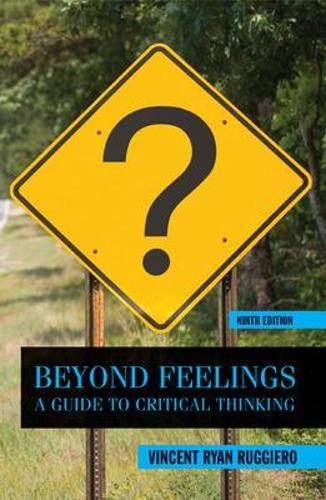
Beyond Feelings: A Guide to Critical Thinking

Author:   Vincent Ruggiero
Publisher:   McGraw-Hill Education - Europe
Edition:   9th edition
ISBN:  

9780078038181


Pages:   256
Publication Date:   16 February 2011
Format:   Paperback
Availability:   Out of stock   Availability explained
The supplier is temporarily out of stock of this item. It will be ordered for you on backorder and shipped when it becomes available.

Our Price $199.95 Quantity:  
Add to Cart

Share |

Beyond Feelings: A Guide to Critical Thinking


Overview

This succinct, interdisciplinary introduction to critical thinking successfully dares students to question their own assumptions and to enlarge their thinking through the analysis of the most common problems associated with everyday reasoning. The text offers a unique and effective organization: Part I explains the fundamental concepts; Part II describes the most common barriers to critical thinking; Part III offers strategies for overcoming those barriers.

Full Product Details

Author:   Vincent Ruggiero
Publisher:   McGraw-Hill Education - Europe
Imprint:   McGraw-Hill Professional
Edition:   9th edition
Dimensions:   Width: 16.00cm , Height: 1.00cm , Length: 23.10cm
Weight:   0.333kg
ISBN:  

9780078038181


ISBN 10:   0078038189
Pages:   256
Publication Date:   16 February 2011
Audience:   General/trade ,  General
Format:   Paperback
Publisher's Status:   Active
Availability:   Out of stock   Availability explained
The supplier is temporarily out of stock of this item. It will be ordered for you on backorder and shipped when it becomes available.

Table of Contents

Preface Introduction PART I. THE CONTEXT 1. Who Are You?The Influence of Time and PlaceThe Influence of IdeasThe Influence of Mass CultureThe ""Science"" of ManipulationThe Influence of PsychologyBecoming an Individual 2. What Is Critical Thinking?Mind, Brain, or Both?Critical Thinking DefinedCharacteristics of Critical ThinkersThe Role of IntuitionThe Basic Activities of Critical ThinkingCritical Thinking and WritingCritical Thinking and DiscussionAvoiding Plagiarism 3. What Is Truth?Where Does It All Begin?Imperfect PerceptionImperfect MemoryDeficient InformationEven the Wisest Can ErrTruth Is Discovered, Not Created 4. What Does It Mean to Know?Requirements of KnowingTesting Your Own KnowledgeHow We Come to KnowWhy Knowing is DifficultA Cautionary TailIs Faith a Form of KnowledgeObstacles to Knowledge 5. How Good Are Your Opinions?Opinions Can Be MistakenOpinions on Moral IssuesEven Experts Can Be WrongKinds of ErrorsInformed Versus Uninformed OpinionForming Opinions Responsibly 6. What Is Evidence?Kinds of EvidenceEvaluating EvidenceWhat Constitutes ""Sufficient"" Evidence? 7. What Is Argument?The Parts of an ArgumentEvaluating ArgumentsMore Difficult Arguments PART II. THE PITFALLS 8. The Basic Problem: ""Mine Is Better""Egocentric PeopleEthnocentric PeopleControlling ""Mine-Is-Better"" Thinking 9. Errors of PerspectivePoverty of AspectUnwarranted AssumptionsThe Either/Or OutlookMindless ConformityAbsolutismRelativismBias For or Against Change 10. Errors of ProcedureBiased Consideration of EvidenceDouble StandardHasty ConclusionOvergeneralization and StereotypingOversimplificationThe Post Hoc Fallacy 11. Errors of ExpressionContradictionArguing in a CircleMeaningless StatementMistaken AuthorityFalse AnalogyIrrational Appeal 12. Errors of ReactionAutomatic RejectionChanging the SubjectShifting the Burden of Proof""Straw Man""Attacking the Critic 13. The Errors in CombinationErrors of PerspectiveErrors of ProcedureErrors of ExpressionErrors of ReactionSample Combinations of ErrorsA Sensible View of Terminology PART III. A STRATEGY 14. Knowing YourselfCritical Thinking InventoryUsing Your InventoryChallenge and Reward 15. Being ObservantObserving PeopleObservation in Science and MedicineThe Range of ApplicationBecoming More ObservantReflecting Your Observations 16. Selecting an IssueThe Basic Rule: Less Is MoreHow to Limit an IssueSample Issue: PornographySample Issue: BoxingSample Issue: Juvenile CrimeNarrowing the Issue Further 17. Conducting InquiryWorking with Inconclusive ResultsWhere to Look for InformationKeeping FocusedHow Much Inquiry is Enough?Managing Lengthy Material 18. Forming a JudgmentEvaluating EvidenceEvaluating Your Sources' ArgumentsMaking Important DistinctionsExpressing Judgments 19. Persuading OthersGuidelines for PersuasionAn Unpersuasive PresentationA Persuasive Presentation Notes Index

Reviews

Author Information

Vincent Ryan Ruggiero is internationally recognized as a pioneer in the movement to make creative and critical thinking central emphases in education and in society. The author of 22 books and over 500 essays, he is Professor of Humanities Emeritus at State University of New York, Delhi.

Tab Content 6

Author Website:  

Countries Available

All regions
Latest Reading Guide

NOV RG 20252


Shopping Cart
Your cart is empty
Shopping cart
Mailing List