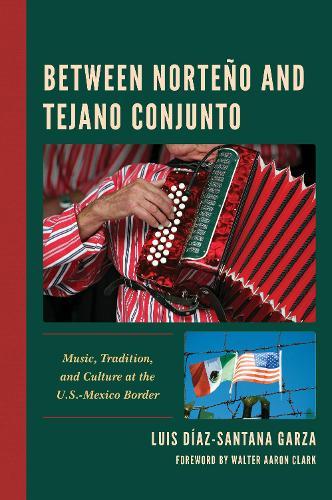
Full Product Details
Author: Luis Díaz-Santana Garza ,
Walter Aaron Clark
Publisher: Bloomsbury Publishing Plc
Imprint: Lexington Books
Dimensions:
Width: 16.00cm
, Height: 1.90cm
, Length: 22.80cm
Weight: 0.449kg
ISBN: 9781793638984
ISBN 10: 1793638985
Pages: 172
Publication Date: 11 June 2021
Audience:
Professional and scholarly
,
Professional & Vocational
Format: Hardback
Publisher's Status: Active
Availability: Manufactured on demand

We will order this item for you from a manufactured on demand supplier.
Reviews
Borders often incite transgression. The musical expressions studied by Luis Diaz Santana Garza are an example of how popular culture in border regions breaks down barriers and fragments conventional identities. Music on the border causes strange, complex and fascinating phenomena that are studied in great detail in this book. The reader will be amazed at the wealth that the border between Nuevo Leon and Texas harbors and generates in its popular musical expressions. --Roger Bartra, Emeritus Researcher, National Autonomous University This is the first comprehensive study of the relationship between norteno and conjunto music that truly takes into consideration both sides of the border. It will be of interest to a wide range of readers to include not only conjunto and norteno fans, but also scholars from disciplines such as musicology, folklore, media studies, popular culture, history, literature, sociology and cultural anthropology. --Dr. Juan Carlos Ramirez-Pimienta, San Diego State University Under a multidisciplinary approach -which combines cultural history, cultural studies and music studies, with musicological analysis-, Diaz-Santana Garza offers a binational perspective of the emergence and evolution of this music that helps to explain the phenomenon of musical nortenizacion that Mexico is currently experiencing. The rigor is remarkable, as well as the variety of its sources: oral and documentary (printed, recorded). The clarity and solidity of the arguments used to critically construct the history around these musical cultures, goes beyond the strictly musical framework and brings us closer to the areas of contemporary culture. --Jose Juan Olvera Gudino, Center for Research and Higher Studies in Social Anthropology
This is the first comprehensive study of the relationship between norteno and conjunto music that truly takes into consideration both sides of the border. It will be of interest to a wide range of readers to include not only conjunto and norteno fans, but also scholars from disciplines such as musicology, folklore, media studies, popular culture, history, literature, sociology and cultural anthropology. --Juan Carlos Ramirez-Pimienta, San Diego State University Borders often incite transgression. The musical expressions studied by Luis Diaz Santana Garza are an example of how popular culture in border regions breaks down barriers and fragments conventional identities. Music on the border causes strange, complex and fascinating phenomena that are studied in great detail in this book. The reader will be amazed at the wealth that the border between Nuevo Leon and Texas harbors and generates in its popular musical expressions. --Roger Bartra, Emeritus Researcher, National Autonomous University Under a multidisciplinary approach -which combines cultural history, cultural studies and music studies, with musicological analysis-, Diaz-Santana Garza offers a binational perspective of the emergence and evolution of this music that helps to explain the phenomenon of musical nortenizacion that Mexico is currently experiencing. The rigor is remarkable, as well as the variety of its sources: oral and documentary (printed, recorded). The clarity and solidity of the arguments used to critically construct the history around these musical cultures, goes beyond the strictly musical framework and brings us closer to the areas of contemporary culture. --Jose Juan Olvera Gudino, Center for Research and Higher Studies in Social Anthropology
""Díaz-Santana Garza is part of a wave of scholars who incorporate their lived experience in their scholarship.... The author provides a history of conjunto, the multiple musical forms the genre incorporates, and its influence in shaping other musical cultures. The author also argues that transnational music of accordion and bajo sexto have become powerful symbols of Mexican and Chicano identity, displacing mariachi music, thanks to demand from Mexican migrants. The author visited ten archives across Mexico and Texas, and his primary research sources include newspapers, songs, and interviews he conducted in southern Texas towns and large urban centers in Mexico. Recommended. Lower-division undergraduates through faculty and professionals; general readers."" --Choice Reviews ""Borders often incite transgression. The musical expressions studied by Luis Díaz Santana Garza are an example of how popular culture in border regions breaks down barriers and fragments conventional identities. Music on the border causes strange, complex and fascinating phenomena that are studied in great detail in this book. The reader will be amazed at the wealth that the border between Nuevo León and Texas harbors and generates in its popular musical expressions."" --Roger Bartra, Emeritus Researcher, Universidad Nacional Autónoma de México ""Under a multidisciplinary approach -which combines cultural history, cultural studies and music studies, with musicological analysis-, Díaz-Santana Garza offers a binational perspective of the emergence and evolution of this music that helps to explain the phenomenon of musical norteñización that Mexico is currently experiencing. The rigor is remarkable, as well as the variety of its sources: oral and documentary (printed, recorded). The clarity and solidity of the arguments used to critically construct the history around these musical cultures, goes beyond the strictly musical framework and brings us closer to the areas of contemporary culture."" --Jose Juan Olvera Gudiño, Center for Research and Higher Studies in Social Anthropology ""This is the first comprehensive study of the relationship between norteño and conjunto music that truly takes into consideration both sides of the border. It will be of interest to a wide range of readers to include not only conjunto and norteño fans, but also scholars from disciplines such as musicology, folklore, media studies, popular culture, history, literature, sociology and cultural anthropology."" --Juan Carlos Ramírez-Pimienta, San Diego State University ""Borders often incite transgression. The musical expressions studied by Luis Díaz Santana Garza are an example of how popular culture in border regions breaks down barriers and fragments conventional identities. Music on the border causes strange, complex and fascinating phenomena that are studied in great detail in this book. The reader will be amazed at the wealth that the border between Nuevo León and Texas harbors and generates in its popular musical expressions."" ""This is the first comprehensive study of the relationship between norteño and conjunto music that truly takes into consideration both sides of the border. It will be of interest to a wide range of readers to include not only conjunto and norteño fans, but also scholars from disciplines such as musicology, folklore, media studies, popular culture, history, literature, sociology and cultural anthropology."" ""Under a multidisciplinary approach -which combines cultural history, cultural studies and music studies, with musicological analysis-, Díaz-Santana Garza offers a binational perspective of the emergence and evolution of this music that helps to explain the phenomenon of musical norteñización that Mexico is currently experiencing. The rigor is remarkable, as well as the variety of its sources: oral and documentary (printed, recorded). The clarity and solidity of the arguments used to critically construct the history around these musical cultures, goes beyond the strictly musical framework and brings us closer to the areas of contemporary culture."" Díaz-Santana Garza is part of a wave of scholars who incorporate their lived experience in their scholarship.... The author provides a history of conjunto, the multiple musical forms the genre incorporates, and its influence in shaping other musical cultures. The author also argues that transnational music of accordion and bajo sexto have become powerful symbols of Mexican and Chicano identity, displacing mariachi music, thanks to demand from Mexican migrants. The author visited ten archives across Mexico and Texas, and his primary research sources include newspapers, songs, and interviews he conducted in southern Texas towns and large urban centers in Mexico. Recommended. Lower-division undergraduates through faculty and professionals; general readers.
Author Information
Luis Díaz-Santana Garza is professor of music history and guitar at the Autonomous University of Zacatecas in Zacatecas, Mexico.