Overview
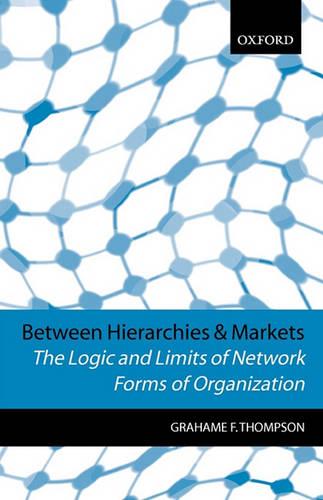
This book conducts a survey into the ways in which the word 'network' has been deployed in a wide range of literature. In particular, it offers a commentary on how the idea of networks has been used to illustrate contemporary forms of socio-economic organization (as with the idea of a 'network society' or a 'network state', for instance), broadly conceived to also include the political aspects of networks. The term 'network' has become a ubiquitous metaphor to describe too many aspects of contemporary life. In doing so, Thompson argues, the term has lost much of its analytical precision and has no clear conceptual underpinnings. The problem is that something claiming to explain everything ends up by explaining very little. The book brings some intellectual clarity to the discussion of networks by asking whether it is possible to construct a clearly demarcated idea of a network as a separable form of socio-economic coordination and governance mechanism with its own consistent logic. In doing this, the primary contrast is with hierarchies and markets as alternative and already well understood forms of socio-economic coordination each with their own distinctive logic.The author identifies two underlying programmatic issues: the question of whether there can be a particular logic to the network form of organization, and whether there are any limits to networks. He makes the argument that if networks are to mean anything then they must not apply to everything, so this raises an obvious limit to their embrace. The questions thus become where and how to draw these limits. These are reviewed in the light of the concrete organizational forms that networks have taken in the contemporary period.
Full Product Details
Author: Grahame F. Thompson (, Professor of Political Economy and Head of Department of Government and Politics, Open University)
Publisher: Oxford University Press
Imprint: Oxford University Press
Dimensions:
Width: 13.80cm
, Height: 1.50cm
, Length: 21.70cm
Weight: 0.336kg
ISBN: 9780198775270
ISBN 10: 019877527
Pages: 284
Publication Date: 20 February 2003
Audience:
Professional and scholarly
,
Professional & Vocational
Format: Paperback
Publisher's Status: Active
Availability: To order

Stock availability from the supplier is unknown. We will order it for you and ship this item to you once it is received by us.
Reviews
<br> This is a timely and useful stock-take of the burgeoning literature on organizational networks. --Review of Political Economy<p><br>
This is a timely and useful stock-take of the burgeoning literature on organizational networks. --Review of Political Economy<br>
Author Information
Grahame F. Thompson is Professor of Political Economy and Head of the Department of Government and Politics at the Open University. He has held visiting appointments at Harvard University, Grifith University, UNAM Mexico, and Curtin University. He is the co-author of Globalization in Question (with Paul Hirst, 1999) and editor of Governing the European Economy (2001).