Overview
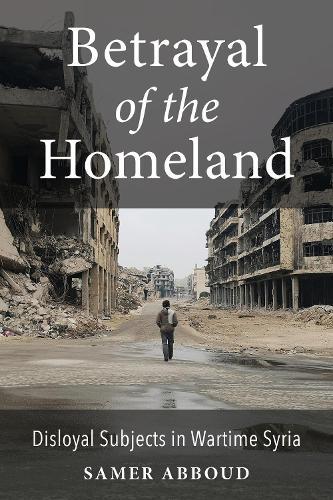
The Syrian regime endured the uprisings that began in 2011, aided by Russian military intervention in 2015 that changed the trajectory of the conflict and brought more territory under government control, until its eventual collapse in 2024. Over this period, how did the state attempt to manage the conflict away from the battlefield and reestablish control over the population? Samer Abboud argues that the Syrian regime sought to entrench its rule during wartime through bifurcating society into ""loyal"" and ""disloyal"" subjects-and punishing those it deemed treacherous. The regime framed the conflict as a war on terror, portraying its opponents as traitors to the homeland. In the post-2015 period, it established new laws, courts, and legal categories that targeted ""betrayal,"" which could include anything from military desertion to absenteeism to critical social media posts. Disloyal subjects were subjected to various forms of punishment and denied reentry into the country if they had been displaced. Bringing together the regime's narratives and rhetoric with the machinery of bureaucratic practices, Abboud traces how the state sculpted the divide between loyalty and disloyalty. Empirically rich and theoretically informed, Betrayal of the Homeland offers a panoramic view of the politics of punishment during the final decade of the Assad regime, with broader implications for understanding how authoritarian states manage conflicts.
Full Product Details
Author: Samer Abboud
Publisher: Columbia University Press
Imprint: Columbia University Press
ISBN: 9780231215329
ISBN 10: 0231215320
Pages: 264
Publication Date: 24 March 2026
Audience:
College/higher education
,
Postgraduate, Research & Scholarly
Format: Hardback
Publisher's Status: Active
Availability: Awaiting stock

The supplier is currently out of stock of this item. It will be ordered for you and placed on backorder. Once it does come back in stock, we will ship it out for you.
Reviews
In Betrayal of the Homeland, Samer Abboud offers a groundbreaking analysis of how the Assad regime transformed warfare into statecraft in Syria. Drawing on his renowned expertise in Syrian politics, Abboud theorizes ‘conflict absorption’ to explain how ‘peace’ was not achieved through reconciliation or democratic transition, but through weaponized legality and the institutionalization of enmity. This book is essential reading for anyone interested in how modern authoritarian regimes sustain illiberal peace through violence—shifting it from the battlefield into bureaucratic, legal, and institutionalized forms of punishment. Only Samer Abboud could have captured this transformation with such depth of knowledge and a profound connection to the Syrian struggle. -- Marwa Daoudy, Georgetown University At a time when many have questions about how the Assad regime persisted and how its legacies might shape the new Syria, this extraordinary book offers vital answers. Advancing scholarship on authoritarian conflict management, illiberal peacebuilding, and repression, Samer Abboud shifts attention from battlefield and carceral violence to pinpoint how states create political order out of conflict through discourses, laws, practices, and institutions that bifurcate society into loyal and disloyal subjects and punish those categorized as disloyal. Betrayal of the Homeland is a must-read for anyone wanting to understand state violence in Syria and beyond. -- Wendy Pearlman, author of <i>The Home I Worked to Make: Voices from the New Syrian Diaspora</i>
In Betrayal of the Homeland, Samer Abboud offers a groundbreaking analysis of how the Assad regime transformed warfare into statecraft, drawing on his renowned expertise in Syrian politics. This book is essential reading for anyone interested in how modern authoritarian regimes sustain illiberal peace through violence—shifting it from the battlefield into bureaucratic, legal, and institutionalized forms of punishment. Only Samer Abboud could have captured this transformation with such depth of knowledge and a profound connection to the Syrian struggle. -- Marwa Daoudy, Georgetown University At a time when many have questions about how the Assad regime persisted and how its legacies might shape the new Syria, this extraordinary book offers vital answers. Advancing scholarship on authoritarian conflict management, illiberal peacebuilding, and repression, Abboud shifts attention from battlefield and carceral violence to pinpoint how states create political order out of conflict through discourses, laws, practices, and institutions. Betrayal of the Homeland is a must-read for anyone wanting to understand state violence in Syria and beyond. -- Wendy Pearlman, author of <i>The Home I Worked to Make: Voices from the New Syrian Diaspora</i>
Author Information
Samer Abboud is associate professor of global interdisciplinary studies and director of the Center for Arab and Islamic Studies at Villanova University. He is the author of Syria (second edition, 2018).