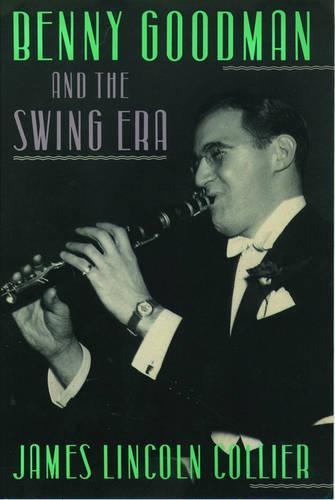
Full Product Details
Author: James Lincoln Collier
Publisher: Oxford University Press
Imprint: Oxford University Press
Dimensions:
Width: 16.30cm
, Height: 3.80cm
, Length: 24.30cm
Weight: 0.844kg
ISBN: 9780195052787
ISBN 10: 0195052781
Pages: 432
Publication Date: 14 June 1990
Audience:
College/higher education
,
Professional and scholarly
,
Undergraduate
,
Postgraduate, Research & Scholarly
Format: Hardback
Publisher's Status: Active
Availability: Manufactured on demand

We will order this item for you from a manufactured on demand supplier.
Reviews
'The author gives a scrupulous account of Goodman's life and character, without indulging in excessive psychological speculation. He also presents an excellent survey of the rise of the big band.' Geoffrey Smith, Country Life 'he has marshalled the available data very diligently ... a commendable work on the Jewish boy from the ghetto who made good' Jim Godbolt, Sunday Telegraph 'his book leaves us with a sharply drawn, far from flattering portrait of the ambitious, totally self-centred clarinettist and band leader ... But Collier paints an enthralling picture of the whole American popular music industry through to the fifties ... Collier is an extremely able social historian ... His ensembles blow as hard as his solos making this book an indispensable companion to the records.' John Ellis, The Guardian 'brilliantly chronicled by James Lincoln Collier in this in-depth study ... With its fine photographs, notes, index and discography, it belongs in every jazz fan's library.' Elaine Ives-Cameron, Jewish Chronicle `Collier... writes wonderfully well' Devon Life 'Even with the benefit of all the diligent research that has made this book so gripping, Collier is unable to explain why Goodman could be so uniquely nasty ... a disturbing and revealing account of one of the most paradoxical lives in jazz.' Jazz FM 'authoritative study ... The author gives a scrupulous account of Goodman's life and character, without indulging in excessive psychological speculation. He also presents an excellent survey of the rise of the big band.' Geoffrey Smith, Country Life 'this is a substantial and recommendable read' Wire Monthly 'Collier's probing of Goodman's personality and his assessment of the music it created is superior to his earlier studies of Duke Ellington and Louis Armstrong.' Times Literary Supplement 'the book gives a new and fascinating insight into Goodman's particular style of leadership and discipline ... This is, without a doubt, the most in-depth analysis of any band leader ... that you are ever likely to read.' Tony Parker, Oldham Evening Chronicle 'the most reliable of Collier's three jazz biographies' Jazztimes, November 1991 'Collier's book amplifies very extensively Goodman's autobiography, The Kingdom of Swing.' Times Literary Supplement
Noted jazz critic Collier adds to his impressive production of biographies (Louis Armstrong: An American Genius; Duke Ellington) with this study of legendary clarinetist Benny Goodman, which includes as well a portrait of the swing era. While this is as complete a bio of Goodman as we are likely to see, the author often punctuates his story with mini portraits of various musical influences (Dixieland, the big band, be-bop) and personal influences on Goodman (Ted Lewis, Doc Berendsohn, Jimmie Noone, Jimmy Dorsey, Pee Wee Russell, Fud Livingston, Jimmy Lytell, Volly DeFault, Don Murray), as well as of important fugures in the creation of the modern dance orchestra (Art Hickman, Ferder Grofe, Paul Whiteman). Collier takes the story back to Goodman's origins as the son of a poor Jewish immigrant family in Chicago, seeing a major influence in Goodman's observing his admired father laboring hard at debilitating and demeaning work. He thus grew up determined to rescue himself and his father (who, nevertheless, died young). Goodman's parents made the propitious choice of clarinet for young Benny, and by the time he was 15, he had so taken to the instrument that he was outearning his father and all of his older brothers. Collier also chronicles and provides critiques of most of Goodman's recordings and concerts (including the famous January 1938 Carnegie Hall concert that brought modern jazz to that hallowed hall for the first time: Goodman's initial reaction to the idea was, Are you out of your mind? What the hell would we do there? ). Meanwhile, Collier makes no bones about the fact that he considers big-band swing music to be the finest kind of popular music we have seen in centuries, a contention that, in itself, elevates Goodman to the highest ranks of popular icons in America. A fine addition to musical autobiography, more studied than Stanley Baron's Benny: King of Swing (1979) and obviously more complete than Goodman's half-century-old The Kingdom of Swing. (Kirkus Reviews)
'The author gives a scrupulous account of Goodman's life and character, without indulging in excessive psychological speculation. He also presents an excellent survey of the rise of the big band.' Geoffrey Smith, Country Life 'he has marshalled the available data very diligently ... a commendable work on the Jewish boy from the ghetto who made good' Jim Godbolt, Sunday Telegraph 'his book leaves us with a sharply drawn, far from flattering portrait of the ambitious, totally self-centred clarinettist and band leader ... But Collier paints an enthralling picture of the whole American popular music industry through to the fifties ... Collier is an extremely able social historian ... His ensembles blow as hard as his solos making this book an indispensable companion to the records.' John Ellis, The Guardian 'brilliantly chronicled by James Lincoln Collier in this in-depth study ... With its fine photographs, notes, index and discography, it belongs in every jazz fan's library.' Elaine Ives-Cameron, Jewish Chronicle 'Collier... writes wonderfully well' Devon Life 'Even with the benefit of all the diligent research that has made this book so gripping, Collier is unable to explain why Goodman could be so uniquely nasty ... a disturbing and revealing account of one of the most paradoxical lives in jazz.' Jazz FM 'authoritative study ... The author gives a scrupulous account of Goodman's life and character, without indulging in excessive psychological speculation. He also presents an excellent survey of the rise of the big band.' Geoffrey Smith, Country Life 'this is a substantial and recommendable read' Wire Monthly 'Collier's probing of Goodman's personality and his assessment of the music it created is superior to his earlier studies of Duke Ellington and Louis Armstrong.' Times Literary Supplement 'the book gives a new and fascinating insight into Goodman's particular style of leadership and discipline ... This is, without a doubt, the most in-depth analysis of any band leader ... that you are ever likely to read.' Tony Parker, Oldham Evening Chronicle 'the most reliable of Collier's three jazz biographies' Jazztimes, November 1991 'Collier's book amplifies very extensively Goodman's autobiography, The Kingdom of Swing.' Times Literary Supplement
Author Information
Author of Louis Armstrong (OUP USA 1983) and Duke Ellington (OUP USA 1987).