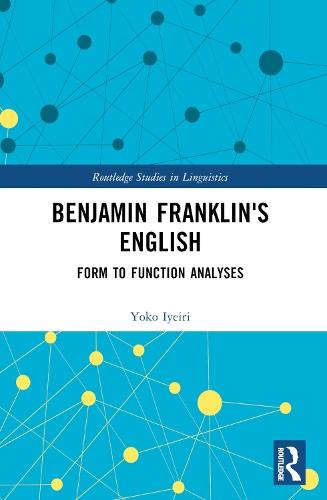
Benjamin Franklin's English: Form to Function Analyses

Author:   Yoko Iyeiri (Kyoto University, Japan)
Publisher:   Taylor & Francis Ltd
ISBN:  

9781032277059


Pages:   240
Publication Date:   21 May 2026
Format:   Paperback
Availability:   Not yet available   Availability explained
This item is yet to be released. You can pre-order this item and we will dispatch it to you upon its release.

Our Price $119.00 Quantity:  
Pre-Order

Share |

Benjamin Franklin's English: Form to Function Analyses


Overview

Full Product Details

Author:   Yoko Iyeiri (Kyoto University, Japan)
Publisher:   Taylor & Francis Ltd
Imprint:   Routledge
ISBN:  

9781032277059


ISBN 10:   103227705
Pages:   240
Publication Date:   21 May 2026
Audience:   College/higher education ,  Tertiary & Higher Education
Format:   Paperback
Publisher's Status:   Forthcoming
Availability:   Not yet available   Availability explained
This item is yet to be released. You can pre-order this item and we will dispatch it to you upon its release.

Table of Contents

Preface and Acknowledgements List of Tables and Figures Abbreviations 1. Introduction 1.1. The aim of this study 1.2. Why a single person’s English? 1.3. Form-to-function approach and corpus linguistics 1.4. Benjamin Franklin Corpus and some additional comments 2. Form-to-Function Approach 1: Historical Sociolinguistic Perspectives 2.1. Introductory remarks 2.1.1. General 2.1.2. Negation in the BF Corpus: A case study 2.2. Become 2.2.1. The frequency of become 2.2.2. The perfect of become 2.2.3. Become in the pseudo passive construction 2.3. Behalf 2.3.1. In behalf of vs. on behalf of 2.4. Choose 2.4.1 The conditional use of choose 2.4.2. Some other aspects of choose 2.5. Come 2.5.1. Come and its progressive forms 2.5.2. The perfect of come 2.5.3. Come and its collocation 2.6. Fall 2.6.1. The frequency of the verb fall and its usage 2.6.2. The perfect of fall 2.7. Fear 2.7.1. The frequency of the verb fear and its first-person use 2.7.2. The complementation of the verb fear and its parenthetical use 2.7.3. The noun fear 2.8. Forget 2.8.1. The past participle forms of forget 2.8.2. If I forget not 2.8.3. Forget and its subject 2.8.4. Forget and its complementation 2.9. Go 2.9.1. Go and its progressive forms 2.9.2. The perfect of go 2.9.3. Go and its collocation 2.10. Like 2.10.1. The verb like 2.10.2. Like as a hedge 2.10.3. Like vs. likely 2.11. Methinks 2.11.1. Methinks as a fossilized lexical item 2.12. Please 2.12.1. The pragmatic use of please 2.12.2. Please and its transitivity 2.13. Pray 2.13.1. The pragmatic use of pray 2.13.2. The verb pray followed by that-clauses and to-infinitives 2.14. Remember 2.14.1. Remember and its collocation 2.14.2. Discoursal nature of remember 2.14.3. Remember and its complementation 2.15. Show 2.15.1. Show vs. Shew 2.15.2. Show and the double-object construction 2.16. Think 2.16.1. Think and the first and second persons 2.16.2. The comment clause I think 2.17. Work 2.17.1. The preterite and past participle forms of work 2.18. Write 2.18.1. The preterite and past participle forms of write 2.18.2. I wrote a few lines to you, or the dative object construction 3. Form-to-Function Approach 2: Synchronic and Diachronic Perspectives 3.1. Introductory remarks 3.2. Arrive 3.2.1. The perfect of arrive 3.2.2. Arrive and adverbs 3.3. Avoid 3.3.1. Avoid -ing 3.4. Dare 3.4.1. The status of dare and its use in comment clauses 3.5. Doubt 3.5.1. The verb doubt and its complementation 3.5.2. The noun doubt and its complementation 3.5.3. Doubt and author orientation 3.6. Drink 3.6.1. Drank and drunk 3.6.2. Drink and its objects 3.7. Exceedingly 3.7.1. Exceeding vs. exceedingly 3.8. Forbear 3.8.1. Forbear and its complementation 3.9. Forbid 3.9.1. The past participle forms of forbid 3.9.2. Forbid and its complementation 3.10. Grow 3.10.1. Grow and some syntactic features 3.10.2. Grow with animate and inanimate subjects 3.11. Help 3.11.1. Help and its complementation 3.11.2. Cannot help -ing 3.12. Need 3.12.1. The status of need 3.12.2. Other related expressions 3.13. Return 3.13.1. The perfect of return 3.13.2. The verb return and adverbs 3.14. Scarce 3.14.1. Scarce vs. scarcely 3.14.2. Scarce, scarcely and their collocation 3.15. Speak 3.15.1. The past participle forms of speak 3.15.2. Bespeak, an etymologically related verb 3.16. Street 3.16.1. In the street vs. on the street 3.17. Suffer 3.17.1. Transitive and intransitive uses of suffer 3.17.2. Suffer plus to-infinitive 4. Discussion and Conclusion 4.1. About this chapter 4.2 Discussion from functional perspectives 4.2.1. Morphological and orthographic variation 4.2.2. Auxiliaries vs. lexical verbs 4.2.3. Progressive forms 4.2.4. Be-perfect vs. have-perfect 4.2.5. Passive 4.2.6. The double-object construction 4.2.7. Complementation 4.2.8. Adverbs 4.2.9. Choice of prepositions 4.2.10. Comment clauses and author orientation 4.2.11. Politeness expressions and others 4.3. Concluding remarks 4.3.1. Benjamin Franklin’s English 4.3.2. On the form-to-function approach References Electronic resources Bibliography Appendix List of Letters Index

Reviews

Author Information

Yoko Iyeiri is Professor of English Language at Kyoto University. Her research interests are in the history of English. Her publications include Negative Constructions in Middle English (Kyushu University Press, 2001) and Verbs of Implicit Negation and their Complements in the History of English (John Benjamins, 2010).

Tab Content 6

Author Website:  

Countries Available

All regions
Latest Reading Guide

April RG 26_2


Shopping Cart
Your cart is empty
Shopping cart
Mailing List