|
|
|||
|
||||
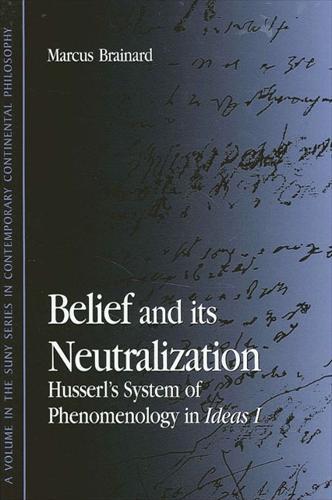
OverviewFull Product DetailsAuthor: Marcus BrainardPublisher: State University of New York Press Imprint: State University of New York Press Dimensions: Width: 15.20cm , Height: 2.50cm , Length: 22.90cm Weight: 0.463kg ISBN: 9780791452202ISBN 10: 0791452204 Pages: 349 Publication Date: 13 February 2002 Audience: College/higher education , General/trade , Undergraduate , Postgraduate, Research & Scholarly Format: Paperback Publisher's Status: Active Availability: Out of stock The supplier is temporarily out of stock of this item. It will be ordered for you on backorder and shipped when it becomes available. Table of ContentsPreface I. Introduction: The Task of Thinking 1. The Idea of Phenomenology 1.1 The Crises, its Source and Dimensions 1.2 Natural Order and Critique 1.3 Systems and Norms 1.4 Ethos, Ought, Teleology 2. The System of Husserlian Phenomenology: Ideas I 2.1 Polarities 2.2 The Order of Critique 2.3 The Whole and its Parts II. Phenomenological Propaedeutics 1. Logical Considerations: Facts and Essence 1.1 The Realm of the Natural 1.2 Individual and Essence, Possibility and Necessity 1.3 Factual and Eidetic Sciences 2. Between Scylla and Charybdis: The Principle of All Principles 2.1 Phenomenology and Philosophy 2.2 Empiricism, Naturalism, Skepticism 2.3 Idealism 2.4 The Blindness of Theory 2.5 The First Principle 2.6 Dogmatism 3. The Epoche and the Phenomenological Reductions 3.1 The Attitudes of Consciousness 3.2 The General Thesis 3.3 The Instrumentalization of Cartesian Doubt 3.4 The Attitudinal Leap 3.5 The Family of Reductions 3.6 The Primacy of the Universal Epoche 4. The Field of Phenomenological Research: Pure Consciousness 4.1 The Phenomenological Residuum 4.2 The Modifiability of Consciousness I: Actionality and Inactionality 4.3 The Modifiability of Consciousness II: Intentionality 4.4 Immanent and Transcendent Perception 4.5 Consciousness and the Natural World 4.6 Merely Phenomenal and Absolute Being 4.7 The Destruction of Transcendence 4.8 The Annihilation of the World 4.9 From the Natural to the Phenomenological Sphere III. The Disclosure of the System's Lowermost Limit: Subjectivity 1. The Science of Phenomenology 1.1 The FIrst Negative Account: Phenomenological Method and its Dissenters 1.2 The First Positive Account: The Aim and Method of Phenomenology 1.3 The Second Negative and Positive Accounts: Intuition and First Science 2. First Categories: The Archimedean Point and its Other 2.1 Phenomenology as Rigorous Science 2.2 The Pure Ego and its Lived Experience 2.3 Intentionality and Constitution 3. The Noetic-Noematic Correlation: Towards the Basis of Conscious Life 3.1 The Functionality of Intentional Reference 3.2 The Discovery of the Noema 3.3 The Modifiability of Consciousness 3.4 Belief-and Being-Characteristics 4. The Doctrine of the Neutrality Modification 4.1 The Epoche and the Neutrality Modification 4.2 Neutrality and Reason 4.3 Supposing and Neutrality 4.4 Fantasy and the Neutrality Modification 4.5 Fantasy, Aesthetic Consciousness, and the Neutrality Modification 4.6 The Abyss between Positional and Neutral Consciousness 4.7 The Levels of Consciousness 4.8 Detours and Direct Routes: The Universality of the Neutrality Modification 4.9 The Transition to the Logical and its Obstruction 5. The Realm of Logos 5.1 Higher Level Features of Consciousness: Synthetic Consciousness 5.2 Positional and Neutral Syntheses 5.3 The Expression of Syntheses 5.4 The Directions of Synthesis 5.5 The Logical Strata 5.6 Expression, Judgment, Belief IV. Towards the System's Uppermost Limit: Reason 1. The Referentiality of the Noema 2. The Verdict of Reason 2.1 The Nature of Reason 2.2 Forms of Rational Consciousness and Evidence 2.3 Hierarchies of Belief, Reason, Evidence, and Truth 2.4 The Animating Force of the Originary, Immediate, Direct 2.5 Being and Thinking 2.6 The Prescriptive Function of Essence 2.7 Belief and Normality 2.8 Phenomenology and the Acquisition of the World 3. Towards Absolute Reason V. Conclusion: The Phenomenological Movement Postscript Notes Bibliography Index of NamesReviews"""This book articulates Husserl's phenomenological system within the context of its guiding intentions. The result is an overpowering work of scholarship, allowing it to be unquestionably ranked as the best discussion on Husserl's Ideas I, now or in the foreseeable future."" - Burt C. Hopkins, editor of Husserl in Contemporary Context: Prospects and Projects for Phenomenology ""Brainard's achievement is not to have merely written about Husserl, but instead to have let Husserl speak for himself. The author has worked his way into the philosopher's thought so well that he has been able to grasp and discuss the various steps of Husserl's thought from within. To grasp a thinker in this way, the interpreter must himself be animated by a philosophical eros, and Brainard most certainly is."" - Walter Biemel, editor of several volumes of Husserl's collected works (Husserliana)" This book articulates Husserl's phenomenological system within the context of its guiding intentions. The result is an overpowering work of scholarship, allowing it to be unquestionably ranked as the best discussion on Husserl's Ideas I, now or in the foreseeable future. - Burt C. Hopkins, editor of Husserl in Contemporary Context: Prospects and Projects for Phenomenology Brainard's achievement is not to have merely written about Husserl, but instead to have let Husserl speak for himself. The author has worked his way into the philosopher's thought so well that he has been able to grasp and discuss the various steps of Husserl's thought from within. To grasp a thinker in this way, the interpreter must himself be animated by a philosophical eros, and Brainard most certainly is. - Walter Biemel, editor of several volumes of Husserl's collected works (Husserliana) Author InformationMarcus Brainard is Postdoctoral Fellow at the Carl Friedrich von Siemens Foundation in Munich. He edited, translated, and provided the introduction to Heribert Boeder's Seditions: Heidegger and the Limit of Modernity, also published by SUNY Press. Tab Content 6Author Website:Countries AvailableAll regions |
||||