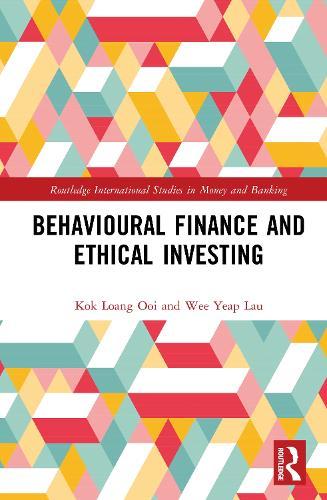
Behavioural Finance and Ethical Investing

Author:   Kok Loang Ooi ,  Wee Yeap Lau ,  Wee Yeap Lau
Publisher:   Taylor & Francis Ltd
ISBN:  

9781041161806


Pages:   208
Publication Date:   04 March 2026
Format:   Hardback
Availability:   Manufactured on demand   Availability explained
We will order this item for you from a manufactured on demand supplier.

Our Price $401.06 Quantity:  
Add to Cart

Share |

Behavioural Finance and Ethical Investing


Overview

Full Product Details

Author:   Kok Loang Ooi ,  Wee Yeap Lau ,  Wee Yeap Lau
Publisher:   Taylor & Francis Ltd
Imprint:   Routledge
Weight:   0.590kg
ISBN:  

9781041161806


ISBN 10:   1041161808
Pages:   208
Publication Date:   04 March 2026
Audience:   College/higher education ,  Tertiary & Higher Education
Format:   Hardback
Publisher's Status:   Active
Availability:   Manufactured on demand   Availability explained
We will order this item for you from a manufactured on demand supplier.

Table of Contents

About the Authors Abstract Funding Preface Acknowledgement CHAPTER 1: RETHINKING ESG: IDEALS, REALITIES, AND BEHAVIORAL VULNERABILITIES · 1.1 Introduction: Deconstructing the ESG Ideal · 1.2 From Rationality to Reflex: Theoretical and Behavioural Grounding · 1.3 ESG in Action: Global Illustrations of Ethical Inconsistency · 1.4 Survey Reflections: What Investors Say vs. What They Do · 1.5 Narrowing the Gap: Policy, Strategy, and Psychological Realism · 1.6 Conclusion: Rethinking ESG through a Behavioral Lens CHAPTER 2: PROFITABILITY VERSUS PRINCIPLE: THE FINANCIAL TRADE-OFFS IN ESG INVESTING · 2.1 Introduction: Rethinking the ESG Payoff · 2.2 Literature and Theory: ESG Returns Through a Behavioral Lens · 2.3 Global Tensions: Ethical Branding and Financial Reality · 2.4 What the Data Shows: ESG Beliefs vs. Investment Actions · 2.5 Closing the Gap: Practical Interventions and Policy Tools · 2.6 Conclusion: Beyond the ESG Narrative CHAPTER 3: THE TRUMP EFFECT AND ESG BACKLASH: POLITICAL RISKS AND MARKET REACTIONS · 3.1 Introduction: Unmasking the Political Vulnerability of ESG · 3.2 When Regulation Reverses: Political Economy and Behavioural Finance · 3.3 Political Shockwaves: ESG Case Studies from the Trump Era · 3.4 Investor Reactions: Survey Evidence on Political Risk Perception · 3.5 Strengthening ESG Resilience in Politicised Markets · 3.6 Conclusion: ESG in an Age of Ideological Volatility CHAPTER 4: CRACKS IN THE INVESTOR LENS: COGNITIVE BIASES IN ESG INVESTMENT · 4.1 Introduction: The Myth of Rational ESG Investing · 4.2 Mapping the Bias Landscape: Theory and Literature · 4.3 Global Patterns of ESG Misjudgment · 4.4 Surveying Bias in Action: Insights from Malaysian Investors · 4.5 Educating the ESG Mindset: Behavioural Solutions · 4.6 Conclusion: Toward a More Rational ESG Investor CHAPTER 5: THE ILLUSION OF GREEN: GREENWASHING, CREDIBILITY RISKS, AND MARKET FAILURES · 5.1 Introduction: Green on the Surface: ESG’s Credibility Crisis · 5.2 Rating Sustainability: Theory and Critiques of ESG Metrics · 5.3 Behind the Green Curtain: Case Examples of Reputational Engineering · 5.4 Insights from the Field: Interviews with Malaysian ESG Professionals · 5.5 Restoring Trust: Institutional and Behavioural Solutions · 5.6 Conclusion: Reclaiming Substance in Sustainable Finance CHAPTER 6: CONFIDENCE GAMES AND HERD INSTINCTS: BEHAVIORAL DISTORTIONS IN SUSTAINABLE MARKETS · 6.1 Introduction: ESG Safety Illusion · 6.2 Theoretical Fault Lines: Overconfidence and Collective Irrationality · 6.3 ESG Boom-Bust Cycles: Global Case Reflections · 6.4 Interview Insights: Herding and Overconfidence in Malaysian ESG Behavior · 6.5 Managing Momentum: Behavioural Risk Controls for ESG Portfolios · 6.6 Conclusion: Rethinking ESG as a Social Signal CHAPTER 7: MALAYSIA’S DUAL ESG FRAMEWORK: INTEGRATING ISLAMIC FINANCE AND SUSTAINABLE INVESTING · 7.1 Introduction: Sustainability Meets Syariah · 7.2 Literature and Theoretical Grounding: Harmonising Ethical Systems · 7.3 Real-World Convergence: Institutional and Policy Innovations in Malaysia · 7.4 Evidence from the Ground: Questionnaire Insights from Malaysian ESG Stakeholders · 7.5 Advancing Dual Integrity: Policy and Behavioral Recommendations · 7.6 Conclusion: A Malaysian Model of ESG Convergence CHAPTER 8: ASIA’S ESG MOMENTUM: GROWTH NARRATIVES AND STRUCTURAL VULNERABILITIES · 8.1 Introduction: The Rise of ESG in Asia · 8.2 Literature and Theory: Asia’s ESG Push Through a Structural Lens · 8.3 Reality Check: Regional Case Studies of ESG Contradictions · 8.5 Rethinking ESG Credibility: Regional Solutions and Behavioural Correctives CHAPTER 9: EUROPE’S ESG LEADERSHIP: REGULATORY INNOVATION AND HIDDEN INEFFICIENCIES · 9.1 Introduction: Reframing Europe’s ESG Reputation · 9.2 Theory Meets Bureaucracy: ESG Regulation in the EU · 9.3 Lost in Translation: Case Examples of ESG Mislabeling and Reclassification · 9.4 Field Reflections: Questionnaire Insights from EU ESG Professionals · 9.5 Reforming the Framework: Making ESG Regulation Work · 9.6 Conclusion: Rethinking ESG Leadership CHAPTER 10: THE UNITED STATES AND ESG: POLITICAL REVERSALS, INVESTOR RESISTANCE, AND MARKET ADAPTATIONS · 10.1 Introduction: ESG’s Politicisation in America · 10.2 Reversals and Repercussions: Unpacking Federal and State-Level ESG Conflicts · 10.3 Realignment in Practice: Case Evidence from Institutional Investors · 10.4 Interviews from the Frontlines: How U.S. ESG Leaders Are Adapting · 10.5 Surveying the Divide: Evidence from ESG Practitioners Nationwide · 10.6 Conclusion: Lessons from Fragmented Markets CHAPTER 11: ESG TECHNOLOGY, INVESTOR JUDGMENT, AND LOCAL ADAPTATION · 11.1 Introduction: Digital Disruption in ESG Investing · 11.2 Algorithmic Oversight: Theoretical Anchors and Behavioural Tensions · 11.3 Embedded or Erased? Case Reflections from Malaysian Fund Managers · 11.4 Quantifying Local Frictions: Survey Insights from ESG Practitioners · 11.5 Conclusion: Tech and Local Insight CHAPTER 12: PLANNING ESG FUTURES: GLOBAL SCENARIOS AND REGIONAL VALUES · 12.1 Introduction: ESG Beyond a Universal Blueprint · 12.2 Worldviews That Matter: Theoretical Foundations and Cultural Anchors · 12.3 Futures as Perceived: Survey Results from Asian ESG Professionals · 12.4 Voices of Vision: Interview Insights from ESG Policymakers and Thought Leaders · 12.5 Competing Horizons: Scenario Mapping and Strategic Differentiation · 12.6 Conclusion: Toward Inclusive ESG Futures

Reviews

Behavioral Finance and Ethical Investing is a simple and helpful book that explains how psychology and human behavior affect the stock market. It helps readers understand why investors often make bad choices and how technology and events across the world affect judgments by integrating research with real-life examples. The book also has useful tips for making better financial decisions and policies. It will be very helpful for students, researchers, and professionals who are keen to learn more about the human side of money. Sevenpri Candra, Professor, BINUS Business School, Indonesia This book makes a compelling case for rethinking classical models in light of empirical evidence on bounded rationality, sentiment, and social influence, making it a essential reference for anyone engaged in financial research or policy design. Lee Kean Yew, Senior Lecturer, Department of Chinese Studies, University of Malaya, Malaysia This book offers a compelling exploration of how psychology, culture, and technology shape financial behaviour across global markets. It provides valuable insights for anyone seeking to understand the forces that influence both market outcomes and organizational decisions, and I highly recommend it to students, academics, and practitioners alike. Nor Fairuz Syazana Nor Fauzi, Deputy Dean of Graduate School, Malaysia The book’s most compelling aspect is its blend of empirical rigour with applied case studies, particularly the insights into the 2015 Chinese stock market crash and Islamic investor sentiment. The strength of this work lies in its wide geographic scope, making it a valuable contribution to the underexplored domain of behavioural finance in emerging and frontier markets. I particularly appreciate the emphasis on investor reactions to shocks such as COVID-19, and the growing influence of Gen Z’s trading behaviour, shaped by influencers. Naveenan R.V, Associate Professor, Christ University, India This book succeeds in translating complex ideas from behavioral finance into clear insights about how emotions, culture, and technology influence investment choices. It is both accessible and rigorous, offering guidance not only for students and researchers but also for policymakers and practitioners who want to better understand the human side of financial markets. Suresh G., Associate Professor, Symbiosis International University, India


Author Information

Kok Loang Ooi, LLM, CMIIA, CIA, is an Adjunct Professor at City University Malaysia and a leading scholar in behavioural finance. He holds a PhD in Behavioural Finance and an MA in Finance from Universiti Sains Malaysia and an LLM in Business Law from the International Islamic University Malaysia. Formerly with KPMG, he has extensive experience in audit and advisory services. His research focuses on herding behaviour, investor sentiment, overreaction, ESG investing, cognitive biases, and AI‑driven financial markets. A Certified Internal Auditor and a member of The Institute of Internal Auditors Malaysia, Dr. Ooi has published over 60 articles in Web of Science and Scopus‑indexed journals and is regularly invited to speak at international academic and policy forums. Wee Yeap Lau is a Professor at the Faculty of Business and Economics and an Academic Board Member of the Asia‑Europe Institute, Universiti Malaya. A former MEXT scholar at Osaka University and AUA Fellow at UAE University, he has also been a Visiting Scholar at the National University of Singapore’s Risk Management Institute. He holds a PhD and an MA in Economics from Osaka University and an MSc in Financial Engineering from NUS, supplemented by executive training at Princeton University. He has published over 70 Web of Science‑indexed articles, authored two books with Palgrave Macmillan, and contributed to professional publications for the Malaysian Insurance Institute and University Press. He is a member of CPA Australia and an elected member of the International Statistical Institute, with research interests in insurance economics, financial engineering, and policy design.

Tab Content 6

Author Website:  

Countries Available

All regions
Latest Reading Guide

MRG 26 2


Shopping Cart
Your cart is empty
Shopping cart
Mailing List