Overview
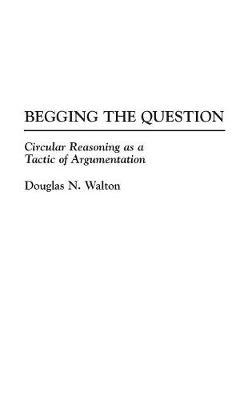
This book offers a new theory of begging the question as an informal fallacy, within a pragmatic framework of reasoned dialogue as a normative theory of critical argumentation. The fallacy of begging the question is analyzed as a systematic tactic to evade fulfillment of a legitimate burden of proof by the proponent of an argument. The technique uses a circular structure of argument to block the further progress of dialogue and, in particular, the capability of the respondent to ask legitimate critical questions in reply to the argument. Walton analyzes the concept of burden of proof in argument, and provides chapters on the use of argument diagramming as a technique of argument reconstruction. This powerful method of argument analysis developed therein is then applied to more than 100 case studies of circular argumentation where the charge of begging the question is or has been thought to be an appropriate criticism. Throughout this work, Walton throws light on the relationship between the problem of circular reasoning and broader issues in the critical analysis of argumentation. Ground-breaking use is made of the pragmatic theory of argument as interactive dialogue. Rules for several kinds of dialogue framework provide standards of good reasoning to validate or to refute the criticism that a particular argument begs the question. This book is directed to students and professionals in the fields of speech communication, philosophy, linguistics, logic, dispute mediation, and education.
Full Product Details
Author: Douglas N. Walton
Publisher: Bloomsbury Publishing Plc
Imprint: Praeger Publishers Inc
Volume: 48
Dimensions:
Width: 15.60cm
, Height: 2.70cm
, Length: 23.50cm
Weight: 0.907kg
ISBN: 9780313275968
ISBN 10: 0313275963
Pages: 360
Publication Date: 18 July 1991
Recommended Age: From 7 to 17 years
Audience:
College/higher education
,
Undergraduate
,
Postgraduate, Research & Scholarly
Format: Hardback
Publisher's Status: Active
Availability: Manufactured on demand

We will order this item for you from a manufactured on demand supplier.
Reviews
This study of a single argumentative fallacy should be of broad interest. Walton, having written extensively on informal logic and the traditional fallacies, is a master of the subject. Begging the question is seemingly one of the simpler fallacies, but one that is quite difficult to pin down. Walton exhibits excellent historical scholarship in tracing the origins of the label begging the question that has been applied to various circular arguments. The discussion of more than 100 examples said to exhibit the fallacy provides a framework for resolving many issues in informal logic. The key to understanding the sense in which apparently circular arguments are fallacious is the context of the dialogue in which the arguments appear. The bibliography surveys a wide range of relevant literature. This work will be of particular interest to those teaching or taking an introductory logic course. It should interest anyone concerned with effective argumentation, which is most everyone. Upper-division undergraduate and graduate collections. -Choice ?This study of a single argumentative fallacy should be of broad interest. Walton, having written extensively on informal logic and the traditional fallacies, is a master of the subject. Begging the question is seemingly one of the simpler fallacies, but one that is quite difficult to pin down. Walton exhibits excellent historical scholarship in tracing the origins of the label begging the question that has been applied to various circular arguments. The discussion of more than 100 examples said to exhibit the fallacy provides a framework for resolving many issues in informal logic. The key to understanding the sense in which apparently circular arguments are fallacious is the context of the dialogue in which the arguments appear. The bibliography surveys a wide range of relevant literature. This work will be of particular interest to those teaching or taking an introductory logic course. It should interest anyone concerned with effective argumentation, which is most everyone. Upper-division undergraduate and graduate collections.?-Choice
?This study of a single argumentative fallacy should be of broad interest. Walton, having written extensively on informal logic and the traditional fallacies, is a master of the subject. Begging the question is seemingly one of the simpler fallacies, but one that is quite difficult to pin down. Walton exhibits excellent historical scholarship in tracing the origins of the label begging the question that has been applied to various circular arguments. The discussion of more than 100 examples said to exhibit the fallacy provides a framework for resolving many issues in informal logic. The key to understanding the sense in which apparently circular arguments are fallacious is the context of the dialogue in which the arguments appear. The bibliography surveys a wide range of relevant literature. This work will be of particular interest to those teaching or taking an introductory logic course. It should interest anyone concerned with effective argumentation, which is most everyone. Upper-division undergraduate and graduate collections.?-Choice
"?This study of a single argumentative fallacy should be of broad interest. Walton, having written extensively on informal logic and the traditional fallacies, is a master of the subject. Begging the question is seemingly one of the simpler fallacies, but one that is quite difficult to pin down. Walton exhibits excellent historical scholarship in tracing the origins of the label ""begging the question"" that has been applied to various circular arguments. The discussion of more than 100 examples said to exhibit the fallacy provides a framework for resolving many issues in informal logic. The key to understanding the sense in which apparently circular arguments are fallacious is the context of the dialogue in which the arguments appear. The bibliography surveys a wide range of relevant literature. This work will be of particular interest to those teaching or taking an introductory logic course. It should interest anyone concerned with effective argumentation, which is most everyone. Upper-division undergraduate and graduate collections.?-Choice ""This study of a single argumentative fallacy should be of broad interest. Walton, having written extensively on informal logic and the traditional fallacies, is a master of the subject. Begging the question is seemingly one of the simpler fallacies, but one that is quite difficult to pin down. Walton exhibits excellent historical scholarship in tracing the origins of the label ""begging the question"" that has been applied to various circular arguments. The discussion of more than 100 examples said to exhibit the fallacy provides a framework for resolving many issues in informal logic. The key to understanding the sense in which apparently circular arguments are fallacious is the context of the dialogue in which the arguments appear. The bibliography surveys a wide range of relevant literature. This work will be of particular interest to those teaching or taking an introductory logic course. It should interest anyone concerned with effective argumentation, which is most everyone. Upper-division undergraduate and graduate collections.""-Choice"
?This study of a single argumentative fallacy should be of broad interest. Walton, having written extensively on informal logic and the traditional fallacies, is a master of the subject. Begging the question is seemingly one of the simpler fallacies, but one that is quite difficult to pin down. Walton exhibits excellent historical scholarship in tracing the origins of the label begging the question that has been applied to various circular arguments. The discussion of more than 100 examples said to exhibit the fallacy provides a framework for resolving many issues in informal logic. The key to understanding the sense in which apparently circular arguments are fallacious is the context of the dialogue in which the arguments appear. The bibliography surveys a wide range of relevant literature. This work will be of particular interest to those teaching or taking an introductory logic course. It should interest anyone concerned with effective argumentation, which is most everyone. Upper-division undergraduate and graduate collections.?-Choice This study of a single argumentative fallacy should be of broad interest. Walton, having written extensively on informal logic and the traditional fallacies, is a master of the subject. Begging the question is seemingly one of the simpler fallacies, but one that is quite difficult to pin down. Walton exhibits excellent historical scholarship in tracing the origins of the label begging the question that has been applied to various circular arguments. The discussion of more than 100 examples said to exhibit the fallacy provides a framework for resolving many issues in informal logic. The key to understanding the sense in which apparently circular arguments are fallacious is the context of the dialogue in which the arguments appear. The bibliography surveys a wide range of relevant literature. This work will be of particular interest to those teaching or taking an introductory logic course. It should interest anyone concerned with effective argumentation, which is most everyone. Upper-division undergraduate and graduate collections. -Choice
Author Information
DOUGLAS N. WALTON is Professor of Philosophy at the University of Winnipeg and Fellow-in-Residence of the Netherlands Institute of Advanced Study. He is the author of numerous works on informal logic and argumentation, including Informal Fallacies formal Logic actical Reasoning and Question-Reply Argumentation (Greenwood Press, 1989).