Overview
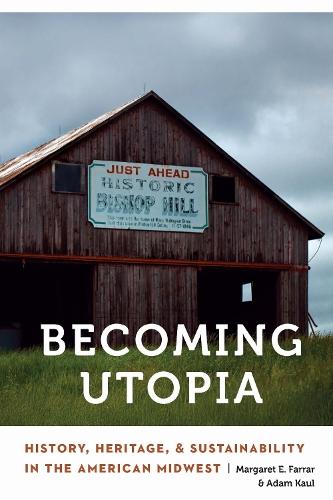
Becoming Utopia centers on the tiny community of Bishop Hill, Illinois, whose marketing materials call it ""Utopia on the Prairie,"" home to a radical communal religious sect that emigrated from Sweden in the 1840s. Through rich textual and ethnographic analyses, Margaret E. Farrar and Adam Kaul tell the story of what happens when a small, historically significant Midwestern community negotiates the contradictory impulses of twenty-first-century place-making. At first glance, Bishop Hill is simply a small heritage tourism destination in Midwestern flyover country, but further inspection reveals it to be a complex place that mixes a deep nostalgia for the past undercut by complex origin stories of displacement and colonialism, an active historic preservation movement amid futuristic green energy technologies built by multinational corporations, and a commitment to localism in the context of omnipresent globalization. Based on fifteen years of fieldwork, Becoming Utopia is an interdisciplinary contribution to conversations about the importance and meaning of place-making, heritage-making, and sustainability (social, economic, and environmental) in the twenty-first century.
Full Product Details
Author: Margaret E. Farrar ,
Adam Kaul
Publisher: University of Nebraska Press
Imprint: University of Nebraska Press
ISBN: 9781496243515
ISBN 10: 149624351
Pages: 256
Publication Date: 01 July 2026
Audience:
Professional and scholarly
,
Professional & Vocational
Format: Hardback
Publisher's Status: Active
Availability: Not yet available

This item is yet to be released. You can pre-order this item and we will dispatch it to you upon its release.
Reviews
""Heritage politics and environmental politics, both of which are active agents in the Bishop Hill community's ability to sustain itself, are also subjects of broader interest in twenty-first-century America. Within political science and anthropology, Becoming Utopia provides an excellent case study for how heritage and environmental decision-making play out at the local level.""--Jennifer Eastman Attebery, author of As Legend Has It: History, Heritage, and the Construction of Swedish American Identity ""Why do some places become important to us? And what (and who) has to be devalued for them to accrue certain kinds of personal, historical, and economic values over time? Becoming Utopia answers these questions through a unique dialogue between American studies; rural anthropology; studies of place, landscape, and cultural meaning; critiques of settler colonialism and constructions of whiteness; and recent and ongoing critiques of cultural heritage and tourist industries around the world. It offers an invaluable contribution to each of these in turn, all while remaining empirically sound and carefully researched.""--Joshua O. Reno, coauthor of Imagining the Heartland: White Supremacy and the American Midwest
""Heritage politics and environmental politics, both of which are active agents in the Bishop Hill community's ability to sustain itself, are also subjects of broader interest in twenty-first-century America. Within political science and anthropology, Becoming Utopia provides an excellent case study for how heritage and environmental decision-making play out at the local level.""—Jennifer Eastman Attebery, author of As Legend Has It: History, Heritage, and the Construction of Swedish American Identity ""Why do some places become important to us? And what (and who) has to be devalued for them to accrue certain kinds of personal, historical, and economic values over time? Becoming Utopia answers these questions through a unique dialogue between American studies; rural anthropology; studies of place, landscape, and cultural meaning; critiques of settler colonialism and constructions of whiteness; and recent and ongoing critiques of cultural heritage and tourist industries around the world. It offers an invaluable contribution to each of these in turn, all while remaining empirically sound and carefully researched.""—Joshua O. Reno, coauthor of Imagining the Heartland: White Supremacy and the American Midwest
Author Information
Margaret E. Farrar is a professor of political science at John Carroll University. She is the author of Building the Body Politic: Power and Urban Space in Washington, D.C. Adam Kaul is a professor of anthropology at Augustana College. He is the author of Turning the Tune: Traditional Music, Tourism, and Social Change in an Irish Village.