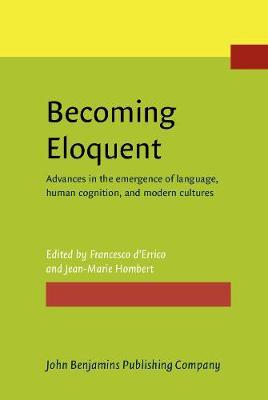
Becoming Eloquent: Advances in the emergence of language, human cognition, and modern cultures

Author:   Francesco d'Errico (CNRS & Université Bordeaux 1) ,  Jean-Marie Hombert (CNRS & Institut des Sciences de l'Homme)
Publisher:   John Benjamins Publishing Co
ISBN:  

9789027232694


Pages:   289
Publication Date:   17 December 2009
Format:   Hardback
Availability:   Available To Order   Availability explained
We have confirmation that this item is in stock with the supplier. It will be ordered in for you and dispatched immediately.

Our Price $163.01 Quantity:  
Add to Cart

Share |

Becoming Eloquent: Advances in the emergence of language, human cognition, and modern cultures


Overview

Few topics of scientific enquiry have attracted more attention in the last decade than the origin and evolution of language. Few have offered an equivalent intellectual challenge for interdisciplinary collaborations between linguistics, cognitive science, prehistoric archaeology, palaeoanthropology, genetics, neurophysiology, computer science and robotics. The contributions presented in this volume reflect the multiplicity of interests and research strategy used to tackle this complex issue, summarize new relevant data and emerging theories, provide an updated view of this interdisciplinary venture, and, when possible, seek a future in this broad field of study.

Full Product Details

Author:   Francesco d'Errico (CNRS & Université Bordeaux 1) ,  Jean-Marie Hombert (CNRS & Institut des Sciences de l'Homme)
Publisher:   John Benjamins Publishing Co
Imprint:   John Benjamins Publishing Co
Weight:   0.675kg
ISBN:  

9789027232694


ISBN 10:   9027232695
Pages:   289
Publication Date:   17 December 2009
Audience:   Professional and scholarly ,  Professional & Vocational
Format:   Hardback
Publisher's Status:   Active
Availability:   Available To Order   Availability explained
We have confirmation that this item is in stock with the supplier. It will be ordered in for you and dispatched immediately.

Table of Contents

1. Introduction (by Hombert, Jean-Marie); 2. Language and archaeology; 3. From the origin of language to the diversification of languages: What can archaeology and palaeoanthropology say? (by d'Errico, Francesco); 4. Early diffusion of domestic bovids in Europe: An indicator for human contacts, exchanges and migrations? (by Tresset, Anne); 5. Language and genes; 6. Linguistic, cultural and genetic perspectives on human diversity in west-central Africa (by Veen, Lolke van der); 7. The Berber and the Berbers: Genetic and linguistic diversities (by Dugoujon, Jean-Michel); 8. East meets West: The Assam corridor (by Jacquesson, Francois); 9. Genetic and linguistic diversity in Central Asia (by Heyer, Evelyne); 10. Genetic and linguistic borders in the Himalayan Region (by Kraaijenbrink, Thirsa); 11. Language acquisition and language universals; 12. From babbling to first words in four languages: Common trends across languages and individual differences (by Kern, Sophie); 13. Language and animal communication; 14. The primate roots of human language: Primate vocal behaviour and cognition in the wild (by Zuberbuhler, Klaus); 15. Language evolution and computer modeling; 16. Can agent-based language evolution contribute to archeology? (by Steels, Luc); 17. Index

Reviews

This is an extremely sophisticated example of cooperative research. With such an interdisciplinary approach to language origins and diffusion, the field is bound to make progress understanding these and related issues. The scale of comparisons and syntheses, alone, are bound to result in new ways of thinking about language among Neandertals, and even earlier species, and modern humans. -- Lewis Binford, Emeritus University Professor, University of New Mexico


Author Information

Tab Content 6

Author Website:  

Countries Available

All regions
Latest Reading Guide

NOV RG 20252


Shopping Cart
Your cart is empty
Shopping cart
Mailing List