Overview
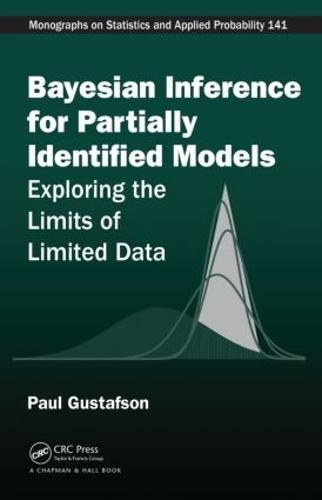
Bayesian Inference for Partially Identified Models: Exploring the Limits of Limited Data shows how the Bayesian approach to inference is applicable to partially identified models (PIMs) and examines the performance of Bayesian procedures in partially identified contexts. Drawing on his many years of research in this area, the author presents a thorough overview of the statistical theory, properties, and applications of PIMs. The book first describes how reparameterization can assist in computing posterior quantities and providing insight into the properties of Bayesian estimators. It next compares partial identification and model misspecification, discussing which is the lesser of the two evils. The author then works through PIM examples in depth, examining the ramifications of partial identification in terms of how inferences change and the extent to which they sharpen as more data accumulate. He also explains how to characterize the value of information obtained from data in a partially identified context and explores some recent applications of PIMs. In the final chapter, the author shares his thoughts on the past and present state of research on partial identification. This book helps readers understand how to use Bayesian methods for analyzing PIMs. Readers will recognize under what circumstances a posterior distribution on a target parameter will be usefully narrow versus uselessly wide.
Full Product Details
Author: Paul Gustafson (University of British Columbia, Vancouver, Canada)
Publisher: Taylor & Francis Inc
Imprint: Chapman & Hall/CRC
Volume: 140
Dimensions:
Width: 15.60cm
, Height: 1.50cm
, Length: 23.40cm
Weight: 0.408kg
ISBN: 9781439869390
ISBN 10: 1439869391
Pages: 196
Publication Date: 01 April 2015
Audience:
College/higher education
,
General/trade
,
Tertiary & Higher Education
,
General
Format: Hardback
Publisher's Status: Active
Availability: In Print

This item will be ordered in for you from one of our suppliers. Upon receipt, we will promptly dispatch it out to you. For in store availability, please contact us.
Reviews
... In this little gem of a monograph, Paul Gustafson ... argues that partially identified models should not be so quickly dismissed. ... Gustafson has drawn together many discussions of identifiability from previous Bayesian analyses (including his own), which are not widely known in non-Bayesian circles. The writing is concise. The examples are simple and insightful. The reader need not be a Bayesian to appreciate this fine monograph. -Dale J. Poirier, University of California, Irvine, in Journal of the American Statistical Association, January 2017
... In this little gem of a monograph, Paul Gustafson ... argues that partially identified models should not be so quickly dismissed. ... Gustafson has drawn together many discussions of identifiability from previous Bayesian analyses (including his own), which are not widely known in non-Bayesian circles. The writing is concise. The examples are simple and insightful. The reader need not be a Bayesian to appreciate this fine monograph. -Dale J. Poirier, University of California, Irvine, in Journal of the American Statistical Association, January 2017
Author Information
Paul Gustafson is a professor in the Department of Statistics at the University of British Columbia. He is the statistics editor for Epidemiology as well as an associate editor for the Journal of the American Statistical Association (Applications and Case Studies Section) and Statistics in Medicine. His current research focuses on identification issues in Bayesian analysis.