|
|
|||
|
||||
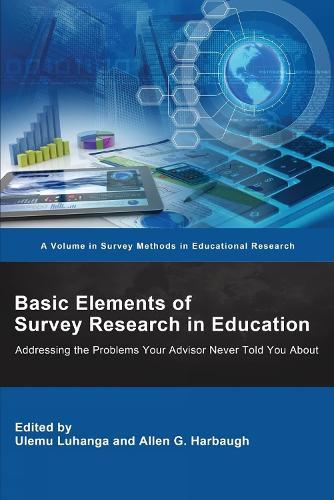
OverviewIn this first book of the series Survey Methods in Educational Research, we have brought together leading authors and scholars in the field to discuss key introductory concepts in the creation, implementation, evaluation and dissemination of survey instruments and their resultant findings. While there are other textbooks that might introduce these concepts adequately well, the authors here have focused on the pragmatic issues that inevitably arise in the development and administration process of survey instruments. Drawing from their rich experiences, the authors present these potential speed bumps or road blocks a survey researcher in education or the social sciences might encounter. Referencing their own work and practice, the authors provide valuable suggestions for dealing with these issues “your advisor never told you about.” And all of the recommendations are aligned with standard protocols and current research on best practices in the field of research methodology. This book is broken into four broad units on creating survey items and instruments, administering surveys, analyzing the data from surveys, and stories of successful administrations modeling the entire research cycle. Each chapter focuses on a different concept in the survey research process, and the authors share their approaches to addressing the issues. These topics include survey item construction, scale development, cognitive interviewing, measuring change with self-report data, translation issues with surveys administered in multiple languages, working with school and program administrators when implementing surveys, a review of current software used in survey research, the use of weights, response styles, assessing validity of results, and effectively communicating your results and findings … and much more. The intended audience of the volume will be practitioners, administrators, teachers as researchers, graduate students, social science and education researchers not experienced in survey research, and students learning program evaluation. In brief, if you are considering doing survey research, this book is meant for you. Full Product DetailsAuthor: Ulemu Luhanga , Allen G. HarbaughPublisher: Emerald Publishing Inc Imprint: Information Age Publishing Dimensions: Width: 15.60cm , Height: 4.30cm , Length: 23.40cm Weight: 1.320kg ISBN: 9781648026034ISBN 10: 1648026036 Pages: 824 Publication Date: 14 September 2021 Audience: Professional and scholarly , Professional & Vocational Format: Hardback Publisher's Status: Active Availability: Manufactured on demand We will order this item for you from a manufactured on demand supplier. Table of ContentsThe Psychological and Statistical Take on Survey Item Construction Subjective Nuances of the Objective Survey Research and Scale Development Survey and Question Construction Creating a Structurally Sound Instrument by Utilizing Principles of Measurement Theory How to Effectively Communicate With Respondents: Principles of Survey Design Cognitive Interview for Survey Development and Validation Methods and Biases in Measuring Change With Self-Reports Translation of Surveys for International Research Using a Measurement Framework to Examine Item Quality/Functioning It's All About Power: Sample Size Considerations for Comparative Studies Using Survey Data Cognitive Interviewing and Pilot Studies Implementing Your Sampling Strategy in an Educational Setting High-Impact Practices: Administrators and Providers Working to Maximize Online Survey Response Rates A Critical Analysis of Most Popular Online Survey Software From a Design Perspective Cleaning and Reporting Complex Survey Data: What to Do About Skip Logic and Conditional Response Options Item Review Methods The Prevention and Detection of Deception in Self-Report Survey Data Calculating and Using Weights Effectively Communicating Survey Results Survey Extreme Response Style Validity Arguments With Survey Scales Detecting and Interpreting Response Bias and Method Effects Enhancing the Interpretation of Scores Through Rasch/Guttman Scenario Scales Validating the Findings of a Survey Research Study Educational Applications Using Large-Scale Assessment and Survey Data: Challenges and Opportunities Translating and Adapting Survey Instruments: Important Steps That Will Define the Quality and Optimize the Validity of a Research Instrument About the Editors and AuthorsReviewsAuthor InformationTab Content 6Author Website:Countries AvailableAll regions |
||||