Overview
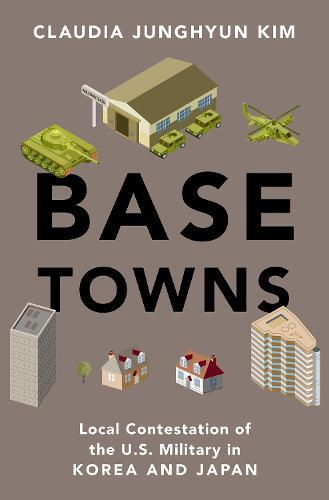
When do we see social movements mobilize against the American military overseas, and what explains their varying intensity? Despite increasing interest in the vast network of U.S. military bases on foreign soil, it is still not well understood why some host communities resist the bases in their backyards, while others remain compliant.In Base Towns, Claudia Junghyun Kim addresses this puzzle by investigating the contentious politics surrounding twenty U.S. military bases across Korea and Japan. In particular, she looks at municipalities hosting these bases and differing levels of community acceptance and resistance over time. Drawing on fieldwork interviews, participant observation, and protest event data from 2000-2015, Kim shows that activists occasionally manage to join hands with the otherwise politically inactive local populations when they deliberately subordinate their radical movement goals to more immediate, mundane demands that form the basis of everyday local grievances. Specifically, the activists in base towns successfully build broad anti-base movements when they take advantage of quotidian disruption, adopt culturally resonant movement frames, and ally with local political elites. These activist strategies, however, sometimes end up reinforcing the widely presumed inevitability of the American presence. In examining activist actions, strategies, and dilemmas, this book sheds light on marginalized actors in domestic and international politics--far removed from elite decision-making processes that shape interstate base politics and yet living with their consequences--who sometimes manage to complicate the operations of America's military behemoth.
Full Product Details
Author: Claudia Junghyun Kim (Assistant Professor, Assistant Professor, City University of Hong Kong)
Publisher: Oxford University Press Inc
Imprint: Oxford University Press Inc
Dimensions:
Width: 23.70cm
, Height: 2.20cm
, Length: 16.20cm
Weight: 0.526kg
ISBN: 9780197665275
ISBN 10: 0197665276
Pages: 248
Publication Date: 14 March 2023
Audience:
Professional and scholarly
,
Professional & Vocational
Format: Hardback
Publisher's Status: Active
Availability: To order

Stock availability from the supplier is unknown. We will order it for you and ship this item to you once it is received by us.
Reviews
Exploring the contentious base politics surrounding the US military presence across the 20 largest individual base locales in Japan and South Korea, Base Towns engages with social movement theory to expand our understanding of the varieties of local base politics. Kim's research is impressive and the mastery of local political nuances and changes in micropolitics is truly commendable, making a significant contribution to the broader field of the politics of US bases. * Alexander Cooley, Claire Tow Professor of Political Science, Barnard College * The United States has more than 500 military bases around the world, and some base towns have accepted these facilities with little dissension while in others their presence has generated open opposition and protest. In this deeply researched, comparative project focused on Korea and Japan, Kim illuminates the factors that lead to open arms in some communities and raised fists in others. Base Towns shows how status quo disruption, framing, and local elites help explain how residents engage with these garrisons. A must read. * Daniel Aldrich, author of Site Fights, Building Resilience, and Black Wave * Base Towns offers a fascinating, in-depth account of local opposition to U.S. military bases in South Korea and Japan. Drawing on extensive ethnographic field research and protest events data, Professor Kim sheds new insights on the microcosm of U.S. overseas bases in the context of local and global politics. The scholarship is first rate and the base town narratives Kim reveals are compelling. * Andrew Yeo, SK-Korea Foundation Chair and senior fellow, Brookings Institution; Professor of Politics, the Catholic University of America; and author of Activists, Alliances, and Anti-Base Protests * Since the end of the Cold War, scholarly interest in the global U.S. military presence has mushroomed. Claudia Kim's Base Towns, focused on Japan and South Korea, makes an important and original contribution to this undertaking. By emphasizing 'the primacy of the local,' Kim argues persuasively that pragmatic considerations take precedence over ideology or international politics in shaping relations between U.S. military garrisons abroad and nearby communities. * Andrew Bacevich, author of On Shedding an Obsolete Past * Claudia Junghyun Kim's history of local opposition to US military bases in Japan and South Korea is meticulously researched and smoothly written. * Steve Rabson, Pacific Affairs: Volume 97 * Base towns advances our knowledge about public opinion and protests against the US military abroad, and offers new directions for future base politics research. * Charmaine N. Willis, Australian Institute of International Affairs * Peace activists are often concerned primarily with the latest military escalation rather than on trying to dismantle the structure of the American empire that enables the forever wars and human carnage associated with them. * Jeremy Kuzmarov, Substack * A strength of Base Towns is its ability to spotlight how and why base communities mobilize against U.S. military bases abroad through the efforts of local actors. Kim reveals a range of stories detailing how some base towns become contestation hotspots while others do not. Kim describes the nuances of base (de)mobilization as they vary in intensity and mobilization over time. This book makes an important contribution bydistinguishing military-base communities as places for (de)mobilization. I hope this work will increase awareness of the grievances of military base communities. * Camila Alvarez, Mobilization *
Exploring the contentious base politics surrounding the US military presence across the 20 largest individual base locales in Japan and South Korea, Base Towns engages with social movement theory to expand our understanding of the varieties of local base politics. Kim's research is impressive and the mastery of local political nuances and changes in micropolitics is truly commendable, making a significant contribution to the broader field of the politics of US bases. * Alexander Cooley, Claire Tow Professor of Political Science, Barnard College * The United States has more than 500 military bases around the world, and some base towns have accepted these facilities with little dissension while in others their presence has generated open opposition and protest. In this deeply researched, comparative project focused on Korea and Japan, Kim illuminates the factors that lead to open arms in some communities and raised fists in others. Base Towns shows how status quo disruption, framing, and local elites help explain how residents engage with these garrisons. A must read. * Daniel Aldrich, author of Site Fights, Building Resilience, and Black Wave * Base Towns offers a fascinating, in-depth account of local opposition to U.S. military bases in South Korea and Japan. Drawing on extensive ethnographic field research and protest events data, Professor Kim sheds new insights on the microcosm of U.S. overseas bases in the context of local and global politics. The scholarship is first rate and the base town narratives Kim reveals are compelling. * Andrew Yeo, SK-Korea Foundation Chair and senior fellow, Brookings Institution; Professor of Politics, the Catholic University of America; and author of Activists, Alliances, and Anti-Base Protests * Since the end of the Cold War, scholarly interest in the global U.S. military presence has mushroomed. Claudia Kim's Base Towns, focused on Japan and South Korea, makes an important and original contribution to this undertaking. By emphasizing 'the primacy of the local,' Kim argues persuasively that pragmatic considerations take precedence over ideology or international politics in shaping relations between U.S. military garrisons abroad and nearby communities. * Andrew Bacevich, author of On Shedding an Obsolete Past *
Since the end of the Cold War, scholarly interest in the global U.S. military presence has mushroomed. Claudia Kim's Base Towns, focused on Japan and South Korea, makes an important and original contribution to this undertaking. By emphasizing 'the primacy of the local,' Kim argues persuasively that pragmatic considerations take precedence over ideology or international politics in shaping relations between U.S. military garrisons abroad and nearby communities. -Andrew Bacevich, author of On Shedding an Obsolete Past: Bidding Farewell to the American Century The United States has more than 500 military bases around the world, and some base towns have accepted these facilities with little dissension while in others their presence has generated open opposition and protest. In this deeply researched, comparative project focused on Korea and Japan, Kim illuminates the factors that lead to open arms in some communities and raised fists in others. Base Towns shows how status quo disruption, framing, and local elites help explain how residents engage with these garrisons. A must read. -Daniel Aldrich, author of Site Fights, Building Resilience, and Black Wave
Exploring the contentious base politics surrounding the US military presence across the 20 largest individual base locales in Japan and South Korea, Base Towns engages with social movement theory to expand our understanding of the varieties of local base politics. Kim's research is impressive and the mastery of local political nuances and changes in micropolitics is truly commendable, making a significant contribution to the broader field of the politics of US bases. * Alexander Cooley, Claire Tow Professor of Political Science, Barnard College * The United States has more than 500 military bases around the world, and some base towns have accepted these facilities with little dissension while in others their presence has generated open opposition and protest. In this deeply researched, comparative project focused on Korea and Japan, Kim illuminates the factors that lead to open arms in some communities and raised fists in others. Base Towns shows how status quo disruption, framing, and local elites help explain how residents engage with these garrisons. A must read. * Daniel Aldrich, author of Site Fights, Building Resilience, and Black Wave * Base Towns offers a fascinating, in-depth account of local opposition to U.S. military bases in South Korea and Japan. Drawing on extensive ethnographic field research and protest events data, Professor Kim sheds new insights on the microcosm of U.S. overseas bases in the context of local and global politics. The scholarship is first rate and the base town narratives Kim reveals are compelling. * Andrew Yeo, SK-Korea Foundation Chair and senior fellow, Brookings Institution; Professor of Politics, the Catholic University of America; and author of Activists, Alliances, and Anti-Base Protests * Since the end of the Cold War, scholarly interest in the global U.S. military presence has mushroomed. Claudia Kim's Base Towns, focused on Japan and South Korea, makes an important and original contribution to this undertaking. By emphasizing 'the primacy of the local,' Kim argues persuasively that pragmatic considerations take precedence over ideology or international politics in shaping relations between U.S. military garrisons abroad and nearby communities. * Andrew Bacevich, author of On Shedding an Obsolete Past * Claudia Junghyun Kim's history of local opposition to US%military bases in Japan and South Korea is meticulously researched and smoothly written. * Steve Rabson, Pacific A!airs: Volume 97 * Base towns advances our knowledge about public opinion and protests against the US military abroad, and offers new directions for future base politics research. * Charmaine N. Willis, Australian Outlook. *
Author Information
Claudia Junghyun Kim is an assistant professor in the Department of Public and International Affairs at City University of Hong Kong. She has written about U.S. military bases overseas, social and transnational movements, global norms, and Korean and Japanese politics. From 2019-2020, she was a postdoctoral fellow at Harvard University's Weatherhead Center for International Affairs, Program on U.S.-Japan Relations.