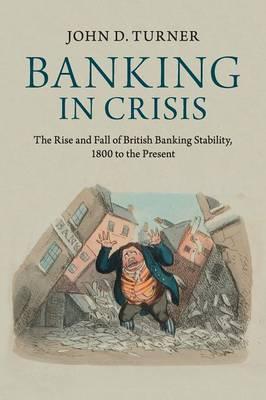
Full Product Details
Author: John D. Turner (Queen's University Belfast)
Publisher: Cambridge University Press
Imprint: Cambridge University Press
Dimensions:
Width: 15.00cm
, Height: 1.00cm
, Length: 22.60cm
Weight: 0.360kg
ISBN: 9781107609860
ISBN 10: 1107609860
Pages: 266
Publication Date: 10 July 2014
Audience:
Professional and scholarly
,
Professional and scholarly
,
Professional & Vocational
,
Professional & Vocational
Format: Paperback
Publisher's Status: Active
Availability: Manufactured on demand

We will order this item for you from a manufactured on demand supplier.
Reviews
'Banking in Crisis combines the very best of serious academic scholarship and keen policy analysis. It should be required reading for anyone - expert and non-expert alike - who is interested in the past, present, and future of British banking.' Richard S. Grossman, Wesleyan University, Connecticut 'What makes for stable banking? Bankers are prone to gamble with depositors's money. What keeps them honest is a personal stake, or tight regulation. Turner shows that since 1825, stability required either the one or the other, and that relaxation of discipline, whatever its advantages, has placed the financial system at risk. The past worked for a long time, and the present doesn't.' Avner Offer, University of Oxford 'John Turner has done the community of banking scholars, regulators and policy makers a great service by writing an account of two centuries of British banking. It is timely, scholarly and most of all highly readable. History, is contextualised in the economic theory of banking making it a must read for students at all levels. Highly recommended.' Kent Matthews, Cardiff University
'Banking in Crisis combines the very best of serious academic scholarship and keen policy analysis. It should be required reading for anyone - expert and non-expert alike - who is interested in the past, present, and future of British banking.' Richard S. Grossman, Wesleyan University, Connecticut 'What makes for stable banking? Bankers are prone to gamble with depositors's money. What keeps them honest is a personal stake, or tight regulation. Turner shows that since 1825, stability required either the one or the other, and that relaxation of discipline, whatever its advantages, has placed the financial system at risk. The past worked for a long time, and the present doesn't.' Avner Offer, University of Oxford 'John Turner has done the community of banking scholars, regulators and policy makers a great service by writing an account of two centuries of British banking. It is timely, scholarly and most of all highly readable … a must-read for students at all levels. Highly recommended.' Kent Matthews, Cardiff University 'This elegant history by John D. Turner of British joint-stock commercial banking spans the period of its birth after the country bank crisis of the 1820s to the moment of its own calamity in 2007–8 … an excellent and stimulating addition to the literature. With so much historical detail in one place, I expect my copy will become well-thumbed.' Duncan Needham, English Historical Review 'In this book, Turner reviews over 200 years of British banking history. He observes that banking, an inherently risky business, enjoyed an extended period of only minor disturbances in Britain between the 1825–6 banking crisis and the 2006–7 financial breakdown. During the intervening period, six disturbances in British banking did occur, but based on data and criteria the author presents, these are judged to have been relatively minor. Turner then seeks to discover the underlying changes in institutional arrangements that account for the stable period and recent widespread financial instability. The book concludes with a recounting of lessons from the past applicable today and proposals for restoring financial stability. Summing up: recommended.' E. L. Whalen, Choice 'Turner has written a timely and admirable book, one that belongs on the shelf (or in the Kindle) of all financial historians, and all policymakers involved in formulating regulations for financial institutions.' Hugh Rockoff, Journal of Economic History
'Banking in Crisis combines the very best of serious academic scholarship and keen policy analysis. It should be required reading for anyone - expert and non-expert alike - who is interested in the past, present, and future of British banking.' Richard S. Grossman, Wesleyan University, Connecticut 'What makes for stable banking? Bankers are prone to gamble with depositors's money. What keeps them honest is a personal stake, or tight regulation. Turner shows that since 1825, stability required either the one or the other, and that relaxation of discipline, whatever its advantages, has placed the financial system at risk. The past worked for a long time, and the present doesn't.' Avner Offer, University of Oxford 'John Turner has done the community of banking scholars, regulators and policy makers a great service by writing an account of two centuries of British banking. It is timely, scholarly and most of all highly readable ... a must-read for students at all levels. Highly recommended.' Kent Matthews, Cardiff University 'This elegant history by John D. Turner of British joint-stock commercial banking spans the period of its birth after the country bank crisis of the 1820s to the moment of its own calamity in 2007-8 ... an excellent and stimulating addition to the literature. With so much historical detail in one place, I expect my copy will become well-thumbed.' Duncan Needham, English Historical Review 'In this book, Turner reviews over 200 years of British banking history. He observes that banking, an inherently risky business, enjoyed an extended period of only minor disturbances in Britain between the 1825-6 banking crisis and the 2006-7 financial breakdown. During the intervening period, six disturbances in British banking did occur, but based on data and criteria the author presents, these are judged to have been relatively minor. Turner then seeks to discover the underlying changes in institutional arrangements that account for the stable period and recent widespread financial instability. The book concludes with a recounting of lessons from the past applicable today and proposals for restoring financial stability. Summing up: recommended.' E. L. Whalen, Choice
'Banking in Crisis combines the very best of serious academic scholarship and keen policy analysis. It should be required reading for anyone - expert and non-expert alike - who is interested in the past, present, and future of British banking.' Richard S. Grossman, Wesleyan University, Connecticut 'What makes for stable banking? Bankers are prone to gamble with depositors's money. What keeps them honest is a personal stake, or tight regulation. Turner shows that since 1825, stability required either the one or the other, and that relaxation of discipline, whatever its advantages, has placed the financial system at risk. The past worked for a long time, and the present doesn't.' Avner Offer, University of Oxford 'John Turner has done the community of banking scholars, regulators and policy makers a great service by writing an account of two centuries of British banking. It is timely, scholarly and most of all highly readable ... a must-read for students at all levels. Highly recommended.' Kent Matthews, Cardiff University 'This elegant history by John D. Turner of British joint-stock commercial banking spans the period of its birth after the country bank crisis of the 1820s to the moment of its own calamity in 2007-8 ... an excellent and stimulating addition to the literature. With so much historical detail in one place, I expect my copy will become well-thumbed.' Duncan Needham, English Historical Review
Author Information
John D. Turner has been a Professor of Finance and Financial History at Queen's University Belfast since 2005. At the time of his appointment to his chair, he was one of the youngest full professors in Queen's University. He is the founder and director of the Queen's University Centre for Economic History. John Turner teaches money, banking and finance to undergraduate and postgraduate students. He is also an active blogger - he writes a blog (www.financelongrun.co.uk), aimed at his students and interested others, which centres on the past, present and future of finance. His research, which has been published in all the leading economic and business history journals, as well as economics journals, is focused on the long-run evolution and development of banking, banking crises, bubbles, corporate law, and financial markets. His research has been funded by the British Academy, Economic and Social Research Council, and the Leverhulme Trust. He has held several distinguished visiting positions during his career - he has been a Houblon–Norman Fellow at the Bank of England and an Alfred D. Chandler Fellow at Harvard Business School.