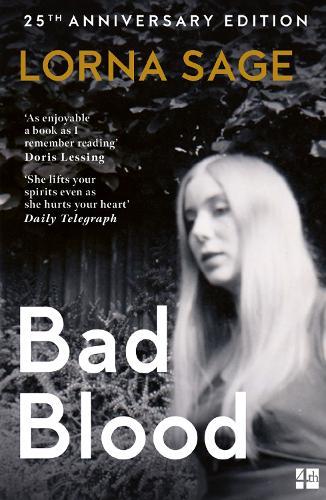
Full Product Details
Author: Lorna Sage
Publisher: HarperCollins Publishers
Imprint: Fourth Estate Ltd
Edition: 20th Anniversary Edition edition
Dimensions:
Width: 12.90cm
, Height: 2.00cm
, Length: 19.80cm
Weight: 0.220kg
ISBN: 9781841150437
ISBN 10: 1841150436
Pages: 288
Publication Date: 02 July 2001
Audience:
General/trade
,
General
Format: Paperback
Publisher's Status: Active
Availability: In Print

This item will be ordered in for you from one of our suppliers. Upon receipt, we will promptly dispatch it out to you. For in store availability, please contact us.
Reviews
'Bad Blood is pretty much in a class of its own! It is a measure of her achievement that she can turn the peculiarities of her own past -- and they are peculiar -- into a narrative that speaks for the whole of post-war Britian! This is not just an exquisite personal memoir, it is a vital piece of our collective past.' Daily Telegraph 'A wonderful book. Women need this kind of book but perhaps men need it more, to give the sort of understanding which we still lack of how girls actually grow up.' Margaret Forster '[a] rich, justly acclaimed autobiography ! this almost perfect memoir is a tribute to imperfection' Independent 'an almost unbearably eloquent memoir ! 'Bad Blood' is also a tale of shared consciousness, and although the lives Sage describes clash with and limit her own, there is much that is redemptive here, and even elegiac' Frances Wilson, Guardian 'This could have been the saddest book you have ever read, but because of Lorna Sage's relish in the details, her exuberant celebration of the vitality of this clever, surviving girl, it is as enjoyable a book as I remember reading.' Doris Lessing 'This could have been the saddest book you have ever read, but because of Lorna Sage's relish in the details, her exuberant celebration of the vitality of this clever, surviving girl, it is as enjoyable a book as I remember reading.' Doris Lessing
'Bad Blood is pretty much in a class of its own! It is a measure of her achievement that she can turn the peculiarities of her own past -- and they are peculiar -- into a narrative that speaks for the whole of post-war Britian! This is not just an exquisite personal memoir, it is a vital piece of our collective past.' Daily Telegraph 'A wonderful book. Women need this kind of book but perhaps men need it more, to give the sort of understanding which we still lack of how girls actually grow up.' Margaret Forster '[a] rich, justly acclaimed autobiography ! this almost perfect memoir is a tribute to imperfection' Independent 'an almost unbearably eloquent memoir ! 'Bad Blood' is also a tale of shared consciousness, and although the lives Sage describes clash with and limit her own, there is much that is redemptive here, and even elegiac' Frances Wilson, Guardian 'This could have been the saddest book you have ever read, but because of Lorna Sage's relish in the details, her exuberant celebration of the vitality of this clever, surviving girl, it is as enjoyable a book as I remember reading.' Doris Lessing
'Bad Blood is pretty much in a class of its own... It is a measure of her achievement that she can turn the peculiarities of her own past - and they are peculiar - into a narrative that speaks for the whole of post-war Britian... This is not just an exquisite personal memoir, it is a vital piece of our collective past.' Daily Telegraph 'A wonderful book. Women need this kind of book but perhaps men need it more, to give the sort of understanding which we still lack of how girls actually grow up.' Margaret Forster '[a] rich, justly acclaimed autobiography ... this almost perfect memoir is a tribute to imperfection' Independent 'an almost unbearably eloquent memoir ... 'Bad Blood' is also a tale of shared consciousness, and although the lives Sage describes clash with and limit her own, there is much that is redemptive here, and even elegiac' Frances Wilson, Guardian 'This could have been the saddest book you have ever read, but because of Lorna Sage's relish in the details, her exuberant celebration of the vitality of this clever, surviving girl, it is as enjoyable a book as I remember reading.' Doris Lessing
Tragicomic winner of the 2000 Whitbread Biography Award, revealing late literary critic Sage's wretched childhood in provincial England during the 1940s and '50s. Born in 1943 while her father was at war in Normandy, Sage was raised in the squalid village of Hanmer. She lived in the dilapidated vicarage with her subservient mother, Valma, and her warring grandparents: a drunken, womanizing clergyman who felt trapped in the wrong career; and his contemptuous wife, who viewed motherhood and marriage as devilish male plots to degrade her and deemed Hanmer a hole full of dirty villagers (though her own grandchildren wore rags and had lice). Sage describes with humor her grandparents' violent battles, from which Valma suffered the most. (Once, running to intervene in one of her parents' murderous rows, she fell down a staircase and lost her front teeth.) Valma yearned to pursue a career outside of home, but after failing her driver's-license test, resigned herself to cooking meat dinners for the family that were dangerously full of knots of choking gristle and shards and spikes of bone. Sage spices up the narrative by prying into her grandfather's scandalous diary, in which he boasts about seducing Valma's friend. Moving on to her teens, the author divulges that her sexual ignorance, promoted by the era's prudery, caused her accidental pregnancy at the age of 16. The sadistic nuns she faced in the delivery room incarnate the misogynist attitudes that prevailed before the resurgence of feminism in the late 1960s. Despite her obstetrician's prediction that she was born only to breed, Sage earned a scholarship to study English at Durham University. By evoking the oppressive atmosphere of an era in which women were often consigned to domestic lots, she reminds us of freedoms that we take for granted. Shockingly frank, but also witty, passionate, and utterly lacking self-pity-and surprisingly uplifting. (Kirkus Reviews)
Though a memoir of a difficult childhood, Lorna Sage's light touch and gentle humour make for a far less gloomy reading experience than, say Angela's Ashes or the crop of similar stories that followed in that book's wake. This is largely thanks to her natural storytelling abilities, her dry humour and dispassionate, unemotional view of those around her, which turn the characters into, for the most part, loveable rogues and the authors of the kind of tragic mistakes that are always much easier to understand, and perhaps forgive, with the wisdom of hindsight. Her book is almost a study in frustration: her grandparents in whose vicarage she was brought up, are constantly at war, turning their marriage into a dialogue in hatred which persists long after even the death of Lorna's grandfather. Her grandmother felt that she had married beneath her and in her new home in a remote village on the Welsh borders, lives cut off from the small outings and affectations she had previously enjoyed. Her husband the vicar saw his ambitions for a better posting thwarted, largely due to his inabiltity to desist from womanising - or at least be more discreet about it. The squalor and lack of fulfilment that characterised life in the vicarage pursue the family to their new home on a post-war council estate, where Lorna's father never quite adjusts to the natural disorders of life outside of the army; while her mother dreams of a world in which she actually has a use for the many dresses she buys despite becoming increasingly indebted to her dressmaker. Lorna finds herself having to carve out her place between the feuds and the unfulfilled passions, compensating for her gaucheness with an outstanding academic record built around a love of books and Latin, which offer a retreat from the more dubious pleasures of her new, ironically named home, Sunnyside. Eventually, Lorna overcomes her shyness and diffidence to make some friends and even a boyfriend, by whom she finds herself pregnant, shockingly so since she was not even aware that she had lost her virginity. But having a child does not stand in the way of her academic ambitions and both she and her by then husband both subsequently graduate with First Class degrees, Lorna going on to become a professor of English. The marriage did not survive though the couple remained friendly. Though the focus of this memoir is very much on the three marriages portrayed, and portrayed very movingly and honestly, it also evokes with astonishing clarity the now all but vanished post-war world of the 40s and 50s in which processed cheese and sliced bread had just started to ease the burden on put-upon housewives, stiff crinoline petticoats were still the order of the day for the first school dance, and Shotgunweddings were the only way to salvage respectability for unmarried women who found themselves pregnant. Sadly, Lorna Sage died just a week after her lively and evocative memoir won the Whitbread Biography Prize. (Kirkus UK)
Author Information
Lorna Sage was a professor of English at the University of East Anglia. Her previous books include Women in the House of Fiction, The Cambridge Guide to Women’s Writing in English, and a short monograph on Angela Carter. Lorna Sage died in Januray 2001