Awards
- Winner of Melba Newell Phillips Award 2007 (United States)
Overview
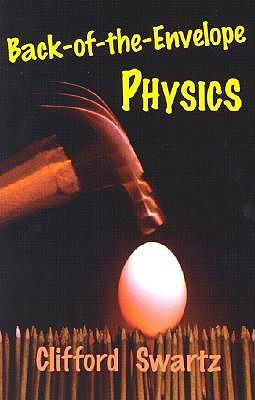
Physicists use ""back-of-the-envelope"" estimates to check whether or not an idea could possibly be right. In many cases, the approximate solution is all that is needed. This compilation of 101 examples of back-of-the-envelope calculations celebrates a quantitative approach to solving physics problems. Drawing on a lifetime of physics research and nearly three decades as the editor of The Physics Teacher, Clifford Swartz provides simple, approximate solutions to physics problems that span a broad range of topics. What note do you get when you blow across the top of a Coke bottle? Could you lose weight on a diet of ice cubes? How can a fakir lie on a bed of nails without getting hurt? Does draining water in the northern hemisphere really swirl in a different direction than its counterpart below the equator? In each case, only a few lines of arithmetic and a few natural constants solve a problem to within a few percent. Covering such subjects as astronomy, magnetism, optics, sound, heat, mechanics, waves, and electricity, the book provides a rich source of material for teachers and anyone interested in the physics of everyday life. ""If the physical world is to make sense to students (or even to professional scientists), then it must be understandable on the basis of broadly applicable principles and simple communicable reasoning. Long, dry calculations alone will not do, for they are as devoid of insight as they are impenetrable. Here, however, is a book of wide-ranging and aptly chosen topics--each brief glimpse conveying its (sometimes surprising!) lesson in one page with a short, physically insightful, quantitative argument. This is a book that will help make the study of physics fun and relevant.""--Mark P. Silverman, author of A Universe of Atoms ...An Atom in the Universe and Waves and Grains: Reflections on Light and Learning ""This book is a treasure trove of fascinating calculations covering a wide range of physical principles, distance scales, and numerical orders of magnitude. Everyone with some curiosity about the natural world, from novice students to seasoned veterans, will find a variety of interesting cases in this wonderful collection.""--Gregory N. Derry, author of What Science Is and How It Works ""The book is fun to read. I look forward to mining it for examples with which to spice up my lectures.""--Don S. Lemons, author of Introduction to Stochastic Processes in Physics
Full Product Details
Author: Clifford Swartz (Professor Emeritus of Physics, State University of New York)
Publisher: Johns Hopkins University Press
Imprint: Johns Hopkins University Press
Dimensions:
Width: 14.00cm
, Height: 1.30cm
, Length: 21.60cm
Weight: 0.227kg
ISBN: 9780801872631
ISBN 10: 0801872634
Pages: 176
Publication Date: 25 July 2003
Recommended Age: From 18 years
Audience:
General/trade
,
General
Format: Paperback
Publisher's Status: Active
Availability: Out of stock

The supplier is temporarily out of stock of this item. It will be ordered for you on backorder and shipped when it becomes available.
Reviews
<p>An entertaining new book Back-of-the-Envelope Physics by Clifford Swartz nicely provides material to assist students (and teachers!) gain experience in handling real-world physics. --Colin Keay The Physicist (01/01/0001)
<p> This delightfully broad spectrum of 104 familiar situations, each one or two pages long, includes the terminal velocity of falling objects, fatal impacts during car wrecks, timing to find the distance of lightning strikes, investigating the size and power of binoculars, and the height of Earth's atmosphere... For the well-grounded physics enthusiast. -- Choice
<p>An entertaining new book Back-of-the-Envelope Physics by Clifford Swartz nicely provides material to assist students (and teachers!) gain experience in handling real-world physics. --Colin Keay The Physicist (01/01/0001)
Author Information
Clifford Swartz is a professor emeritus of physics at State University of New York, Stony Brook. He was the editor of The Physics Teacher for twenty-nine years and has written numerous physics texts for students from kindergarten to graduate level. He was the recipient in 2007 of the Melba Newell Phillips Award and in 1987 of the Oersted Medal, the most prestigious award of the American Association of Physics Teachers.