Overview
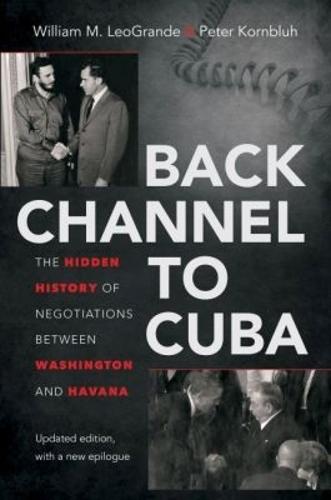
History is being made in U.S.-Cuban relations. Now updated to tell the story behind the stunning December 17, 2014, announcement by President Obama and President Castro of their move to restore full diplomatic relations, this powerful book is essential to understanding ongoing efforts towards normalization. Challenging the conventional wisdom of perpetual conflict and aggression between the United States and Cuba since 1959, Back Channel to Cuba chronicles a surprising, untold history of bilateral efforts toward rapprochement and reconciliation. William M. LeoGrande and Peter Kornbluh here present a remarkably new and relevant account, describing how, despite the intense political clamor surrounding efforts to improve relations with Havana, negotiations have been conducted by every presidential administration since Eisenhower's through secret, back-channel diplomacy. From John F. Kennedy's offering of an olive branch to Fidel Castro after the missile crisis, to Henry Kissinger's top secret quest for normalization, to Barack Obama's promise of a new approach, LeoGrande and Kornbluh uncovered hundreds of formerly secret U.S. documents and conducted interviews with dozens of negotiators, intermediaries, and policy makers, including Fidel Castro and Jimmy Carter. They reveal a fifty-year record of dialogue and negotiations, both open and furtive, that provides the historical foundation for the dramatic breakthrough in U.S.-Cuba ties.
Full Product Details
Author: William M. LeoGrande ,
Peter Kornbluh
Publisher: The University of North Carolina Press
Imprint: The University of North Carolina Press
Edition: Updated Edition with a New Epilogue
Dimensions:
Width: 15.80cm
, Height: 3.50cm
, Length: 23.40cm
Weight: 0.833kg
ISBN: 9781469626604
ISBN 10: 1469626608
Pages: 584
Publication Date: 01 November 2015
Audience:
General/trade
,
General
Format: Paperback
Publisher's Status: Active
Availability: In Print

This item will be ordered in for you from one of our suppliers. Upon receipt, we will promptly dispatch it out to you. For in store availability, please contact us.
Reviews
Masterful. . . . A multifaceted contribution to our understanding of why the U.S.-Cuban relationship remained hostile for so long.--Political Science Quarterly
LeoGrande and Kornbluh's exhaustive and masterful diplomatic history will stand as the most authoritative account of U.S.-Cuban diplomatic relations during the five decades of Cuban President Fidel Castro's rule.--Foreign Affairs An exceedingly well-written and well-documented account. . . . Essential for libraries that support research into the political and diplomatic history of America foreign relations with Cuba in the latter half of the 20th century.--Library Journal, starred review Masterful. . . . A multifaceted contribution to our understanding of why the U.S.-Cuban relationship remained hostile for so long.--Political Science Quarterly Told in clear prose, this richly detailed book underscores how diplomacy makes headlines, but many exchanges happen far from official negotiation tables.--Publishers Weekly, starred review A tour de force, Back Channel to Cuba never simplifies the complexity of the post-Revolution relationship between the United States and Cuba. The authors' virtuosity and enthusiastic vigor is reminiscent of John Le Carre as a political moralist while adhering to exacting scholarly standards.--The American Conservative Challenging the prevailing narrative of U.S.-Cuba relations, this book investigates the history of the secret, and often surprising, dialogue between Washington and Havana. . . . Suggest[s] that the past holds lessons for future negotiators.--The New Yorker A rich and timely review of the background to the normalization recently achieved.--Studies in Intelligence
Masterful. . . . A multifaceted contribution to our understanding of why the U.S.-Cuban relationship remained hostile for so long.--Political Science Quarterly A tour de force, Back Channel to Cuba never simplifies the complexity of the post-Revolution relationship between the United States and Cuba. The authors' virtuosity and enthusiastic vigor is reminiscent of John Le Carre as a political moralist while adhering to exacting scholarly standards.--The American Conservative LeoGrande and Kornbluh's exhaustive and masterful diplomatic history will stand as the most authoritative account of U.S.-Cuban diplomatic relations during the five decades of Cuban President Fidel Castro's rule.--Foreign Affairs A rich and timely review of the background to the normalization recently achieved.--Studies in Intelligence An exceedingly well-written and well-documented account. . . . Essential for libraries that support research into the political and diplomatic history of America foreign relations with Cuba in the latter half of the 20th century.--Library Journal, starred review Told in clear prose, this richly detailed book underscores how diplomacy makes headlines, but many exchanges happen far from official negotiation tables.--Publishers Weekly, starred review Challenging the prevailing narrative of U.S.-Cuba relations, this book investigates the history of the secret, and often surprising, dialogue between Washington and Havana. . . . Suggest[s] that the past holds lessons for future negotiators.--The New Yorker
Challenging the prevailing narrative of U.S.-Cuba relations, this book investigates the history of the secret, and often surprising, dialogue between Washington and Havana. . . Suggest[s] that the past holds lessons for future negotiators.-- The New Yorker
A fascinating and thorough intellectual introduction to the [December 2014 Obama-Castro] accords. . . . The book makes it clear that, during the long period of the Cuban-Soviet alliance, an agreement was practically impossible, though the history of attempts reads like a James Bond novel.""--New York Review of Books A rich and timely review of the background to the normalization recently achieved.""--Studies in Intelligence A tour de force, Back Channel to Cuba never simplifies the complexity of the post-Revolution relationship between the United States and Cuba. The authors' virtuosity and enthusiastic vigor is reminiscent of John Le Carre as a political moralist while adhering to exacting scholarly standards.""--American Conservative An exceedingly well-written and well-documented account. . . . Essential for libraries that support research into the political and diplomatic history of America foreign relations with Cuba in the latter half of the 20th century.""--Library Journal, starred review Challenging the prevailing narrative of U.S.-Cuba relations, this book investigates the history of the secret, and often surprising, dialogue between Washington and Havana. . . . Suggest[s] that the past holds lessons for future negotiators.""--New Yorker LeoGrande and Kornbluh's exhaustive and masterful diplomatic history will stand as the most authoritative account of U.S.-Cuban diplomatic relations during the five decades of Cuban President Fidel Castro's rule.""--Foreign Affairs Masterful. . . . A multifaceted contribution to our understanding of why the U.S.-Cuban relationship remained hostile for so long.""--Political Science Quarterly Told in clear prose, this richly detailed book underscores how diplomacy makes headlines, but many exchanges happen far from official negotiation tables.""--Publishers Weekly, starred review
Author Information
William M. Leogrande, professor of government at American University, USA is the author of Our Own Backyard: The United States in Central America, 1977–1992, among other books. Peter Kornbluh, director of the Cuba Documentation Project at the National Security Archive in Washington, D.C., USA is the author of The Pinochet File: A Declassified Dossier on Atrocity and Accountability, among other books.