Full Product Details
Author: Ruth Levy Guyer
Publisher: Capital Books, Incorporated,US
Imprint: Capital Books, Incorporated,US
Dimensions:
Width: 16.00cm
, Height: 2.20cm
, Length: 23.50cm
Weight: 0.413kg
ISBN: 9781933102269
ISBN 10: 1933102268
Pages: 256
Publication Date: 02 April 2007
Audience:
Professional and scholarly
,
Professional & Vocational
Format: Paperback
Publisher's Status: Active
Availability: In Print

This item will be ordered in for you from one of our suppliers. Upon receipt, we will promptly dispatch it out to you. For in store availability, please contact us.
Reviews
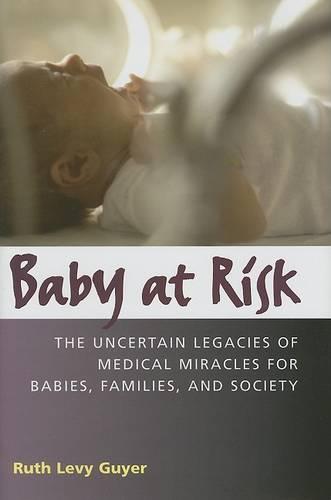
Dr. Guyer discusses long-term outcomes, children with impairments, and the ethics of offering, or not offering, palliative care as an option for marginally viable infants. Guyer gets up close and personal, and interviews key players who are asking moral questions around neonatal medicine. The author of Baby at Risk says not enough time is spent talking about this issue and poses some tough questions for the reader: What does it mean to ask a baby to suffer? What does it mean to ask the family, the parents and the siblings and the grandparents and anybody else who cares about the baby to suffer as this baby is suffering? Guyer says parents must decide - often in the first hours or days of a baby's life - what makes sense for their child and for themselves, and then accept the consequences. In a well written review of medical ethics since the inception of neonatal intensive care, Ruth Levy Guyer writes a compelling book. She conveys the sorrow, anger and frustration of families attempting to cope with children left with disabilities following NICU stays by utilizing interview with parents, doctors and nursing staff .The thought provoking focus of this book was on poor outcomes and gave me pause to do a lot of soul searching about my own practice and interactions with families. I think that is exactly what Dr. Guyer intended and hoped to accomplish. Baby at Risk is a narrative of the perils and promises of neonatal intensive care. The goal is to give a more balanced account of the successes of neonatology. The thesis is that with a more nuanced appreciation of the miracles and the complications, parents and physicians would make better collaborative decisions for premature infants and other children born with serious health problems that compromise the transition from fetus to infant. Through interviews with parents and medical personnel, Guyer investigates how high-tech pregnancies and medical interventions affect the lives of babies born at risk, their families, and society at large. The trials of these infants, though, do not stop at the nursery s door. How these children affect both their families and society is the subject of Ruth Levy Guyer s Baby at Risk. Guyer (a science writer who teaches bioethics at Haverford College) uses conversations with neonatal professionals, parents of prematurely born infants, and medical ethicists to present what she hopes is a realistic picture of the survivors of neonatal intensive care. Bioethics professor, science writer and National Public Radio commentator Ruth Levy Guyer dares to say what some may find unthinkable that the technology of modern neonatal intensive care units (NICUs) is hazardous to the long-term well-being of some newborns, who would be better off allowed to die a natural death Guyer by no means advocates shutting the doors of NICUs; she is well aware of the miracles achieved by caring doctors and nurses According to Guyer, there are no national guidelines about when and when not to take aggressive measures to maintain a newborn s life. Guyer says the NICU can also be a curse. A baby may be saved only to face a life of prolonged suffering. The author of Baby at Risk says not enough time is spent talking about this issue and poses some tough questions for the reader: 'What does it mean to ask a baby to suffer? What does it mean to ask the family, the parents and the siblings and the grandparents and anybody else who cares about the baby to suffer as this baby is suffering?' Baby at Risk: The Uncertain Legacies of Medical Miracles for Babies, Families, and Society by Ruth Levy Guyer, an NPR commentator and bioethicist, investigates the effects of high-tech pregnancies and medical interventions. Ruth Levy Guyer s illuminating and compelling account of neonatal medicine interweaves the stories of infants, parents, and clinicians and shows how neonatal medicine wields a double-edged sword with the power to heal, but where prognosis may be uncertain and survival may come at a dear cost in many ways. Ruth Levy Guyer has written a beautiful, moving, passionate account of the agonies and the joys of families that have included infants with serious, often fatal, medical problems. Just after every couple contemplating an addition is assured of how unlikely such a tragedy will be, they should read this book and begin calmly thinking about the experiences of the sometimes heroic and often desperate families who have been cursed and blessed with the births Guyer describes so vividly and compassionately. The book has to find its way to the doctors and nurses who advise these families and care for these infants. Medical miracles make the news. The everyday failures of medicine do not. We owe a debt to Ruth Levy Guyer, a courageous bioethicist, for sharing the true stories of medicine s smallest patients and their families. If policy makers, families, and medical personnel read and understood this book, decisions could be based on hard realities, not medical rescue fantasies. Baby At Risk is right on target: balanced and true-to-life, touching equally on the limits, victories, and questions of a moneymaking branch of medicine. And it captures as few works have and few in the field will still even admit that neonatology remains rife with tunnel vision and experimentation. Every NICU parent and professional should read it.
Baby At Risk is right on target: balanced and true-to-life, touching equally on the limits, victories, and questions of a moneymaking branch of medicine. And it captures as few works have and few in the field will still even admit that neonatology remains rife with tunnel vision and experimentation. Every NICU parent and professional should read it.