Overview
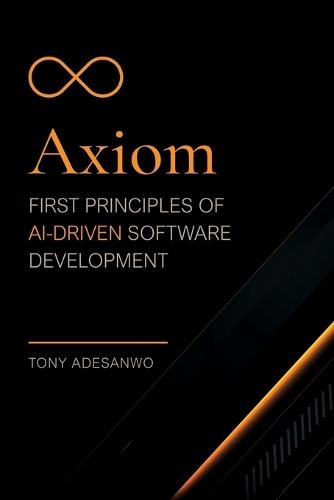
The AI landscape changes fast enough that most advice about it goes stale in months. Tutorials age. Frameworks shift. Models get replaced. What does not change is the underlying logic of how good systems are built. Axiom is a practitioner's guide to building software with AI, grounded in first principles instead of tools. Across 12 principles and 6 parts, it gives engineers a stable way to reason about the hardest problems in AI-driven development: how to design for probabilistic output, how to scope autonomous systems safely, how to evaluate what you cannot unit test, and how to build for a technology stack that will not stop changing underneath you. This is not a book about any particular model or framework. It is a book about thinking clearly in a field that rewards it. What you will find in these pages is a structured way to reason through problems that do not have clean answers yet. The twelve principles in Axiom are not rules to memorize or checklists to run through before a deployment. They are lenses for thinking through the specific tensions that AI introduces into software development, tensions that are real and recurring and that most engineering teams are already bumping into whether they have named them or not. There is the tension between confidence and accuracy when your system's output is probabilistic by nature and a user's trust depends on it being right most of the time. There is the tension between autonomy and oversight when an agent is making decisions faster than any human reviewer can keep up with, and the cost of a wrong decision is not a failed assertion in a test suite but a real action taken in the world. There is the tension between shipping and correctness when your evaluation framework is immature, your user base is growing, and the feedback loop between what the model does and what the user actually needed is long and indirect. There is the tension between building on top of a foundation model and owning the behavior that foundation model produces, a question that touches intellectual property, reliability, and accountability all at once. These are not abstract concerns. They are the kinds of problems that show up in production, in incident reviews, in architecture discussions, and in the conversations that happen after something goes wrong and the team is trying to figure out what to do differently next time. Each part is designed to be useful on its own for an engineer who is working through a specific problem in a specific context, and to read as a coherent argument when taken together from beginning to end. The principles build on each other, but the book is organized so that a reader who needs to understand evaluation right now can start in Part III without losing the thread. The through-line across all twelve principles is a single conviction, one that the book returns to in different forms across every chapter: the engineers who will build the most reliable, the most useful, and the most durable AI-driven systems are not necessarily the ones who know the most tools or have worked with the most models. They are the ones who have developed the clearest thinking about the underlying problems those tools are trying to solve. Tools give you leverage. Principles give you judgment. In a field moving as fast as this one, judgment is what compounds. Tony Adesanwo is a Director of Software Engineering at Match Group, where he brings over 20 years of hands-on experience building and leading software teams. A practitioner as much as a leader, he writes and speaks on engineering leadership, software quality, and the first principles behind AI-driven development.
Full Product Details
Author: Tony Adesanwo
Publisher: Amatus Press
Imprint: Amatus Press
Dimensions:
Width: 15.20cm
, Height: 1.90cm
, Length: 22.90cm
Weight: 0.454kg
ISBN: 9798950372018
Pages: 338
Publication Date: 30 April 2026
Audience:
General/trade
,
General
Format: Paperback
Publisher's Status: Active
Availability: Available To Order

We have confirmation that this item is in stock with the supplier. It will be ordered in for you and dispatched immediately.
Author Information
Tony Adesanwo is a software engineering leader with more than 20 years of progressive experience building and scaling technology organizations. He currently directs multiple engineering teams at Match Group, where his work supports over 60 million users across consumer platforms. Throughout his career, Tony has developed a track record of growing management layers, aligning engineering strategy with business outcomes, and leading platform modernizations that have produced meaningful cost savings and improved system reliability. He is a strong proponent of integrating AI into modern engineering practice.