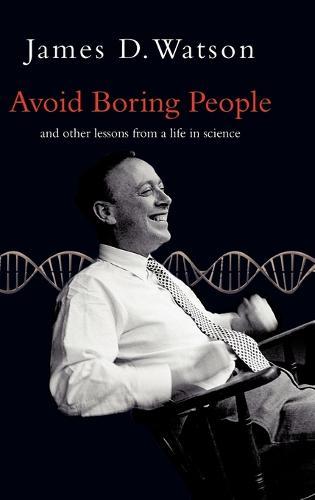
Full Product Details
Author: James D. Watson (, Chancellor, Cold Spring Harbor Laboratory)
Publisher: Oxford University Press
Imprint: Oxford University Press
Dimensions:
Width: 16.20cm
, Height: 3.50cm
, Length: 24.10cm
Weight: 0.661kg
ISBN: 9780192802736
ISBN 10: 0192802739
Pages: 368
Publication Date: 22 October 2007
Audience:
General/trade
,
General
Format: Hardback
Publisher's Status: Active
Availability: To order

Stock availability from the supplier is unknown. We will order it for you and ship this item to you once it is received by us.
Reviews
It's never dull. The Herald (Glasgow) A lively and provocative book. Financial Times, Books of the Year Scientists will find the book most interesting. Irish Times The story is frank, personal, revealing and sometimes entertaining. Peter Lawrence, Literary Review ...a deliciously detailed account of his life...Watson remains one of the most fascinating scientists of our time, as iconic in some respects as his double helix. Nature
Age cannot whither nor custom stale the sharp tongue of Honest Jim - the title the Nobel Prize - winning Watson (DNA: The Secret of Life, 2003, etc.) originally wanted for The Double Helix, his first tell-all account of science and personal history.Now in his late 70s, Watson chronicles his life from birth through middle age. We learn of a close-knit family and an early love of ornithology, but the even greater appeal of genetics by the time of graduate school. Watson's career took off as he began working with hot-shot geneticists studying bacterial viruses (phages) like the future Nobelists Salvador Luria and Max Delbruck. Indeed, the names of Watson's mentors, peers and former graduate students read like a Who's Who in molecular biology. They also underscore some of the remembered lessons he adds to each chapter, e.g., choose a young thesis advisor ; choose an objective apparently ahead of its time. The main text deals with the years Watson taught at Harvard and later when he became director of the Cold Spring Harbor Laboratory on Long Island, moving it from near bankruptcy to growth and continued pre-eminence. Watson has certainly made his mark as scientist, teacher, textbook writer, nurturer of talent and canny administrator. But Honest Jim also made known his contempt for mediocre faculty and administrators, and he lost a key battle in trying to get Harvard to fund tumor virus studies - the Next Big Thing in the '60s and '70s. Around that time, Jim, ever the nerd, finally met and won the lovely Liz, a Radcliffe undergraduate who married the 39-year-old bachelor in 1968. The chronicle ends abruptly in the mid-'70s, save for a shocker of an epilogue 30 years later. Watson again confronts Harvard with the need to beef up basic science only to face Larry Summers and later Derek Bok, who had distinctly other ideas - though Watson does not fault Summers for his conjecture on women in science.Vintage Watson: brash, bumptious, brilliant - and never boring. (Kirkus Reviews)
Author Information
In 1953, while working at the Cavendish Laboratory at Cambridge University, James Watson and Francis Crick discovered the double helical structure of DNA. For their discovery they were awarded the 1962 Nobel Prize in Physiology or Medicine, with Maurice Wilkins. Watson was appointed to the faculty at Harvard University in 1956. In 1968, while retaining his position at Harvard, he became director of Cold Spring Harbor Laboratory (CSHL). In 1988 he was appointed as associate director of the National Institute of Health (NIH) to help launch the Human Genome Program. A year later he became the first director of the National Center for Human Genome Research at the NIH. Watson was awarded the National Medal of Science in 1997, and is today Chancellor of CSHL.