Overview
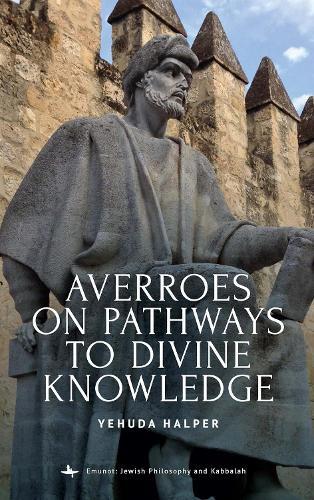
The twelfth-century Andalusian philosopher Averroes sought to understand the divine in a way independent of religious theology, by turning to the philosophical works of Aristotle and, to a lesser extent, Plato. In doing so, he established standards of scientific inquiry into God that were and remain highly influential on Jewish and Christian thought. Averroes, however, does not provide much in the way of demonstrative knowledge of God, and most of his arguments remain dialectical, rhetorical, or political. This volume explores the various pathways towards attaining divine knowledge that we find in Averroes' commentaries on Aristotle's De Anima, Metaphysics, and Nicomachean Ethics, and on Plato's Republic, along with Averroes' Epistle on Divine Knowledge, Decisive Treatise, and more.
Full Product Details
Author: Yehuda Halper
Publisher: Academic Studies Press
Imprint: Academic Studies Press
ISBN: 9798887197616
Pages: 188
Publication Date: 24 July 2025
Audience:
Professional and scholarly
,
General/trade
,
Professional & Vocational
,
General
Format: Hardback
Publisher's Status: Active
Availability: Temporarily unavailable

The supplier advises that this item is temporarily unavailable. It will be ordered for you and placed on backorder. Once it does come back in stock, we will ship it out to you.
Reviews
“In Averroes on Pathways to Divine Knowledge, Yehuda Halper guides his readers through a transformative exploration of Averroes’s metaphysical thought, uncovering the manifold ways the Commentator illuminates humanity’s longing for divine truth. Through careful analysis of Averroes’s engagement with Aristotle’s Metaphysics and Plato’s Republic, Halper reveals a thinker grappling earnestly with the deepest questions of intentionality, dialectics, and the very nature and purpose of philosophical inquiry. Moving deftly between Averroes’s Arabic texts and their broader historical-philosophical implications, this work not only elucidates the enduring tensions between dialectic and demonstration, human reason and divine intellect, but also positions Averroes as a partner in a continued philosophical journey begun in antiquity. Halper’s study is invaluable to scholars in medieval thought, but also richly rewarding for contemporary philosophers, historians, and theologians navigating epistemology, politics, metaphysics, and the timeless quest for the divine. A luminous contribution, elegantly composed and profoundly insightful, this book invites its readers into the inexhaustible dialogue of philosophy itself.” — Katja Krause, Professor for the History of Science, Technische Universität Berlin, Research Group Leader, Max Planck Institute for the History of Science This valuable publication brings together in a single volume eight insightful articles by Halper providing analyses of various writings of Ibn Rushd / Averroes relating directly or indirectly to the Cordoban’s dialectical and metaphysical aspirations to divine knowledge. This collection is particularly successful in acquainting readers with several dialectical efforts on metaphysical issues."" — Dr. Richard C. Taylor, Professor of Philosophy, Marquette University, and annual Visiting Professor, Katholieke Universiteit, Leuven
“In Averroes on Pathways to Divine Knowledge, Yehuda Halper guides his readers through a transformative exploration of Averroes’s metaphysical thought, uncovering the manifold ways the Commentator illuminates humanity’s longing for divine truth. Through careful analysis of Averroes’s engagement with Aristotle’s Metaphysics and Plato’s Republic, Halper reveals a thinker grappling earnestly with the deepest questions of intentionality, dialectics, and the very nature and purpose of philosophical inquiry. Moving deftly between Averroes’s Arabic texts and their broader historical-philosophical implications, this work not only elucidates the enduring tensions between dialectic and demonstration, human reason and divine intellect, but also positions Averroes as a partner in a continued philosophical journey begun in antiquity. Halper’s study is invaluable to scholars in medieval thought, but also richly rewarding for contemporary philosophers, historians, and theologians navigating epistemology, politics, metaphysics, and the timeless quest for the divine. A luminous contribution, elegantly composed and profoundly insightful, this book invites its readers into the inexhaustible dialogue of philosophy itself.” —Katja Krause, Professor for the History of Science, Technische Universität Berlin, Research Group Leader, Max Planck Institute for the History of Science.
Author Information
Yehuda Halper is Professor in the Department of Jewish Philosophy at Bar Ilan University. His first monograph,Jewish Socratic Questions in an Age without Plato(Brill, 2021) won the Goldstein-Goren Book Award for the best book in Jewish Thought in 2019-2021. He is currently directing the ISF grant (#622/22) ""Samuel Ibn Tibbon's Explanation of Foreign Terms and the Foundations of Philosophy in Hebrew.""