Overview
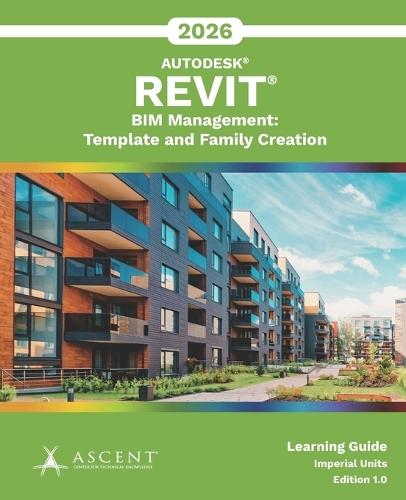
Please note: The print version of this guide is printed in black and white with images in grayscale. Building Information Modeling (BIM) is an approach to the entire building life cycle. Autodesk(R) Revit(R) is a powerful BIM program for architecture, MEP, and structure that supports the ability to coordinate, update, and share design data with team members throughout the design construction and management phases of a building's life. A key component in managing the BIM process is to establish a company foundation for different types of projects by creating standard templates and custom family elements. Having this in place makes the process of creating new projects flow smoothly and efficiently. The objective of the Autodesk(R) Revit(R) 2026 BIM Management: Template and Family Creation guide is to enable users who have worked with the software to expand their knowledge in setting up office standards with templates that include annotation styles, preset views, sheets, and schedules, as well as creating custom system, in-place, and component families. This guide contains practices that are specific to each discipline. Topics Covered Create custom templates with annotation styles, title blocks, and custom element types. Create schedules, including material takeoff schedules with formulas. Create custom wall, roof, and floor types, as well as MEP system families. Set up a component family file with a parametric framework. Create family geometry. Create family types. Modify the visibility of components and incorporate additional family items such as controls, MEP connectors, and nested components. Create specific families, including in-place families, profiles, annotations, and parameters. This guide also contains discipline-specific practices for families, including doors, windows, railings, pipe fittings, light fixtures, gusset plates, and built-up columns. Prerequisites Access to the 2026.0 version of the software, to ensure compatibility with this guide. Future software updates that are released by Autodesk may include changes that are not reflected in this guide. The practices and files included with this guide might not be compatible with prior versions (e.g., 2025). You should be comfortable with the fundamentals of the Autodesk Revit software, as found in the Autodesk Revit 2026: Fundamentals for Architecture, Autodesk Revit 2026: Fundamentals for Structure, or Autodesk Revit 2026: Fundamentals for MEP guides. Knowledge of basic techniques is assumed, such as creating standard elements, copying and moving elements, and creating and working with views. Information on Collaboration Tools, Conceptual Design, and Site Planning and Design is covered in other guides.
Full Product Details
Author: Ascent - Center for Technical Knowledge
Publisher: Ascent, Center for Technical Knowledge
Imprint: Ascent, Center for Technical Knowledge
Dimensions:
Width: 19.10cm
, Height: 3.80cm
, Length: 23.50cm
Weight: 1.279kg
ISBN: 9781967625505
ISBN 10: 1967625506
Pages: 758
Publication Date: 10 February 2026
Audience:
General/trade
,
General
Format: Paperback
Publisher's Status: Active
Availability: Available To Order

We have confirmation that this item is in stock with the supplier. It will be ordered in for you and dispatched immediately.