Awards
- Winner of Honorable Mention, Prize for a First Book, Modern Language.
Overview
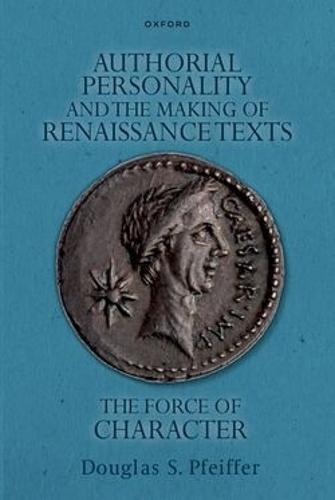
How did we first come to believe in a correspondence between writers' lives and their works? When did the person of the author—both as context for and target of textual interpretation—begin to matter so much to the way we read? This book traces the development of author centrism back to the early Renaissance humanists. Working against allegoresis and other traditions of non-historicizing textual reception, these innovative scholars discovered the power of engaging ancient works through the speculative reconstruction of writers' personalities and artistic motives. To trace the multi-lingual and cross-cultural rise of reading for the author, this book presents four case studies of resolutely experimental texts by and about writers of high ambition in their respective generations: Lorenzo Valla on the forger of the Donation of Constantine, Erasmus on Saint Jerome, the poet George Gascoigne on himself, and Fulke Greville on Sir Philip Sidney. An opening methodological chapter and an exhortative conclusion frame these four studies with accounts of the central lexicon—character, ethos, intention, persona—and the range of genres of evidence that contemporaries used to discern and articulate authorial character and purpose. Constellated throughout with examples from the works of major contemporaries, including John Aubrey, John Hayward, Galileo, Machiavelli, and Shakespeare, this book resurrects a vibrant culture of biographical criticism continuous with modern practice and yet radically more attuned to the explanatory powers of probabilism and historical conjecture—the discursive middle grounds eventually displaced by the post-Enlightenment binaries of truth and fiction, history and story, fact and fable.
Full Product Details
Author: Douglas S. Pfeiffer (Associate Professor of English,, Associate Professor of English,, Stony Brook University)
Publisher: Oxford University Press
Imprint: Oxford University Press
ISBN: 9780197901205
ISBN 10: 0197901204
Pages: 496
Publication Date: 20 February 2026
Audience:
College/higher education
,
Professional and scholarly
,
Postgraduate, Research & Scholarly
,
Professional & Vocational
Format: Paperback
Publisher's Status: Forthcoming
Availability: Not yet available

This item is yet to be released. You can pre-order this item and we will dispatch it to you upon its release.
Reviews
Honorable Mention, Prize for a First Book, Modern Language Association Winner, 2025 The Jozef IJsewijn Prize for the best book published in the triennium 2022 to 2024 Winner, 2023 Roland H. Bainton Prize for literature, Sixteenth Century Society Our habit of evaluating books based on their author's personality has a history, and in The Force of Character Douglas Pfeiffer identifies a decisive moment in that story, locating the roots of how and why, a half-century ago, Renaissance readers began searching for the life in the works. Learned, lucid, and consistently illuminating, Pfeiffer's contribution to our understanding of authorship and biography is a major one, to which many will be indebted. * Professor James Shapiro, Columbia University * Force of Character challenges us to reconsider acquiescing too easily in arguments for the death of the author. It invites us instead to reflect on how the related reading and writing practices of early modernity, especially through their prefatory and other paratextual materials, tether authors' characters and intentions not only to their words but to the highly individualized, ethically inflected literary styles and agendas their words underwrite. * Professor Kathy Eden, Columbia University * In Authorial Personality and the Making of Renaissance Texts, Douglas Pfeiffer advances a brilliantly simple claim: that Renaissance readers considered the author a text when reflecting upon its meaning. Against those who would locate the genesis of readerly interest in authorship in the eighteenth century, Pfeiffer suggests that interest in authorship flourished in the Renaissance, developing most vibrantly in the philologist's reliance upon authorial ethos in the interpretation of language. With immense erudition, Pfeiffer traces this interest in the works and lives of English, Italian, and Dutch authors such as Erasmus, Gascoigne, Greville, Shakespeare, and Machiavelli. By demonstrating the longstanding critical interest in reading for authorial intent, Pfeiffer makes a genuine intervention in our understanding of literary history and helps to bridge the chasm which (for too long) has separated scholarly and popular readers. * Committee for The Roland H. Bainton Prize in Literature * Douglas S. Pfeiffer's Authorial Personality and the Making of Renaissance Texts: The Force of Character is a tremendous achievement. In this substantial volume, Pfeiffer graces the phenomenon of author centrism to the scholarship of early Renaissance humanists. Focusing on several well-chosen case studies, this deeply researched multilingual monograph brings welcome new interpretations and insights not only to Renaissance studies but to literary studies more broadly. Pfeiffer demonstrates how the act of reading for the author's person and creatively filling in the blanks was a prevalent practice in many circles from the fifteenth through seventeenth centuries that used sources from classical antiquity in ways that resonate with our contemporary critical dilemmas. * MLA First Book Prize Committee * The Force of Character is ""a critically innovative, sharply illuminating work of scholarship which spans nearly two centuries and juxtaposes four authors from across early modern Europe, all variously forceful and characterful. . . . [T]he approach Pfeiffer chose, to chart the emergence and frequent use of reading methods focused on the close connection between author and text, has borne rich fruit for both Latin and the English works this study analyses. Grounding the book in the classical and subsequently the humanist rhetorical tradition, especially Cicero's De inventione and the fashioning of an authorial persona, has created similarly fertile ground for the comparative critical work that the four chapters go on to perform. Pfeiffer's book is equally persuasive in its analysis of Quattrocento Italian and early sixteenth-century Dutch Latin writing as it is in examining Elizabethan and Jacobean English poetry and prose.” * IANLS Jury for the Jozef IJsewijn Prize * Differentiating this study from the renewed and recent emphasis on characters within literary works, Pfeiffer deftly explores the ways in which Renaissance authors (and the ancient authors they studied) became characters of intense interest in their own right . . . [The Force of Character is] a rich and essential study . . . [Pfeiffer's] methods and conclusions are rigorously historical; he uses careful philological analysis as well [as] a close study of the original editions of the texts he treats, which he mines both for the material details of these texts are well as the traces that early modern readers have left of them. At the same time, Pfeiffer reconstructs and presents this history with an eye to present concerns of readers and scholars, often asking us to reconsider our established notions of what an author is and means, and how and when it came to take on that meaning. * Stanley Benfell, Renaissance Quarterly, vol. LXXVI, no. 3 (2023) 1184-5 *
Author Information
Douglas S. Pfeiffer is Associate Professor of English at Stony Brook University and a recipient of Jacob K. Javits, Whiting Foundation, and Folger and Huntington Library fellowships and the State University of New York Chancellor's Award for Excellence in Teaching.