Overview
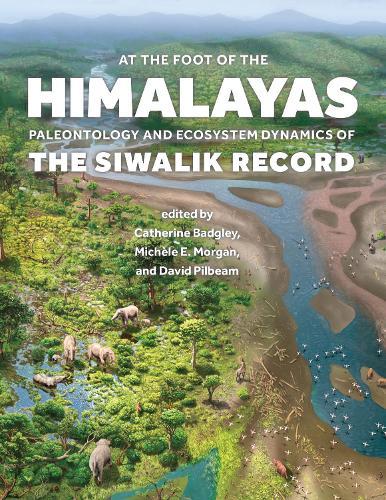
This authoritative volume brings together decades of insights from one of the longest terrestrial fossil records on the planet. The fabled Himalayas have isolated and sheltered the Indian subcontinent for millions of years. The Siwalik sequence of sediments at their feet has been a treasure trove of visions into the past for generations of paleontologists, preserving an immense 20 million years of terrestrial ecosystems' fossil record. The Siwalik sequence reveals a unique forest wonderland of diverse animal species: from huge elephant relatives, great rhinos, and sabertooth cats, to mongooses, swamp rats, crocodiles, and catfish. Regional climate change eventually caused this forest ecosystem to unravel, as grasslands replaced the forests and established the habitats and animals of the modern ecosystems of the Indus and Ganges rivers. In At the Foot of the Himalayas, celebrated paleontologists Catherine Badgley, Michèle Morgan, and David Pilbeam bring together a collection of world-renowned scholars to present an interdisciplinary approach to documenting and interpreting this fossil record. By investigating changes in landscape, climate, and vertebrate species diversity, their analysis reveals insights into a central question about biodiversity: which evolutionary developments were influenced by changes in climate, and which were caused by interactions among the species themselves? This groundbreaking book illuminates for the first time a mysterious and vibrant paleontological past, bringing together more than 40 years of exciting international collaborative studies that forge invaluable knowledge pathways for the ecologists, evolutionary scientists, and paleontologists of the future, and pose important questions about our fragile ecosystems in the present day.
Full Product Details
Author: Catherine Badgley (Associate Professor, University of Michigan) ,
Michèle E. Morgan (Curator of Osteology and Paleoanthropology, Harvard University) ,
David Pilbeam (Peabody Museum, Harvard University)
Publisher: Johns Hopkins University Press
Imprint: Johns Hopkins University Press
Dimensions:
Width: 21.60cm
, Height: 3.80cm
, Length: 27.90cm
Weight: 2.313kg
ISBN: 9781421450278
ISBN 10: 1421450275
Pages: 576
Publication Date: 28 February 2025
Audience:
Professional and scholarly
,
Professional & Vocational
Format: Hardback
Publisher's Status: Active
Availability: Out of stock

The supplier is temporarily out of stock of this item. It will be ordered for you on backorder and shipped when it becomes available.
Reviews
...what makes [At the Foot of the Himalayas] so compelling is not just its exhaustive cataloguing of fossil finds – from sabertooth cats to swamp-loving crocodiles – but its commitment to telling a broader ecological story.... it is a landmark achievement—a kind of intellectual Everest, scaled with clarity and care. —Deposits
Author Information
Catherine Badgley is a professor in the Department of Ecology and Evolutionary Biology and Residential College at the University of Michigan. Michèle Morgan is the Curator of Osteology and Paleoanthropology at the Peabody Museum at Harvard University. David Pilbeam is a professor emeritus in the Department of Human Evolutionary Biology at Harvard University, and longtime curator of paleoanthropology at the Peabody Museum.