Overview
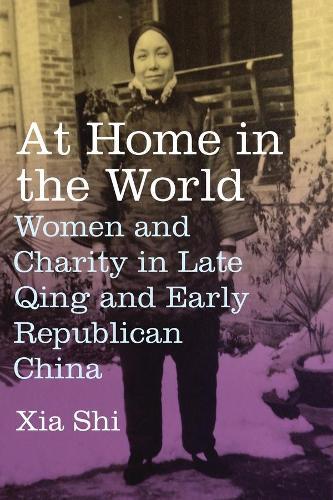
During the years spanning the late Qing dynasty and the early Republican era, the status of Chinese women changed in both subtle and decisive ways. As domestic seclusion ceased to be a sign of virtue, new opportunities emerged for a variety of women. Much scholarly attention has been given to the rise of the modern, independent ""new women"" during this period. However, far less is known about the stories of married nonprofessional women without modern educations and their public activities. In At Home in the World, Xia Shi unearths the history of how these women moved out of their sequestered domestic life; engaged in charitable, philanthropic, and religious activities; and repositioned themselves as effective public actors in urban Chinese society. Investigating the lives of individual women as well as organizations such as the YWCA and the Daoyuan, she shows how her protagonists built on the past rather than repudiating it, drawing on broader networks of family, marriage, and friendship and reconfiguring existing beliefs into essential components of modern Chinese gender roles. The book stresses the collective forms of agency these women exercised in their endeavors, highlighting the significance of charitable and philanthropic work as political, social, and civic engagement. Shi also analyzes how men-alive, dead, or absent-both empowered and constrained women's public ventures. She offers a new perspective on how the public, private, and domestic realms were being remade and rethought in early twentieth-century China, in particular, how the women navigated these developing spheres. At Home in the World sheds new light on how women exerted their influence beyond the home and expands the field of Chinese women's history.
Full Product Details
Author: Professor Xia Shi
Publisher: Columbia University Press
Imprint: Columbia University Press
ISBN: 9780231185608
ISBN 10: 023118560
Pages: 288
Publication Date: 20 March 2018
Audience:
College/higher education
,
Professional and scholarly
,
Tertiary & Higher Education
,
Professional & Vocational
Format: Hardback
Publisher's Status: Active
Availability: Manufactured on demand

We will order this item for you from a manufactured on demand supplier.
Language: English
Reviews
Whether singing and dancing by female government students while selling handicrafts to support flood relief in late Qing Beijing or moving exhortations by Zhu Qihui (a.k.a. Mme Xiong Xiling) that extracted large sums of money from warlords and skeptical literati for the Mass Education Movement, philanthropic work by Chinese women in early twentieth-century China captured the public imagination, challenged gender ideals, and delivered charity to those in need. Xia Shi demonstrates in compelling detail that female philanthropists embraced contemporary social needs to expand their moral purview and the realm of their licit social space beyond the personal and family to encompass the nation and society as a whole. In so doing, they expanded notions of citizenship and its obligations for women and men alike.--Peter Carroll, Northwestern University While there are many formidable works of history focused upon iconoclastic and progressively educated 'new women, ' there are far fewer that address the political and progressive lives of so-called 'home' women such as those featured in Xia Shi's work. By situating individual figures within their broader social and familial contexts, and in shifting contexts of work and leisure, Shi masterfully reveals the complex economic, social, and political webs that defined these women's progressive activities.--Thomas Mullaney, Stanford University This book brings the stories of a number of fascinating women to light and highlights their connections to broader developments in modern Chinese history. Xia Shi adds nuance and layers of understanding to our existing sense of the late Qing and Republican periods.--Joan Judge, York University
Whether singing and dancing by female government students while selling handicrafts to support flood relief in late Qing Beijing or moving exhortations by Zhu Qihui (a.k.a. Mme Xiong Xiling) that extracted large sums of money from warlords and skeptical literati for the Mass Education Movement, philanthropic work by Chinese women in early twentieth-century China captured the public imagination, challenged gender ideals, and delivered charity to those in need. Xia Shi demonstrates in compelling detail that female philanthropists embraced contemporary social needs to expand their moral purview and the realm of their licit social space beyond the personal and family to encompass the nation and society as a whole. In so doing, they expanded notions of citizenship and its obligations for women and men alike.--Peter Carroll, Northwestern University This book brings the stories of a number of fascinating women to light and highlights their connections to broader developments in modern Chinese history. Xia Shi adds nuance and layers of understanding to our existing sense of the late Qing and Republican periods.--Joan Judge, York University While there are many formidable works of history focused upon iconoclastic and progressively educated 'new women, ' there are far fewer that address the political and progressive lives of so-called 'home' women such as those featured in Xia Shi's work. By situating individual figures within their broader social and familial contexts, and in shifting contexts of work and leisure, Shi masterfully reveals the complex economic, social, and political webs that defined these women's progressive activities.--Thomas Mullaney, Stanford University
While there are many formidable works of history focused upon iconoclastic and progressively-educated 'new women, ' there are far fewer that address the political and progressive lives of so-called 'home' women such as those featured in Xia Shi's work. By situating individual figures within their broader social and familial contexts, and in shifting contexts of work and leisure, Shi masterfully reveals the complex economic, social, and political webs that defined these women's progressive activities.--Thomas Mullaney, Stanford University
This book brings the stories of a number of fascinating women to light and highlights their connections to broader developments in modern Chinese history. Xia Shi adds nuance and layers of understanding to our existing sense of the late Qing and Republican periods.--Joan Judge, York University While there are many formidable works of history focused upon iconoclastic and progressively educated 'new women, ' there are far fewer that address the political and progressive lives of so-called 'home' women such as those featured in Xia Shi's work. By situating individual figures within their broader social and familial contexts, and in shifting contexts of work and leisure, Shi masterfully reveals the complex economic, social, and political webs that defined these women's progressive activities.--Thomas Mullaney, Stanford University Whether singing and dancing by female government students while selling handicrafts to support flood relief in late Qing Beijing or moving exhortations by Zhu Qihui (a.k.a. Mme Xiong Xiling) that extracted large sums of money from warlords and skeptical literati for the Mass Education Movement, philanthropic work by Chinese women in early twentieth-century China captured the public imagination, challenged gender ideals, and delivered charity to those in need. Xia Shi demonstrates in compelling detail that female philanthropists embraced contemporary social needs to expand their moral purview and the realm of their licit social space beyond the personal and family to encompass the nation and society as a whole. In so doing, they expanded notions of citizenship and its obligations for women and men alike.--Peter Carroll, Northwestern University
Author Information
Xia Shi is assistant professor of history and Marian Hoppin Chair of Asian Studies at New College of Florida.