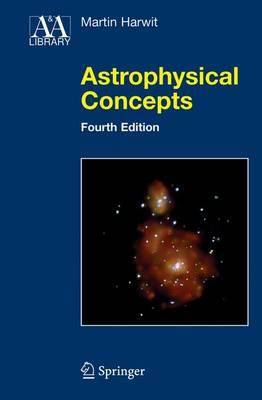
Full Product Details
Author: Martin Harwit
Publisher: Springer-Verlag New York Inc.
Imprint: Springer-Verlag New York Inc.
Edition: Fourth Edition 2006
Dimensions:
Width: 15.50cm
, Height: 4.30cm
, Length: 23.50cm
Weight: 1.104kg
ISBN: 9781441921994
ISBN 10: 1441921990
Pages: 716
Publication Date: 29 November 2010
Audience:
College/higher education
,
Postgraduate, Research & Scholarly
Format: Paperback
Publisher's Status: Active
Availability: Manufactured on demand

We will order this item for you from a manufactured on demand supplier.
Reviews
FROM REVIEWS OF THE PREVIOUS EDITION a clear, solid introduction to astrophysics ... that shows how physics can be applied to astronomical objects ... One of the strong points is the problems (that) give students a real feel for the sort of calculations astronomers must do ... were I teaching a junior/senior astrophysics course, this is the book I would use. AM.J.PHYS. This is a popular book among professional astrophysicists, produced with that meticulous detail and completeness of the house of Springer ... This is indeed a theoretician,s book [and] Harwit has made a prodigious effort in organizing all this information in a logical sequence ... A masterly mathematical exposition of a galaxy of astrophysical processes. Astronomy The great strength of the book lies in the lucidity and elegance with which chosen topics are quantitatively developed using elementary and clever arguments, instructive problems being distributed throughout, and in the skeptical spirit of inquiry that pervades the writing. NATURE Astronomer Harwit has finally updated his classic textbook to encompass the exciting developments of the decade since its last edition. It is ideal for those Scientific American readers who are mathematically literate and who want to pursue topics covered in the magazine to greater depth. Harwit takes a thematic approach to the subject, oriented around the guiding physical principles rather than the conventional sequence of planet, star, galaxy and cosmos. The approach rewards readers who just want to flip through the book as well as students who want to derive for themselves some of the basic equations in astronomy. SCIENTIFIC AMERICAN
FROM REVIEWS OF THE PREVIOUS EDITION a clear, solid introduction to astrophysics ... that shows how physics can be applied to astronomical objects ... One of the strong points is the problems (that) give students a real feel for the sort of calculations astronomers must do ... were I teaching a junior/senior astrophysics course, this is the book I would use. AM.J.PHYS. This is a popular book among professional astrophysicists, produced with that meticulous detail and completeness of the house of Springer ! This is indeed a theoretician's book [and] Harwit has made a prodigious effort in organizing all this information in a logical sequence ! A masterly mathematical exposition of a galaxy of astrophysical processes. Astronomy The great strength of the book lies in the lucidity and elegance with which chosen topics are quantitatively developed using elementary and clever arguments, instructive problems being distributed throughout, and in the skeptical spirit of inquiry that pervades the writing. NATURE Astronomer Harwit has finally updated his classic textbook to encompass the exciting developments of the decade since its last edition. It is ideal for those Scientific American readers who are mathematically literate and who want to pursue topics covered in the magazine to greater depth. Harwit takes a thematic approach to the subject, oriented around the guiding physical principles rather than the conventional sequence of planet, star, galaxy and cosmos. The approach rewards readers who just want to flip through the book as well as students who want to derive for themselves some of the basic equations in astronomy. SCIENTIFIC AMERICAN