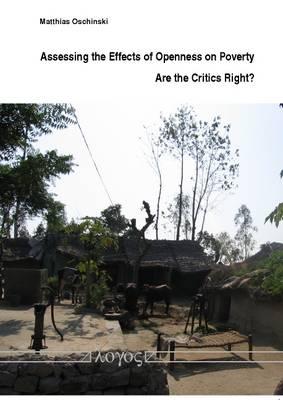
Assessing the Effects of Openness on Poverty - are the Critics Right?

Author:   Matthias Oschinski
Publisher:   Logos Verlag Berlin GmbH
ISBN:  

9783832512071


Pages:   253
Publication Date:   15 May 2006
Format:   Paperback
Availability:   Available To Order   Availability explained
We have confirmation that this item is in stock with the supplier. It will be ordered in for you and dispatched immediately.

Our Price $161.04 Quantity:  
Add to Cart

Share |

Assessing the Effects of Openness on Poverty - are the Critics Right?


Overview

This study aims to contribute to the ongoing debate on whether and how globalization influences poverty. Starting out with a detailed discussion of the so-called anti-globalization movement, it shows that the name is somewhat of a misnomer as the movement is neither homogenous nor necessarily anti globalization per se. In a second step, a cross-country analysis is conducted for 80 developing nations to test the impact of globalization on poverty and human development. The results indicate a positive influence of openness on overall per capita incomes. In addition, it appears that there is a positive impact of institutional quality on human development, i.e. higher quality institutions can contribute to poverty alleviation. The findings further confirm a significant influence of openness on institutional quality, implying that by enhancing institutional quality openness contributes to poverty alleviation. Digging deeper, the following chapters explore India's development experience; a focus chosen as it is the country with the highest absolute number of poor people worldwide. The analysis first provides an overview of the dynamics leading to the decision to implement a policy of import-substitution which in part aimed at realizing political independence and sovereignty after decades of colonization, and in part was carried out in the conviction that it was the best policy to overcome mass poverty. A comparison of India's trade regimes before and after liberalization shows that since the initiation of economic reforms India was able to lift more people out of poverty than in the first four decades of independence. The results also reveal, however, that additional factors are needed for the poor to fully participate in the growth process. In applying different methods and different levels of aggregation, the overall results indicate that poverty and income inequality do not result from globalization but from a lack of it; i.e. rather than globalization it is social exclusion that prevents progress for the poor.

Full Product Details

Author:   Matthias Oschinski
Publisher:   Logos Verlag Berlin GmbH
Imprint:   Logos Verlag Berlin GmbH
Weight:   0.386kg
ISBN:  

9783832512071


ISBN 10:   3832512071
Pages:   253
Publication Date:   15 May 2006
Audience:   Professional and scholarly ,  Professional & Vocational
Format:   Paperback
Publisher's Status:   Active
Availability:   Available To Order   Availability explained
We have confirmation that this item is in stock with the supplier. It will be ordered in for you and dispatched immediately.

Table of Contents

Reviews

Author Information

Tab Content 6

Author Website:  

Countries Available

All regions
Latest Reading Guide

NOV RG 20252


Shopping Cart
Your cart is empty
Shopping cart
Mailing List