Overview
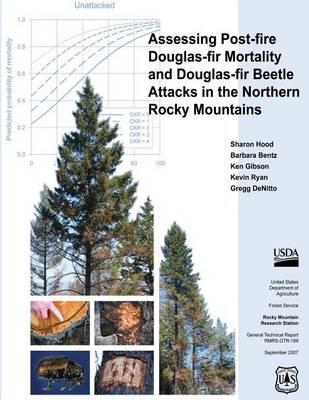
Many coniferous species have life history traits and characteristics that greatly enhance their resistance to injury from fire, thereby increasing post-fire survival rates. Douglas-fir (Pseudotsuga menziesii (Mirbel) Franco), for example, is known for its fire tolerance, in large part, due to thick insulating bark that develops with age and protects the inner cambium from heat injury. Mortality following fire, however, depends not only on tree species, but also on type and degree of fire-caused injuries, initial tree vigor, and post-fire environment. These same factors may also influence timing of tree death, which can be delayed as long as 4 years post-fire. Within a few months to a few years following fire, bark and wood boring beetles may preferentially attack, and wood deterioration caused by staining, decay pathogens, and/or checking can occur. Parker and others provide an extensive review of interactions between insects and fire (prescribed and wildfire) in coniferous forests of interior western North America. Development of management plans immediately following fire, therefore, can be difficult due to the timing and uncertainty of many interacting factors. Reliable estimates of post-fire Douglas-fir mortality, predicted from field-based characterizations of fire injury, would greatly facilitate informed post-fire management, including salvage, following both mixed-severity wildfires and applications of prescribed fire. Prediction of fire- and beetle-caused delayed tree mortality is also an important component in the development of prescribed burn plan objectives. Managers must know what fire intensity levels are needed to accomplish mortality related objectives. Also, in adaptive management, a key part to determining if burn objectives were met is installation of monitoring plots. By revisiting prescribed burns and monitoring fire effects, future burn prescriptions can be adjusted to better achieve desired results. To do this, field crews must be able to accurately assess post-fire tree injury and the potential for delayed mortality. Fire behavior and effects models, such as the First Order Fire Effects Model (FOFEM) and BehavePlus, are available for use in predicting post-fire tree mortality. The tree mortality model in these software packages is based on models developed by Ryan and Reinhardt (1988) and Ryan and Amman (1994). However, this tree mortality model was developed from data for several different tree species. More importantly, this model does not fully account for bark beetle effects on post-fire tree mortality. Douglas-fir bark beetles (Dendroctonus pseudotsugae Hopkins Coleoptera: Curculionidae, Scolytine) are highly attracted to fire-injured Douglas-fir and can cause significant tree mortality, apart from fire injuries alone. If Douglas-fir beetle populations are a concern following fire, it is important to characterize the fire-related tree injuries most conducive to beetle attack and successful brood production and survival. Hood and Bentz (2007) developed a model to predict the probability of Douglas-fir mortality and one to predict the probability of Douglas-fir beetle attacks within 4 years post-fire based on data collected from three mixed-severity wildfires in western Montana and Wyoming. The intent of this guide is to facilitate use of these models in post-fire management and prescribed burn planning. We note that ecological and economic constraints make forest management following wildfire a complex task. Our models are meant to be used as part of a multidisciplinary strategy aimed at maximizing benefits to post-fire ecological communities and forest management. Following a brief description of the two models, variables significant in predicting post-fire Douglas-fir mortality and Douglas-fir beetle attack are described.
Full Product Details
Author: Barbara Bentz ,
Ken Gibson ,
Kevin Ryan
Publisher: Createspace Independent Publishing Platform
Imprint: Createspace Independent Publishing Platform
Dimensions:
Width: 21.60cm
, Height: 0.20cm
, Length: 28.00cm
Weight: 0.113kg
ISBN: 9781480164581
ISBN 10: 1480164585
Pages: 38
Publication Date: 22 October 2012
Audience:
General/trade
,
General
Format: Paperback
Publisher's Status: Active
Availability: Available To Order

We have confirmation that this item is in stock with the supplier. It will be ordered in for you and dispatched immediately.