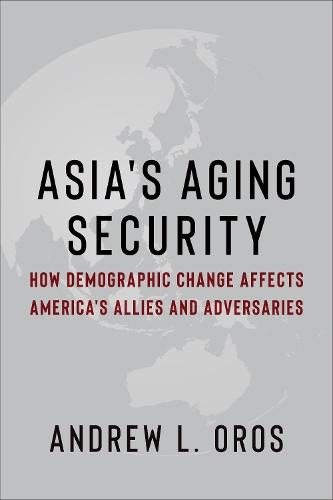
Asia's Aging Security: How Demographic Change Affects America's Allies and Adversaries

Author:   Andrew Oros
Publisher:   Columbia University Press
ISBN:  

9780231205603


Pages:   320
Publication Date:   09 September 2025
Format:   Hardback
Availability:   Manufactured on demand   Availability explained
We will order this item for you from a manufactured on demand supplier.

Our Price $240.95 Quantity:  
Add to Cart

Share |

Asia's Aging Security: How Demographic Change Affects America's Allies and Adversaries


Overview

Major demographic transitions are underway in Asia and the Pacific. The populations of China, Japan, Taiwan, South Korea, and Russia are aging and shrinking, while India, the Philippines, Vietnam, and Australia, among others, continue to grow. How will these striking changes affect regional security dynamics and the United States-led alliance structure in the Indo-Pacific? Andrew L. Oros offers an expert analysis of how rapid aging and population shifts are transforming the military strategies and capabilities of regional powers in Asia. Examining sixteen states, he provides a comparative view of the developing landscape and explores ways to address the consequences. Oros demonstrates that, contrary to what many have claimed, states with shrinking populations will continue to be formidable military powers. He develops a novel theoretical and empirical argument for why rapid aging does not necessarily dampen security competition. Nonetheless, demographic shifts in the coming decades will fundamentally alter the security challenges facing the United States and its allies. Oros considers how technological change and health care advances are mitigating the drawbacks of aging populations as well as how factors such as autonomous defense systems and artificial intelligence present new challenges. Rigorous and timely, Asia's Aging Security makes a forceful case that adjustment to demographic change is a necessity for twenty-first-century foreign policy.

Full Product Details

Author:   Andrew Oros
Publisher:   Columbia University Press
Imprint:   Columbia University Press
ISBN:  

9780231205603


ISBN 10:   0231205600
Pages:   320
Publication Date:   09 September 2025
Audience:   Professional and scholarly ,  Professional & Vocational
Format:   Hardback
Publisher's Status:   Active
Availability:   Manufactured on demand   Availability explained
We will order this item for you from a manufactured on demand supplier.

Table of Contents

List of Figures and Tables Note on Asian Family and Place Names Acknowledgments Introduction 1. Reconsidering the Demographics: the National Security Nexus Through a Twenty-First-Century Indo-Pacific Lens 2. Indo-Pacific Security Challenges and Rapid Aging: Pressures for New Security Architecture 3. Northeast Asia’s Rapidly Aging Democracies: the Leading Edge of Super-Aging in Asia 4. Northeast Asia’s Rapidly Aging Autocracies: Later Timing, Greater Control 5. Opportunities and Cautions from the Demographic Diversity of the Broader Indo-Pacific Conclusion: Addressing the Security Implications of Rapid Aging in the Indo-Pacific Notes Bibliography Index

Reviews

Oros' nuanced and thorough review of the links between population aging and national security is crucial for policy makers given that the world's strongest military powers are also some of the world's demographically oldest states. The stakes are high—and so is the possibility of miscalculation. -- Jennifer Sciubba, author of <i>8 Billion and Counting: How Sex, Death, and Migration Shape our World</i>


Author Information

Andrew L. Oros is professor of political science and international studies at Washington College. His books include Japan’s Security Renaissance: New Policies and Politics for the Twenty-First Century (Columbia, 2017).

Tab Content 6

Author Website:  

Countries Available

All regions
Latest Reading Guide

April RG 26_2


Shopping Cart
Your cart is empty
Shopping cart
Mailing List