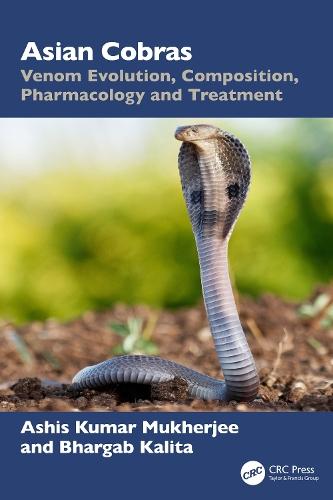
Full Product Details
Author: Ashis Kumar Mukherjee (Institute of Advanced Study in Science and Technology, Assam) ,
Bhargab Kalita
Publisher: Taylor & Francis Ltd
Imprint: CRC Press
Weight: 0.490kg
ISBN: 9781032983318
ISBN 10: 1032983310
Pages: 170
Publication Date: 01 June 2025
Audience:
Professional and scholarly
,
College/higher education
,
Professional & Vocational
,
Postgraduate, Research & Scholarly
Format: Hardback
Publisher's Status: Active
Availability: In Print

This item will be ordered in for you from one of our suppliers. Upon receipt, we will promptly dispatch it out to you. For in store availability, please contact us.
Author Information
Prof. Ashis Kumar Mukherjee is currently serving as the Director of the Institute of Advanced Study in Science and Technology (I.A.S.S.T.), Guwahati. He completed his M.Sc. in Biochemistry from Banaras Hindu University in 1992, his Ph.D. in 1998 on Indian cobra and Russell's viper venoms from the Department of Biochemistry, Burdwan Medical College, Burdwan University, and his D.Sc. in Biotechnology from Calcutta University in 2017, focusing on snake venom phospholipase A2 and protease enzymes. With more than 30 years of research experience in characterizing snake and scorpion venom toxins, his current research interests include proteomic analysis of snake and scorpion venoms, pharmacological re-assessment of medicinal plants used against snakebite and scorpion stings, quality assessment of commercial antivenoms, and cardiovascular and anticancer drug discovery from natural resources, including snake and scorpion venoms. Prof. Mukherjee has received several awards and medals for his academic and research achievements, including the prestigious Visitor's Award for Research in Basic and Applied Sciences from the Honorable President of India in 2018. He is a fellow of the Royal Society of Biology, U.K., the West Bengal Academy of Science and Technology, Kolkata, India, the Indian Academy of Science, Bangalore, the National Academy of Science, India, Prayagraj, and the National Academy of Medical Sciences, New Delhi. He has published over 175 research articles in peer-reviewed international and national journals, as well as book chapters and review articles. Additionally, he serves as a task force member for the D.B.T., I.C.M.R., and WHO on the prevention and treatment of snakebite envenoming. Dr. Bhargab Kalita is currently serving as an Assistant Professor at the Amrita Research Center, Faridabad. He completed his M.Sc. in Biotechnology from St. Anthony’s College in 2013 and earned his Ph.D. in 2019 from Tezpur University, specializing in the proteomics and antivenomics of Russell's viper venoms. With over five years of experience in venom research, Dr. Kalita has published more than 30 research articles in peer-reviewed international journals.