Overview
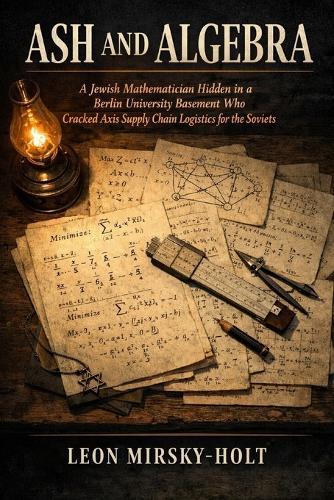
Berlin, 1938. They erased him from the university rolls in a single morning. He disappeared the same afternoon. They never looked in the basement. When Jewish mathematician Isaac Blum receives his dismissal letter from Humboldt University under the Nuremberg Laws, he has no emigration papers, no money, and no time. He does have one thing: a key to a building where he spent the best years of his life. He goes down the stairs. He does not come back up for seven years. Hidden in the basement of the Institut fur Mathematik by the department's administrative secretary, a woman named Katharina Wolff who risks everything and explains nothing, Blum survives the war doing the only thing he has ever known how to do. He calculates. For a decade before his dismissal, Blum had been developing a revolutionary branch of mathematics now known as linear programming, the science of finding the optimal solution within a system of constraints. He had applied it to the German railway network. He had consulted for the Reichsbahn. He understood, at a level of mathematical precision no one in military intelligence on either side possessed, exactly how the German logistics system worked, where it was vulnerable, and what minimum disruption would be required to collapse its supply delivery to forward combat units below the threshold required to sustain operations. In 1939, a quiet man arrives in the basement with a question. The analysis travels up the stairs. Through couriers Blum never meets, it reaches Soviet military intelligence in Moscow. His model predicts the German supply failure at Stalingrad months before it happens. It maps the logistics collapse that ends the German offensive at Kursk. It calculates, with the cold precision of pure mathematics, the most efficient way to break the Wehrmacht's ability to fight. All of it produced by hand, by lamplight, on wartime paper, by a man the Reich believes does not exist. Drawing on the real history of Jewish academics stripped of their positions under the Nuremberg Laws of 1935, the documented Soviet intelligence penetration of German military networks, and the foundational mathematics of linear programming developed independently by Nobel laureate Leonid Kantorovich in 1939, Ash and Algebra is historical fiction built on verified fact. It is a novel about mathematics as a weapon, about survival as an act of will, about the moral weight of being useful in a war you are not allowed to fight openly, and about the woman who made all of it possible at the cost of everything she could have lost. Devastating, precise, and unforgettable. Essential reading for fans of The Tattooist of Auschwitz by Heather Morris, Beneath a Scarlet Sky by Mark Sullivan, and The Alice Network by Kate Quinn.
Full Product Details
Author: Leon Mirsky-Holt
Publisher: Independently Published
Imprint: Independently Published
Dimensions:
Width: 15.20cm
, Height: 0.40cm
, Length: 22.90cm
Weight: 0.122kg
ISBN: 9798195231873
Pages: 84
Publication Date: 02 May 2026
Audience:
General/trade
,
General
Format: Paperback
Publisher's Status: Active
Availability: Available To Order

We have confirmation that this item is in stock with the supplier. It will be ordered in for you and dispatched immediately.