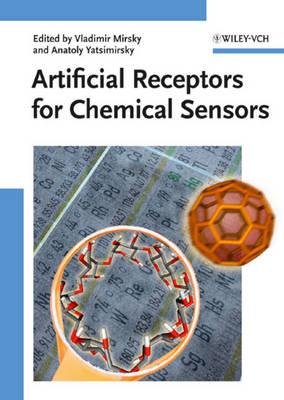
Artificial Receptors for Chemical Sensors

Author:   Vladimir M. Mirsky (Lausitz University of Applied Sciences, Germany) ,  Anatoly Yatsimirsky (Universidad Nacional Autónoma de México,)
Publisher:   Wiley-VCH Verlag GmbH
ISBN:  

9783527323579


Pages:   486
Publication Date:   15 December 2010
Format:   Hardback
Availability:   In Print   Availability explained
Limited stock is available. It will be ordered for you and shipped pending supplier's limited stock.

Our Price $448.80 Quantity:  
Add to Cart

Share |

Artificial Receptors for Chemical Sensors


Overview

Full Product Details

Author:   Vladimir M. Mirsky (Lausitz University of Applied Sciences, Germany) ,  Anatoly Yatsimirsky (Universidad Nacional Autónoma de México,)
Publisher:   Wiley-VCH Verlag GmbH
Imprint:   Blackwell Verlag GmbH
Dimensions:   Width: 17.70cm , Height: 2.70cm , Length: 24.60cm
Weight:   1.039kg
ISBN:  

9783527323579


ISBN 10:   3527323570
Pages:   486
Publication Date:   15 December 2010
Audience:   Professional and scholarly ,  Professional & Vocational
Format:   Hardback
Publisher's Status:   Out of Print
Availability:   In Print   Availability explained
Limited stock is available. It will be ordered for you and shipped pending supplier's limited stock.

Table of Contents

Preface QUANTITATIVE CHARACTERIZATION OF AFFINITY PROPERTIES OF IMMOBILIZED RECEPTORS Introduction Measurements Under Equilibrium Conditions Kinetic Measurements Analysis of Temperature Dependencies Experimental Techniques SELECTIVITY OF CHEMICAL RECEPTORS Introduction Some General Considerations on Selectivity Correlation Between Selectivity and Affinity Crown Ether and Cryptand Complexes: Hole Size Fitting and Other Effects Recogniction of Transition and Heavy Metal Ions Recognition via Ion Pairing Hydrogen Bonded Complexes and Solvent Effects Lewis Acid Receptors Complexes with Stacking and van der Waals Interactions Multifunctional Receptors for Recognition of Complex Target Molecules Conclusions COMBINATORIAL DEVELOPMENT OF SENSING MATERIALS Introduction General Principles of Combinatorial Materials Screening Opportunities for Sensing Materials Designs of Combinatorial Libraries of Sensing Materials Discovery and Optimization of Sensing Materials Using Discrete Arrays Optimization of Sensing Materials Using Gradient Arrays Emerging Wireless Technologies for Combinatorial Screening of Sensing Materials Summary and Outlook FLUORESCENT CYCLODEXTRINS AS CHEMOSENSORS FOR MOLECULE DETECTION IN WATER Introduction Pyrene-Appended Cyclodextrins Fluorophore-Amino Acid-CD Triad Systems Molecular Recognition by Regioisomers of Dansyl-Appended CDs Turn-On Fluorescent Chemosensors Effect of Protein Environment on Molecule Sensing CD-Peptide Conjugates as Chemosensors Immobilized Fluorescent CD on a Cellulose Membrane Conclusion CYCLOPEPTIDE DERIVED SYNTHETIC RECEPTORS Introduction Receptors for Cations Receptors for Ion Pairs Receptors for Anions Receptors for Neutral Substrates Conclusion BONORIC ACID-BASED RECEPTORS AND CHEMOSENSORS Introduction De Novo Design Combinatorial Approaches Template Directed Synthesis ARTIFICIAL RECEPTOR COMPOUNDS FOR CHIRAL RECOGNITION Introduction Cyclodextrins Crown Ethers Calixarenes Calix[4]resorcinarenes Miscellaneous Receptor Compounds Metal-Containing Receptor Compounds FULLERENE RECEPTORS BASED ON CALIXARENE DERIVATIVES Introduction Calixarenes Solid State Complexation by Calixarenes Comlexation in Solution Calixarenes as Molecular Scaffolds Outlook GUANIDINIUM BASED ANION RECEPTORS Introduction Instructive Historical Examples Recent Advances in Inorganic Anion Recognition Organic and Biological Phosphates Polycarboxylate Binding Amino Acid Recognition Dipeptides as Substrate Polypeptide Recognition Conclusion ARTIFICIAL RECEPTORS BASED ON SPREADER-BAR SYSTEMS POTENTIAL OF APTAMERS AS ARTIFICIAL RECEPTORS IN CHEMICAL SENSORS Introduction Generation and Synthesis of Aptamers Aptamer Arrays Techniques for Readout of Ligand Binding to the Aptamer Outlook/Summary CONDUCTING POLYMERS AS ARTIFICIAL RECEPTORS IN CHEMICAL SENSORS Introduction Transducers for Artificial Receptors Based on Conducting Polymers Intrinsic Sensitivity of Conducting Polymers Conducting Polymers Modified with Receptor Groups Conclusion MOLECULARLY IMPRINTED POLYMERS AS ARTIFICIAL RECEPTORS Introduction Fundamentals of Molecular Imprinting Polymer Formats and Polymerization Methods for MIPs Evaluation of MIP Performance - Imprinting Efficiency MIPs Mimicking Natural Receptors Conclusions and Outlook QUANTITATIVE AFFINITY DATA ON SELECTED ARTIFICIAL RECEPTORS Structures of Receptors

Reviews

The first to provide systematically organized information on all three important aspects of artificial receptor design, this book brings together knowledge on an exceptionally hot and multidisciplinary field of research. (MyCFO, 28 February 2011)


Artificial Receptors for Chemical Sensors provides a well-rounded summary of applications of macromolecular receptors in the field of chemical sensors without neglecting the fundamentals of sensor design and function. The chapters are well-written and nicely balance the basic chemistry and practical applications of artificial receptors. The book will be a valuable resource for scientists working on all aspects of sensor development from the initial design to bringing sensors to the market. (Analytical and Bioanalytical Chemistry, 2011)


Author Information

"Vladimir M. Mirsky is Professor at Lausitz University of Applied Sciences, Senftenberg, Germany. He graduated from Moscow Medical University in Biophysics and went on to study Physical Chemistry and Electrochemistry at the Frumkin Institute of Electrochemistry of the Soviet Academy of Sciences, obtaining there his PhD in 1986. He subsequently held an Alexander-von-Humboldt Research Fellowship and a research position at the CNRS Centre of Molecular Biology in France prior to joining the Institute of Analytical Chemistry, Chemical Sensors and Biosensors at Regensburg University in 1995. After habilitation he became Professor of Nanobiotechnology and moved to Lausitz. He is editor of two recent books, ""Ultrathin Electrochemical Chemo- and Biosensors"" and ""Combinatorial Methods for Chemical and Biological Sensors"". His work has led to about 20 patents and patent applications as well as 120 peer-reviewed scientifi c papers. Anatoly K. Yatsimirsky is Professor of Chemistry at the National Autonomous University of Mexico in Mexico City. He obtained his PhD and Dr. Sc. degrees from Moscow Lomonosov State University, where he was Professor prior to his move to Mexico in 1992. He spent Visiting Scholar/Professor stays at Milan University, Italy, in 1980/81 and at the University of California at Santa Barbara in 1998/99. His research is focused on physical organic chemistry and metal complex catalysis and he is the author of 160 peer-reviewed scientifi c publications including a monograph ""Principles and Methods in Supramolecular Chemistry"" by John Wiley & Sons and further book contributions."

Tab Content 6

Author Website:  

Countries Available

All regions
Latest Reading Guide

NOV RG 20252


Shopping Cart
Your cart is empty
Shopping cart
Mailing List