Overview
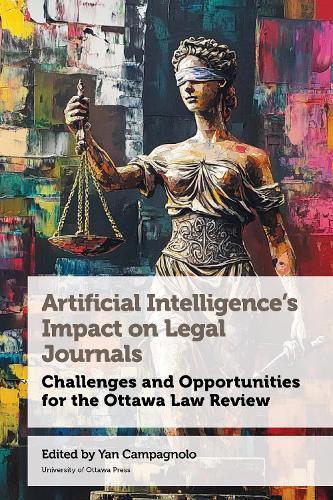
Artificial Intelligence's Impact on Legal Journals provides an overview of the opportunities and challenges presented by the use of artificial intelligence (AI) and its impact on legal journals, including the Ottawa Law Review (OLR). Throughout the publication lifecycle of a given piece, AI tools may play a pivotal role in enhancing the editorial and publishing processes. Similarly, authors submitting to legal journals may also leverage AI tools for purposes that range from improving readability to generating content. While the potential benefits are significant, the use of such tools raises various issues pertaining to the accuracy and quality of publications, as well as broader ethical and legal issues. Journals have responded to these opportunities and challenges at different speeds and in different ways. Some journals in non-legal disciplines have developed extensive AI policies, while the majority of legal journals appear to be falling behind in this regard. This book contains several recommendations that will empower the OLR to embrace the transformative potential of AI responsibly while maintaining its commitment to safeguarding privacy, intellectual property, and scholarly rigour. Central to this endeavour is the adoption of three AI policies: one covering the use of generative AI and AI-assisted technologies in submissions, another addressing AI usage in the peer review process, and a final one relating to the editorial team. This book ultimately aspires to ensure the OLR upholds its reputation as a reliable contributor to legal scholarship by guiding the organization through this new technological revolution.
Full Product Details
Author: Yan Campagnolo
Publisher: University of Ottawa Press
Imprint: University of Ottawa Press
ISBN: 9780776645247
ISBN 10: 0776645242
Pages: 128
Publication Date: 05 March 2025
Audience:
Professional and scholarly
,
College/higher education
,
Professional & Vocational
,
Tertiary & Higher Education
Format: Paperback
Publisher's Status: Active
Availability: Temporarily unavailable

The supplier advises that this item is temporarily unavailable. It will be ordered for you and placed on backorder. Once it does come back in stock, we will ship it out to you.
Language: French
Reviews
This is a thoughtful engagement with the risks and opportunities posed by generative artificial intelligence for legal scholarship. The study and recommendations of the editorial team of the Ottawa Law Review offer insights and guidance that will inform debates on these challenging issues. -Professor Teresa Scassa, Canada Research Chair in Information Law and Policy, Faculty of Law, University of Ottawa
Author Information
Yan Campagnolo is Vice-Dean and Full Professor at the University of Ottawa Faculty of Law. He also serves as faculty advisor to the Ottawa Law Review and editor of the Law and Justice series at the University of Ottawa Press. Professor Campagnolo is the recipient of several prestigious awards for the quality of his teaching and research. Prior to joining the University of Ottawa, he practised law at the Privy Council Office and worked as a law clerk at the Supreme Court of Canada. Leonie van Haeren holds a J.D. from the University of Ottawa, an M.A. in international affairs from Carleton University's Norman Paterson School of International Affairs, and a B.Sc. in economics from Dalhousie University. Prior to pursuing law, she worked in international development, international health research, and immigration. As a Volume 55 senior editor and chair of the Ottawa Law Review AI Research and Working Group, Leonie led the research and authorship of the book Artificial Intelligence's Impact on Legal Journals. Shaarini Ravitharan holds a J.D. from the University of Ottawa and a B.Sc in Life Sciences (Hon) from Queen's University. In law school, she completed the Dean's Fellowship, was a teaching assistant to first-year law students, and served as Editor-in-Chief, English Articles, for Volume 55 of the Ottawa Law Review. Shaarini gained valuable legal experience as an intern at the Canadian Public Internet Policy and Public Interest Clinic, where she explored issues of privacy, consumer protection, extended reality technologies, and artificial intelligence. Emma Murray is a J.D. candidate at the University of Ottawa and is set to graduate in 2025 on the Dean's Honour List with a specialization in public law. During her time in law school, Emma was involved in the Ottawa Law Review as an assistant, associate, and senior editor and served as Special Projects Manager. Additionally, she pursued her interest in advocacy by participating in several moot court competitions and completed an internship at Sharp Ang Family Law. After graduation, Emma will article at Gowling WLG in Ottawa. Ephraim Barrera is a Master of Laws candidate at the University of Ottawa, researching technology law and public law. He holds a J.D. and an M.A. in philosophy from the University of Ottawa and a B.A. (Hons.) in public ethics from Saint Paul University. During his undergraduate legal studies, Ephraim completed the Dean's Fellowship and served as an assistant editor with the Ottawa Law Review, a writing leader at the Legal Writing Academy, and a research assistant for the Centre for Law, Technology and Society.