|
|
|||
|
||||
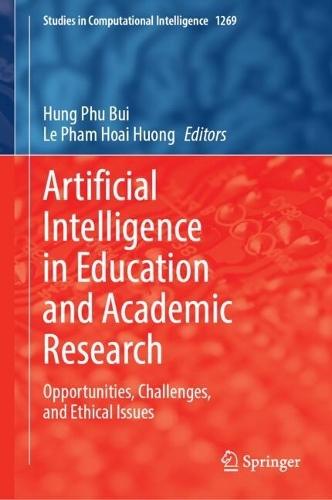
OverviewThis book presents empirical and conceptual manuscripts across contexts and disciplines, offering insights into how AI has been applied in teaching, learning, and research practices. This book, with eleven chapters spanning different aspects of AI use in educational settings, contributes to the knowledge of how AI can be responsibly and effectively incorporated into educational and research practices that foster innovation, inclusivity, and lifelong learning. As the landscape of AI integration in education and research is evolving rapidly, the future use of AI should be guided by humanistic and ethical principles Full Product DetailsAuthor: Hung Phu Bui , Le Pham Hoai HuongPublisher: Springer Nature Switzerland AG Imprint: Springer Nature Switzerland AG ISBN: 9783032183910ISBN 10: 303218391 Pages: 220 Publication Date: 07 April 2026 Audience: Professional and scholarly , College/higher education , Professional & Vocational , Postgraduate, Research & Scholarly Format: Hardback Publisher's Status: Forthcoming Availability: Not yet available This item is yet to be released. You can pre-order this item and we will dispatch it to you upon its release. Table of ContentsSECTION 1: CONCEPTUAL AND POLICY FOUNDATIONS OF AI IN EDUCATION AND RESEARCH.- 1. Generative Artificial Intelligence (GenAI) in Language Education: Current Trends and Perspectives.- 2. AI Integration into Higher Education Curricula: A Multiple-Case Study of Key Universities in Vietnam.- SECTION 2: AI APPLICATIONS IN TEACHING AND LEARNING CONTEXTS.- 3. Turkish Students’ Use of NotebookLM in an Online Digital Literacy Course.- 4. Impacts of Chatbot Training on EFL Teachers’ Confidence and Acceptance of AI Technologies.- 5. Building Audiobooks with AI Support as Digital Resources for ESL Learning.- SECTION 3: AI-MEDIATED LEARNING AND INTERACTION.- 6. Chatbot-Human Interaction In Vietnamese EFL Speaking Classes: Exploring The Unchartered Territory.- 7. EFL Learners’ Engagement in ChatGPT–Generated Speaking Tasks from a Text-Driven Approach: A Case in Vietnam.- 8. Artificial Intelligence-Supported Willingness to Communicate and Intercultural Communication.- 9. Artificial Intelligence-Enhanced Scaffolding and Peer Collaboration in Culturally and Linguistically Diverse Classrooms: Evidence from Asia.- SECTION 4: AI FEEDBACK AND LEARNING ASSESSMENT.- 10. AI-Mediated L2 Written Feedback: Characteristics of Prompts, AI Tools, and Learners’ Feedback Use.- 11. Ethical, Pedagogical, and Research Implications of AI in Education and Academic Research.ReviewsAuthor InformationHung Phu Bui is an associate professor at Faculty of Foreign Languages, Ton Duc Thang University, Vietnam. He holds a Ph.D. in English Language Education. His research interests span across many aspects of applied linguistics and language education: second language acquisition, L2 classroom assessment, teaching English for specific purposes, and computer-assisted language teaching and learning. Influenced by educational, linguistic, and psychological perspectives, his endeavors, mainly published in leading journals in the fields of language education and applied linguistics, have been stimulating discussions. Serving as the keynote and plenary speaker in many national and international conferences, Hung has had opportunities to spread his knowledge and research interests to students, colleagues, and novice researchers. Le Pham Hoai Huong is an associate professor in the English Department at Hue University of Foreign Languages and International Studies, Hue University, Vietnam. Her research interests include sociocultural theory, tool-mediated language learning, and language education curriculum development Tab Content 6Author Website:Countries AvailableAll regions |
||||