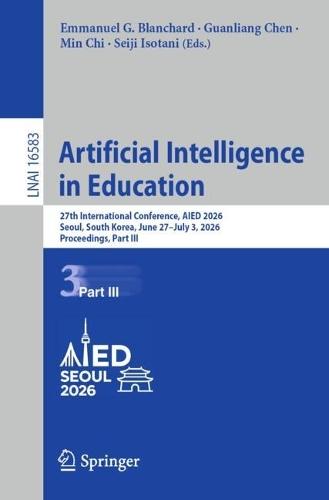
Artificial Intelligence in Education: 27th International Conference, AIED 2026, Seoul, South Korea, June 27–July 3, 2026, Proceedings, Part III

Author:   Emmanuel G. Blanchard ,  Guanliang Chen ,  Min Chi ,  Seiji Isotani
Publisher:   Springer Nature Switzerland AG
ISBN:  

9783032297594


Publication Date:   23 July 2026
Format:   Paperback
Availability:   Not yet available   Availability explained
This item is yet to be released. You can pre-order this item and we will dispatch it to you upon its release.

Our Price $290.37 Quantity:  
Pre-Order

Share |

Artificial Intelligence in Education: 27th International Conference, AIED 2026, Seoul, South Korea, June 27–July 3, 2026, Proceedings, Part III


Overview

Full Product Details

Author:   Emmanuel G. Blanchard ,  Guanliang Chen ,  Min Chi ,  Seiji Isotani
Publisher:   Springer Nature Switzerland AG
Imprint:   Springer Nature Switzerland AG
ISBN:  

9783032297594


ISBN 10:   3032297591
Publication Date:   23 July 2026
Audience:   Professional and scholarly ,  College/higher education ,  Professional & Vocational ,  Postgraduate, Research & Scholarly
Format:   Paperback
Publisher's Status:   Forthcoming
Availability:   Not yet available   Availability explained
This item is yet to be released. You can pre-order this item and we will dispatch it to you upon its release.

Table of Contents

.- Agnoagentia: The Illusion of Agency in AI-Assisted Learning. .- Do Instructional Behaviors Generalize Across Disciplines? An Empirical Study with Fine-Tuned Multimodal LLMs. .- From Black-Box Generation to Pedagogically Controllable Creation: A Text-to-Image Interactive System in Design Education. .- Scaffolding-First Constraint Design for LLM Tutors in Data-Science Problem Solving. .- Representation Learning to Study Temporal Dynamics in Tutorial Scaffolding. .- Enabling Multi-Agent Systems as Learning Designers: Applying Learning Sciences to AI Instructional Design. .- Multi-Label Collaborative Dialogue Act Recognition for Adaptive Team Training Environments. .- Circuit Complexity of Hierarchical Knowledge Tracing. .- Beyond the Gold Standard: Reliability Estimation of Human and GenAI Scoring. .- CODE-GEN: A RAG-Based Agentic AI System for Multiple-Choice Question Generation. .- Content-Grounded Learning Behavior Analysis for Contextualized Feedback. .- Evaluating a Data-Driven Redesign Process for Intelligent Tutoring Systems. .- Time-window ONA: Model the impact of utterances in Ordered Network Analysis. .- On Generating and Validating Erroneous Examples in CS1 using LLMs. .- Contrastive Network-based Similarity for Zero-Shot Automatic Scoring of Very Short Handwritten Answers. .- MAML-KT: Addressing Cold Start Problem in Knowledge Tracing for New Students via Few-Shot Model-Agnostic Meta Learning. .- Peer and Tutor in One: A Productive Failure-Based  Architecture for Multi-Role Conversational Agents in Physics Learning. .- EduArt-Bench: A Benchmark and Lightweight Scoring Calibration for K-12 Art Education. .- Conceptualization of Thinking Activities-specific Metacognitive Knowledge Ontology. .- Mix and Match: Context Pairing for Scalable Topic-Controlled Educational Summarisation. .- Study Program Curriculum Development with AI. .- Cross-Dataset Bloom Question Classification: Supervised Models and Prompted LLMs. .- Decoding Latent Reasoning: Mechanistic Interpretability ofChain of Continuous Thought with Sparse Autoencoders. .- Personalizing Mathematical Game-based Learning for Children: A Preliminary Study. .- A Hybrid Human-AI Content Generation Framework for Safe and Personalized Dialogic Learning with Children. .- Likelihood-Based Diagnosis with Generative Models:Confidence-Aware Measurement from Student Writing. .- Delegating Educational Tasks to Large Language Models: A Systematic Analysis of Evaluation Approaches. .- An ORID-Structured GenAI Reading Companion Integrating Structured Book Chat and Virtual Labs for Science Reading. .- Large Language Models for Automated Bloom's Taxonomy Classification in Computer Science Assessment. .- A Framework for Human-AI Q-Matrix Refinement: A NeuralCDM Evaluation. .- MCQ Difficulty Prediction through Modeling Learner Heterogeneity using Data-Driven Cognitive Profiling. .- Can Large Language Models Learn to Grade Like Teachers? A Few-Shot Study on Open-Ended Assessment. .- ArguAgent: AI-Supported Real-Time Grouping for Productive Argumentation in STEM Classrooms. .- Minimizing Data Exposure in Higher Education LLM Applications: Evaluating the Model Context Protocol (MCP) for Preserving Privacy in Academic Advising. .- Re-imagine Knowledge Tracing with Student Agency in a Generative AI Language Tutor. .- From Predictive Models to Actionable Recommendations: A Survey of Counterfactual Approaches in Student Dropout. .- Simulating Validity: Modal Decoupling in MLLM Generated Feedback on Science Drawings. .- Confidence-Aware Automated Assessment of Student-Drawn Scientific Models. .- Exploring Question Isomorphism through Different Numerical and Computational Representations. .- A Generator–Aligner Pipeline for LLM-Based Situational Judgment Test Generation. .- When Can We Trust AI Coding of Student-Generated Text? A Committee-Based Approach to Diagnosing Agreement and Uncertainty at Scale. .- From Rule-Based to LLM-Based Agents: A Calibrated Simulation Framework for Classroom Social Networks. .- Making Advanced Temporal Visualizations Accessible to Educators Using Generative AI. .- FairDetect: Training-Time Fairness for AI-Generated Text Detection via Perplexity-Adaptive Focal Loss. .- Reliability as a Teammate: Budgeted Verifier-in-the-Loop (BVIL) Policies for Reliable LLM Tutoring Actions. .- Estimating Learners' Skill Acquisition Without Temporal Information. .- Multimodal Analytics of Cybersecurity Crisis Preparation Exercises: What Predicts Success?. .- From Exploration to Creation: How Teachers Orchestrate AI-Supported Learning in History Classrooms. .- Explaining, Solving, or Generating? Functional Differences in Students’ AI Use in a University Database Course. .- Leveraging Human-AI Collaboration for a Passage-Based Question Authoring Tool. .- Automating Supportive Psychological Processes: How Source Attribution Shapes Perceived Empathy, Working Alliance, and Acceptability of a Supportive Conversa-tional Agent. .- Tailoring AI-Driven Reading Scaffolds to the Distinct Needs of Neurodiverse Learners. .- Should AI Ask First? Investigating the Effects of Proactive vs Reactive AI Mentoring in Self-Directed Learning. .- Uncertain AI – Better AI? Effects of Uncertainty Indicators in Collaborative Learning with a Human Peer or an Artificial Intelligence. .- Using LLMs to score mathematics lessons for instructional quality with the UTOP. .- Making AI Planning Visible: Narrative-Centered Goal-Directed AI Reasoning to Foster AI Literacy. .- A Comparative Study of Student Perspectives on Technical Writing Feedback Quality: Evaluating LLMs, SLMs, and Humans in Computer Science Topics. .- Teachers’ Perspectives on Decision-Making in AI-Supported Classrooms: A Cross-Cultural Study of Germany and Japan. .- AI Partners that Support Productive Uncertainty within “Jigsaw” Activities during Small Group Collaborative Learning in Classrooms. .- Impact of Multimodal and Conversational AI on Learning Outcomes and Experience. .- From Examples to Rules? Exploring Inductive Reverse Engineering and Deductive Few-Shot Coding via LLMs for Qualitative Data Analysis.

Reviews

Author Information

Tab Content 6

Author Website:  

Countries Available

All regions
Latest Reading Guide

MRGC26


Shopping Cart
Your cart is empty
Shopping cart
Mailing List