Overview
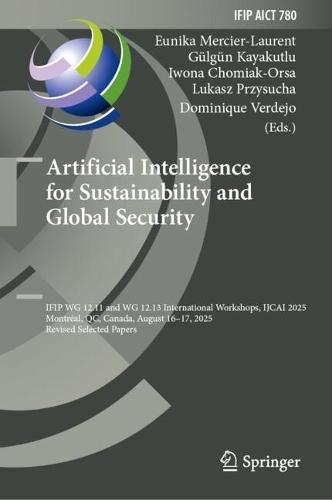
These workshops follows the previously organized AI4KM on IJCAI15 – 19. It evolved to AI4KMES on IJCAI 20 and 21 and to AI4S held on ECAI23. It will focus on various ways of using AI to address effectively the sustainability issues including 17 UN SD goals.
Full Product Details
Author: Eunika Mercier-Laurent , Gülgün Kayakutlu , Iwona Chomiak-Orsa , Lukasz Przysucha
Publisher: Springer Nature Switzerland AG
Imprint: Springer Nature Switzerland AG
ISBN: 9783032211835
ISBN 10: 3032211832
Pages: 356
Publication Date: 09 June 2026
Audience:
Professional and scholarly
,
College/higher education
,
Professional & Vocational
,
Postgraduate, Research & Scholarly
Format: Hardback
Publisher's Status: Forthcoming
Availability: Not yet available 
This item is yet to be released. You can pre-order this item and we will dispatch it to you upon its release.
Table of Contents
.- Artificial Intelligence for Sustainability. .- A Hybrid Knowledge-Based and Large Language Model Framework for Sustainable Design Education Toktam B. Fabrizi. .- The Future of Work: Exploring Expectations and Fears Toward Artificial Intelli gence in the Labor Market” Jolanta Kowal, Dmitriy Yanchylik, and Paweł Weichbroth. .- Generative AI for sustainable problem solving in I5.0 Generative AI by Cristina R. Monsone, Eunika Mercier-Laurent and Ádám B. Csapó. .- Causal Analysis of Machine Deviations on Espresso Sensory Quality” Kouassi Kouakou Kan Maxime, Michal Ptaszynski, Fumito Masui, Tanjim Mahmud, Tsuyoshi Gotoda, Hirofumi Arai, Chao-Hui Feng, and Jun Watanabe. .- Studying Neural Network Robustness to Weight. Perturbations for Sustainable In cremental Learning” by Parth Mehta and Xiaoyin Wang. .- Time Series Augmentations with Unsupervised Viewmakers for Robust Disruption Prediction in Nuclear Fusion” by Dhruva Chayapathy, Lucas Spangher, Tavis Siebert, Om Patil and Akshata Kishore. .- Self-Refining Segment Anything: A Perturbation-Driven Approach for Semi-Super vised Satellite Image Segmentation by Renzo Larenas, Luis Caro, and Billy Peralta. .- A review of reinforcement learning methods and performance measures in algorith mic stock trading Aleksander Kruczkowski and Paweł Weichbroth. .- Artificial Intelligence Business and Global Sustainability Review Konstantin M. Golubev. .- Supply Chain Considerations for AI Implementation – Critical Minerals, Data Cen ters, and the Environment Lynne Schneider. .- Accelerating LSTM model training through biologically inspired NeuroAI and in vestigating novel applications Robert Tracey, M. Emre Sahin and Carol Mak. .- Optimal Planning and Machine Learning for Responsive Tracking and Enhanced Forecasting of Wildfires using a Spacecraft Constellation”. Sreeja Roy-Singh, Vinay Ravindra, Richard Levinson, Mahta Moghaddam, Jan Mandel, Adam Kochanski, An gel Farguell Causo, Kurtis Nelson, Samira Alkaee Taleghan, Archana Kannan and Amer Melebari. .- Classification Framework for Stream Type Identification Golnaz Mesbahi, Shadan Golestan, Buddy Brown, Joey Ton, and Jerome Cranston. .- Explainable AI for Wildfire Management and Ecological Sustainability: A Short Survey of Techniques, Case Studies, and Operational Pathways Akshata Kishore Mo harir, Sameera S Kashyap, Jay Prakash Thakur, and Divya Nayak. .- RAG4MuniESG: ESG Assessment for Municipal Sustainability through Retrieval Augmented Generation” by Dorsaf Sallami and Juste Rajaonson. .- Changing the perception of digital competences in 2018 and 2025 among Polish and Slovak students Marek Szajt, Klaudia Smoląg, Katarzyna Kozioł-Nadolna, Zuzana Hajduová and Iwona Chomiak-Orsa. .- The current intensity of AI use and the perception of AI applications in strategic decision-making by Katarzyna Grzesik, Renata Brajer-Marczak, Michał Nadolny, Katarzyna Liwarska-Fulczyk, Iwona Chomiak-Orsa and Anna Marciszewska. .- A Simulation-Based Approach to Processes in the Municipal Waste Management Sector Aleksander Binsztok, Beata Butryn, Krzysztof Hauke and Maciej Pondel. .- AI and Sustainability – Canada Focus Margaret Havey. .- Data-Driven Sustainability: The Role of Urban Platforms in Participatory Smart City Governance Lukasz Przysucha and Adam Sulich. .- Algorithmic Governance in ESG Reporting: A Comparative Study of AI Tools' Ef fectiveness in Mitigating Greenwashing Michał Petri, Iwona Chomiak-Orsa and Łukasz Przysucha. .- Technological challenges, energy poverty and other barriers to the expansion of en ergy communities in Europe” by Evaldo Costa and Eunika Mercier-Laurent. .- Towards sustainable, AI-powered agriculture: Emerging technologies, benefits and barriers” by Marios Paraskevopoulos, George Routis and Ioanna Roussaki. .- Artificial Intelligence for Global Security. .- A SWOT analysis of AI technology sovereignty landscape assessment Mariya Ev timova-Gardair, Frédérique Segond, Patrick Fabiani, Thibault Lahire, and Michel Rott maier. .- Rule-Based Coordination Strategies for Protection in Multi-Agent Defense Scenar ios"" by Thibault Lahire. .- Trust and Explainability in Ethical AI for Global Security"" by Brian Challita and Pierre Parrend.
Reviews
Author Information
Tab Content 6
Author Website:
Countries Available
All regions
|