|
|
|||
|
||||
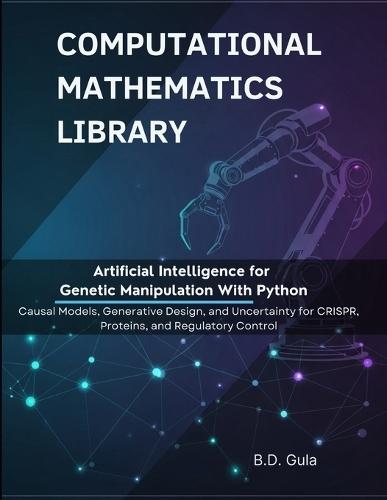
OverviewThis is a research-grade guide to designing, predicting, and stress-testing genetic interventions with modern AI, built for readers who want more than high-level intuition and benchmark scores. Across 24 tightly argued chapters, you will learn to treat genome editing as an end-to-end decision system where representation, causality, repair biology, uncertainty, and optimization all compete to define what an algorithm can safely and profitably propose. The book reframes genetic manipulation through a set of unusually powerful mental models: genomes as tokenized languages with tenant-specific ontologies, epistasis as the true object of prediction, CRISPR guide selection as risk management rather than scoring, and cellular repair as a distribution you must forecast. You will see why multi-omics fusion can destroy signal by manufacturing false coherence, why ""more data"" often deepens confounding unless experiments are chosen counterfactually, and why the most valuable interpretability is the kind that suggests an actionable edit, not a story. Every chapter includes full Python code demos that implement the core idea in a reproducible way, from sequence representations and structure-aware protein optimization to active learning loops that choose the next construct to build, calibration techniques that prevent overconfident out-of-distribution recommendations, and federated training patterns that learn across institutions while preserving heterogeneity. Just as importantly, the book treats customization as a first-class engineering problem: what changes when the same AI system serves a clinic, an enzyme team, a microbial platform, and a plant lab. You will learn how objectives, constraints, priors, and acceptable failure modes shift by domain, and how to build models that expose those tradeoffs rather than hide them. If you care about causal genotype-phenotype reasoning, repair pathway forecasting, regulatory grammar engineering, RNA circuit design, protein generative modeling, multi-locus optimization, and population-scale genetic interventions, this book gives you both the conceptual architecture and the working code to push beyond conventional pipelines. Full Product DetailsAuthor: B D GulaPublisher: Independently Published Imprint: Independently Published Dimensions: Width: 21.60cm , Height: 1.90cm , Length: 27.90cm Weight: 0.853kg ISBN: 9798248443710Pages: 368 Publication Date: 15 February 2026 Audience: General/trade , General Format: Paperback Publisher's Status: Active Availability: Available To Order We have confirmation that this item is in stock with the supplier. It will be ordered in for you and dispatched immediately. Table of ContentsReviewsAuthor InformationTab Content 6Author Website:Countries AvailableAll regions |
||||