Overview
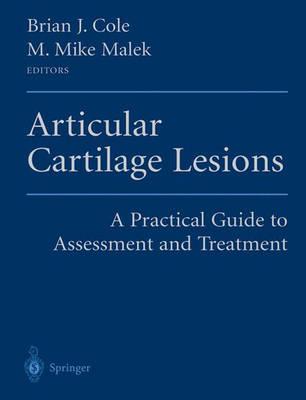
Drs. Cole and Malek, recognized leaders in the field, wrote this cutting-edge text to fill the void in the literature regarding the management of articular cartilage disease and meniscal deficiency. The book enables orthopedic surgeons to develop an evidence-based decision-making framework that guides the management of articular cartilage lesions. Carefully chosen contributors provide readers with a practical background in articular lesions, patient assessment, and management strategies. Subsequent chapters address the gamut of current surgical techniques, from arthroscopy and debridement to unicondylar arthroplasty, in a step-by-step manner. More than 500 detailed illustrations, many in color, help readers understand and master treatments. Case studies, which include preoperative planning and postoperative outcomes, reinforce the decision-making process. Nearly every permutation and treatment option is covered, making this text a prime resource for surgeons committed to exercising sound judgement.
Full Product Details
Author: Brian J. Cole ,
M. Mike Malek
Publisher: Springer-Verlag New York Inc.
Imprint: Springer-Verlag New York Inc.
Edition: 2004 ed.
Dimensions:
Width: 21.60cm
, Height: 2.20cm
, Length: 27.90cm
Weight: 1.360kg
ISBN: 9780387955407
ISBN 10: 0387955402
Pages: 336
Publication Date: 08 April 2004
Audience:
General/trade
,
Professional and scholarly
,
College/higher education
,
General
,
Professional & Vocational
Format: Hardback
Publisher's Status: Active
Availability: Awaiting stock

The supplier is currently out of stock of this item. It will be ordered for you and placed on backorder. Once it does come back in stock, we will ship it out for you.
Reviews
From the reviews: This excellent book covers the details of cartilage anatomy, basic science, physiology, defects and injuries, and all possible treatment programmes. a ] The book is beautifully illustrated with many colour plates, bound in a most pleasing style. a ] The decision-making factors are well presented in each case and they make fascinating reading. This book is timely and welcome. (P. Aichroth, Journal of Bone and Joint Surgery, Vol. 87B(5), 2005) This book a ] covers the state of the art in the management of articular cartilage lesions. a ] This book should be available in every orthopaedic department. (N. Allington, Acta Orthopaedica Belgica, Vol. 70(6), 2004) New therapeutic solutions, on the biology and biomechanics of chondrocytes, were found in the beginning of the 1990s. a ] One of the objectives of the authors was thus to clarify the indications for the experts confronted with degenerative or traumatic chondral pathologies. a ] In conclusion, this work is a success and should fulfill all the experts who treat chondral pathologies in their daily activity. (L. Balabaud, European Journal of Orthopaedic Surgery & Traumatology, Vol. 16, 2006)
From the reviews: <p> This excellent book covers the details of cartilage anatomy, basic science, physiology, defects and injuries, and all possible treatment programmes. a ] The book is beautifully illustrated with many colour plates, bound in a most pleasing style. a ] The decision-making factors are well presented in each case and they make fascinating reading. This book is timely and welcome. (P. Aichroth, Journal of Bone and Joint Surgery, Vol. 87B(5), 2005) <p> This book a ] covers the state of the art in the management of articular cartilage lesions. a ] This book should be available in every orthopaedic department. (N. Allington, Acta Orthopaedica Belgica, Vol. 70(6), 2004) <p> New therapeutic solutions, on the biology and biomechanics of chondrocytes, were found in the beginning of the 1990s. a ] One of the objectives of the authors was thus to clarify the indications for the experts confronted with degenerative or traumatic chondral pathologies. a ] In conclusion, this work is a success and should fulfill all the experts who treat chondral pathologies in their daily activity. (L. Balabaud, European Journal of Orthopaedic Surgery & Traumatology, Vol. 16, 2006)
From the reviews: This excellent book covers the details of cartilage anatomy, basic science, physiology, defects and injuries, and all possible treatment programmes. The book is beautifully illustrated with many colour plates, bound in a most pleasing style. The decision-making factors are well presented in each case and they make fascinating reading. This book is timely and welcome. (P. Aichroth, Journal of Bone and Joint Surgery, Vol. 87B(5), 2005) This book covers the state of the art in the management of articular cartilage lesions. This book should be available in every orthopaedic department. (N. Allington, Acta Orthopaedica Belgica, Vol. 70(6), 2004) New therapeutic solutions, on the biology and biomechanics of chondrocytes, were found in the beginning of the 1990s. One of the objectives of the authors was thus to clarify the indications for the experts confronted with degenerative or traumatic chondral pathologies. In conclusion, this work is a success and should fulfill all the experts who treat chondral pathologies in their daily activity. (L. Balabaud, European Journal of Orthopaedic Surgery & Traumatology, Vol. 16, 2006)
From the reviews: This excellent book covers the details of cartilage anatomy, basic science, physiology, defects and injuries, and all possible treatment programmes. The book is beautifully illustrated with many colour plates, bound in a most pleasing style. The decision-making factors are well presented in each case and they make fascinating reading. This book is timely and welcome. (P. Aichroth, Journal of Bone and Joint Surgery, Vol. 87B(5), 2005) This book covers the state of the art in the management of articular cartilage lesions. This book should be available in every orthopaedic department. (N. Allington, Acta Orthopaedica Belgica, Vol. 70(6), 2004) New therapeutic solutions, on the biology and biomechanics of chondrocytes, were found in the beginning of the 1990s. One of the objectives of the authors was thus to clarify the indications for the experts confronted with degenerative or traumatic chondral pathologies. In conclusion, this work is a success and should fulfill all the experts who treat chondral pathologies in their daily activity. (L. Balabaud, European Journal of Orthopaedic Surgery & Traumatology, Vol. 16, 2006)
From the reviews: This excellent book covers the details of cartilage anatomy, basic science, physiology, defects and injuries, and all possible treatment programmes. ... The book is beautifully illustrated with many colour plates, bound in a most pleasing style. ... The decision-making factors are well presented in each case and they make fascinating reading. This book is timely and welcome. (P. Aichroth, Journal of Bone and Joint Surgery, Vol. 87B(5), 2005) This book ... covers the state of the art in the management of articular cartilage lesions. ... This book should be available in every orthopaedic department. (N. Allington, Acta Orthopaedica Belgica, Vol. 70(6), 2004) New therapeutic solutions, on the biology and biomechanics of chondrocytes, were found in the beginning of the 1990s. ... One of the objectives of the authors was thus to clarify the indications for the experts confronted with degenerative or traumatic chondral pathologies. ... In conclusion, this work is a success and should fulfill all the experts who treat chondral pathologies in their daily activity. (L. Balabaud, European Journal of Orthopaedic Surgery & Traumatology, Vol. 16, 2006)